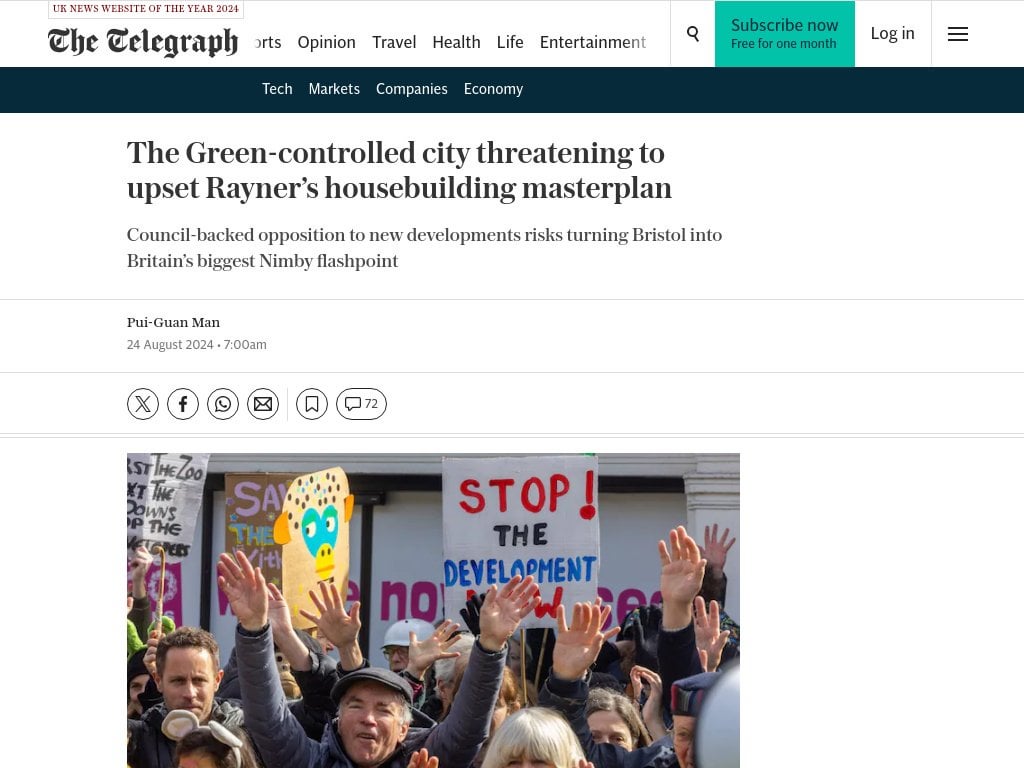
When plans were submitted to build almost 200 homes on the site of the loss-making Bristol Zoo in 2022, the charity behind the project was hoping to ease the housing crisis while also securing much-needed funds for its conservation efforts.
Despite local protests aimed at preserving the zoo in the well-heeled Clifton neighbourhood, a cross-party coalition of councillors approved the project. “Families from our waiting list will get the great opportunity to live in such a beautiful area,” councillor Paul Goggin noted during a lengthy planning debate last year.
Yet the future of the development is now in doubt. Opponents have requested a judicial review and are hoping for support from the new city council, now led by the Green Party after May’s local elections. Three Green councillors were the sole voices of dissent when the project first went before the council.
Nimby flashpoints such as this are likely to become far more common in Bristol as Labour plots a construction boom.
Locals should be cheering Angela Rayner’s plan to deliver 1.5m homes across the country by the end of this parliament. The waiting list for social housing in Bristol runs to 20,000 people and more than 1,300 households are in temporary accommodation. Each privately rented home gets about 300 enquiries on average.
Yet there are fears that the march of the Green Party in the city and local Nimbyism could stifle development efforts. Those who have dealt with the Greens complain that environmental concerns and ideals often trump the housing crisis when it comes to decision-making.
Former Labour mayor Marvin Rees, who stood down in April after eight years, says: “One of my frustrations was their unwillingness to deal with the realities of tackling a housing crisis in a finite land mass.”
Rees claims that Green councillors opposed or abstained from votes on recent projects that would have delivered at least 2,250 homes. In his experience, the Greens “talked in principle” about tackling the housing crisis but “didn’t support houses being delivered in practice”.
“If they are serious about social justice and climate change, they’ll have to step into a space where they are prepared to tell people things they don’t want to hear,” he says.
“I’m not saying principles aren’t important but … the difference between the politics they declare and the politics they practise has been one of the most disappointing experiences of my time as mayor.”
The Greens now have a firm grip on the city, with not only control of the council but also an MP, Carla Denyer, representing Bristol Central.
The party pledged to build 150,000 social homes a year nationally ahead of July’s general election but said it would “simultaneously protect valuable green space for communities [and] reduce climate emissions”.
Such ambitions can prove contradictory in practice.
Adrian Ramsay, the Green Party’s co-leader, for example, is seeking to halt net zero plans for a corridor of pylons through his Waveney Valley constituency that would supply wind power. While the infrastructure would help to reduce emissions, Ramsay has raised concerns about the impact on the landscape.
Bristol teems with low-rise, two-storey buildings and has the second-lowest population density of major cities in England, after Bradford, according to think tank the Centre for Cities.
There is already a shortage of housing and, without more building, it will get worse. The city’s population is projected to rise to 550,000 by 2050, up from 483,000 in mid-2023.
mostanonymousnick on
We should go after the greens for their left-NIMBYism but it’s rich coming from the Telegraph, who is an epicenter of right-NIMBYism.

3 Comments
[deleted]
When plans were submitted to build almost 200 homes on the site of the loss-making Bristol Zoo in 2022, the charity behind the project was hoping to ease the housing crisis while also securing much-needed funds for its conservation efforts.
Despite local protests aimed at preserving the zoo in the well-heeled Clifton neighbourhood, a cross-party coalition of councillors approved the project. “Families from our waiting list will get the great opportunity to live in such a beautiful area,” councillor Paul Goggin noted during a lengthy planning debate last year.
Yet the future of the development is now in doubt. Opponents have requested a judicial review and are hoping for support from the new city council, now led by the Green Party after May’s local elections. Three Green councillors were the sole voices of dissent when the project first went before the council.
Nimby flashpoints such as this are likely to become far more common in Bristol as Labour plots a construction boom.
Locals should be cheering Angela Rayner’s plan to deliver 1.5m homes across the country by the end of this parliament. The waiting list for social housing in Bristol runs to 20,000 people and more than 1,300 households are in temporary accommodation. Each privately rented home gets about 300 enquiries on average.
Yet there are fears that the march of the Green Party in the city and local Nimbyism could stifle development efforts. Those who have dealt with the Greens complain that environmental concerns and ideals often trump the housing crisis when it comes to decision-making.
Former Labour mayor Marvin Rees, who stood down in April after eight years, says: “One of my frustrations was their unwillingness to deal with the realities of tackling a housing crisis in a finite land mass.”
Rees claims that Green councillors opposed or abstained from votes on recent projects that would have delivered at least 2,250 homes. In his experience, the Greens “talked in principle” about tackling the housing crisis but “didn’t support houses being delivered in practice”.
“If they are serious about social justice and climate change, they’ll have to step into a space where they are prepared to tell people things they don’t want to hear,” he says.
“I’m not saying principles aren’t important but … the difference between the politics they declare and the politics they practise has been one of the most disappointing experiences of my time as mayor.”
The Greens now have a firm grip on the city, with not only control of the council but also an MP, Carla Denyer, representing Bristol Central.
The party pledged to build 150,000 social homes a year nationally ahead of July’s general election but said it would “simultaneously protect valuable green space for communities [and] reduce climate emissions”.
Such ambitions can prove contradictory in practice.
Adrian Ramsay, the Green Party’s co-leader, for example, is seeking to halt net zero plans for a corridor of pylons through his Waveney Valley constituency that would supply wind power. While the infrastructure would help to reduce emissions, Ramsay has raised concerns about the impact on the landscape.
Bristol teems with low-rise, two-storey buildings and has the second-lowest population density of major cities in England, after Bradford, according to think tank the Centre for Cities.
There is already a shortage of housing and, without more building, it will get worse. The city’s population is projected to rise to 550,000 by 2050, up from 483,000 in mid-2023.
We should go after the greens for their left-NIMBYism but it’s rich coming from the Telegraph, who is an epicenter of right-NIMBYism.