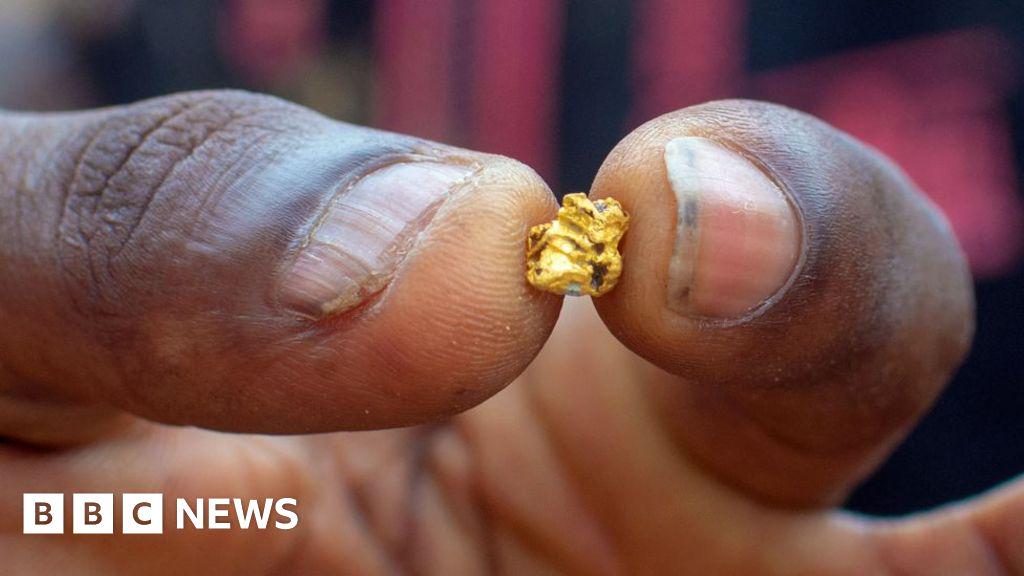
For centuries, gold provided a steady flow of income for West African empires – today, the cash-strapped military juntas in Mali, Burkina Faso and Niger are turning to the mineral to fund their counter-insurgency operations and cement their legitimacy, with the help of Russia.
Together, the three countries united in the Alliance of Sahelian States (AES) produce 230 tonnes of gold per year, making the AES the fourth-largest gold producer in the world, below Australia and above Canada, representing an annual value of $15 billion – a trove for the regimes ruling over some of the world’s most impoverished countries, facing expanding insurgencies by separatist and jihadist groups.
Boosted by global uncertainty, gold has nearly doubled in ten years, but its profits still largely escape the Malian, Burkinabe, and Nigerien governments. Following the military coups in the early 2020s, those countries have launched a forceful confrontation with the Western companies that until now had exploited the rich Sahelian ground, seeking to strenghten their legitimacy by “recovering their sovereignty”. In 2024, Terry Holohan, the CEO of Australian conglomerate Resolute Mining was arrested and detained by Malian forces during a routine visit in Bamako, and forced to sign a $160 million payment to the Malian state to secure his release. In 2025, Canadian mining giant Barrick Gold saw their Bamako offices closed by the junta, who are demanding the payment of hundreds of millions of dollars, by retroactive standing of a 2024 decree stripping foreign companies of most of their power in the country. At the same time, the Malian government welcomed the Russian mining conglomerate Yadran Group to exploit a new refinery, as part of the juntas’ pivot towards Moscow.
But in the Sahel, the majority of gold production stems from artisanal mines operated by independent local actors, who escape government taxation by sending their production towards informal circuits, mostly towards the United Arab Emirates. With the rise in violence both from state and non-state actors, these mines have become a target, both from separatist, jihadist, and bandit armed groups, and from the government forces, assisted by Russian paramilitaries. In Burkina Faso, the majority of the mines are located in disputed territory, further fueling trafficks and human rights abuses.
Could an international certification scheme like the KImberley Process, that aimed to identify and curtail the trade of “blood diamonds” fueling wars in Sierra Leone, Liberia, Angola or the Central African Republic, be a model? Dr Alex Vines, who worked for the UN on the elaboration of the Kimberley Process, says the process cannot be replicated for gold, as the mineral is very quickly smelt in the supply chain, rendering identification of “blood gold” near-impossible. Furthermore, the Kimberley Process was built around the repression of non-state actors, and may not be efficient to tackle state-sponsored human rights abuses, as is the case in Mali, Burkina Faso, and Niger.
Maximilianne on
> alliance of sahelian states (AES)
Okay I’m convinced the Africans are doing this on purpose now

2 Comments
!ping AFRICA&COMMODITIES
For centuries, gold provided a steady flow of income for West African empires – today, the cash-strapped military juntas in Mali, Burkina Faso and Niger are turning to the mineral to fund their counter-insurgency operations and cement their legitimacy, with the help of Russia.
Together, the three countries united in the Alliance of Sahelian States (AES) produce 230 tonnes of gold per year, making the AES the fourth-largest gold producer in the world, below Australia and above Canada, representing an annual value of $15 billion – a trove for the regimes ruling over some of the world’s most impoverished countries, facing expanding insurgencies by separatist and jihadist groups.
Boosted by global uncertainty, gold has nearly doubled in ten years, but its profits still largely escape the Malian, Burkinabe, and Nigerien governments. Following the military coups in the early 2020s, those countries have launched a forceful confrontation with the Western companies that until now had exploited the rich Sahelian ground, seeking to strenghten their legitimacy by “recovering their sovereignty”. In 2024, Terry Holohan, the CEO of Australian conglomerate Resolute Mining was arrested and detained by Malian forces during a routine visit in Bamako, and forced to sign a $160 million payment to the Malian state to secure his release. In 2025, Canadian mining giant Barrick Gold saw their Bamako offices closed by the junta, who are demanding the payment of hundreds of millions of dollars, by retroactive standing of a 2024 decree stripping foreign companies of most of their power in the country. At the same time, the Malian government welcomed the Russian mining conglomerate Yadran Group to exploit a new refinery, as part of the juntas’ pivot towards Moscow.
But in the Sahel, the majority of gold production stems from artisanal mines operated by independent local actors, who escape government taxation by sending their production towards informal circuits, mostly towards the United Arab Emirates. With the rise in violence both from state and non-state actors, these mines have become a target, both from separatist, jihadist, and bandit armed groups, and from the government forces, assisted by Russian paramilitaries. In Burkina Faso, the majority of the mines are located in disputed territory, further fueling trafficks and human rights abuses.
Could an international certification scheme like the KImberley Process, that aimed to identify and curtail the trade of “blood diamonds” fueling wars in Sierra Leone, Liberia, Angola or the Central African Republic, be a model? Dr Alex Vines, who worked for the UN on the elaboration of the Kimberley Process, says the process cannot be replicated for gold, as the mineral is very quickly smelt in the supply chain, rendering identification of “blood gold” near-impossible. Furthermore, the Kimberley Process was built around the repression of non-state actors, and may not be efficient to tackle state-sponsored human rights abuses, as is the case in Mali, Burkina Faso, and Niger.
> alliance of sahelian states (AES)
Okay I’m convinced the Africans are doing this on purpose now