
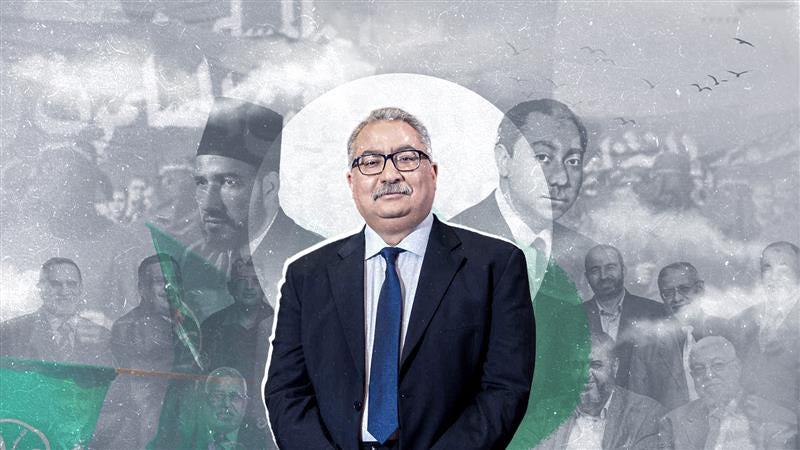
History has come full circle, and in the past decade, the Muslim Brotherhood has returned to the cycle of failure.
Just a few years ago, many believed the group would come to dominate the Arab world, as its branches advanced—whether through the ballot box, the streets, or by gaining popular and even armed presence.
At that time, the Brotherhood spoke at length about intellectual reform, moderation, and modernizing its methods. But once they glimpsed power, it became clear that the most reactionary, regressive, and extremist ideas still governed them.
They allied with Iran in more than one country and on more than one issue, and they partnered with dictatorships (Sudan under Omar al-Bashir is a clear example).
The Brotherhood often spoke of peaceful means, yet whenever given the chance, they took up arms—either directly or by spawning armed factions.
They derailed major regional initiatives (like the Palestinian-Israeli peace process) and insisted on dragging Arab societies back to a “revolutionary” phase that history had already surpassed. This deprived Arab societies of development and participation in modernization projects that coincided globally with a technological revolution that transformed everything.
So, are we witnessing the final chapter of the Muslim Brotherhood’s story?
After nearly 100 years, is it fair to say that the ideology, methodology, and rhetoric that once captivated tens of millions is fundamentally flawed—not just in practice but in its very essence?
In this critical historical account, Egyptian journalist and author Ibrahim Issa reflects on a century of the Brotherhood’s legacy. Alhurra is publishing a video series by Issa critiquing the Brotherhood, summarized and edited here for text publication.
The Founding: A Crisis From the Start
The founder of the Muslim Brotherhood, Hassan al-Banna, was not a religious scholar, nor was he an expert in Arabic language, theology, or Islamic jurisprudence.
Rather, he was the founder of a political activist group, more than a religious body capable of claiming it spread Islamic culture or preaching. The Brotherhood falsely claimed this role in its early charters, as part of its propaganda and lies that began from day one.
Al-Banna's personal history is deeply ambiguous, as is the Brotherhood’s. However, what is clear is that he worked as a calligraphy teacher in Ismailia, along the Suez Canal, in 1928—a time when British forces still occupied Egypt.
The group’s first financial support came from the British-run Suez Canal Company—500 Egyptian pounds.
There is no doubt that al-Banna had a genius for organization. He started with just a handful of people—some say six or seven—and now, a century later, we are still talking about the group he founded.
He reportedly traveled extensively throughout Egypt’s villages—some say 4,000, though this is likely exaggerated. Still, his energy, persistence, and organizational ability were undeniable.
When examining the Brotherhood’s structure, it is clear that al-Banna was heavily influenced by Shiite hierarchies and Sufi structures: the idea of the "guide" or "spiritual leader," the concept of religious taxes (khums), dissimulation (taqiyya), and a top-down hierarchy with hidden and public layers.
From the Sufis, he adopted the idea of absolute obedience to a master—the member is like a corpse in the hands of its washer, to be turned and cleaned however he wishes.
These roots—steeped in secrecy and historical models of underground organization—formed the DNA of the Brotherhood.
Between Ignorance and Herd Mentality
Claims about al-Banna’s powers of persuasion are exaggerated. In truth, he was largely ignorant, and the early Brotherhood base consisted of the uneducated, both religiously and academically.
He recruited carpenters, blacksmiths, and coffeehouse patrons—not scholars or intellectuals. It was only later that he gained followers who claimed to be educated.
The Brotherhood's core was built on a block of followers who prioritized obedience over discussion, creating a herd-like mentality from the very beginning.
“We don’t understand religion—he does. We don’t understand life—he does. He is our great leader and guide,” they would say.
The first to disagree and break away from al-Banna was Ahmad al-Sukkari, a teacher and co-founder who many believe was the true engine of the Brotherhood. He was the first to see through al-Banna’s intellectual and religious emptiness.
Early internal struggles centered on this question: Who stays—the obedient follower or the thinker who questions and challenges?
In any closed ideological group, obedience is key. If you're dealing with thinkers and debaters, you're looking at a democratic political party—not a secret organization built on loyalty and silence.
A Biography of Shifting Loyalties
When the Brotherhood was founded in 1928, the Ottoman Caliphate had collapsed, and Egypt was embracing a nationalist, secular state based on citizenship. The spirit of the 1919 Revolution championed the idea that “Religion is for God, and the homeland is for all.”
The dominant environment was liberal, civil, and anti-colonial, focused on ending British occupation—military and political.
The Brotherhood disrupted this consensus, asserting that Egyptians were not citizens but Muslims, and that they should return to a caliphate model. For them, Jews and Christians were not equal citizens, but dhimmis.
Thus, the Brotherhood opposed Egypt’s modernist, nationalist project, offering instead a pan-Islamist, global project. This wasn’t about fighting colonialism—it was about undermining national unity.
That idea spread across the Arab world, just as Arab societies were mobilizing for independence after World War I.
Al-Banna spent nearly a decade quietly building the movement before declaring its political ambitions.
The Brotherhood’s fundamental mission was to undermine civil nationalism, modernity, secularism, and all values of the age.
This group is based on a forged history, a forged ideology, and a forged mission. From the start, it practiced violence, contrary to claims that only later factions strayed from al-Banna’s peaceful vision.
In truth, Hassan al-Banna himself was the first ideological deviant. His project was supremacist—claiming his group alone were true Muslims and others were not.
This exclusionary, destructive mindset aimed to tear apart societies, oppose nationalism, and reject patriotism itself.
The Long Chapter of Violence
The Brotherhood’s ideology justified the violation of others' blood and homeland.
They were the first to bring back assassinations in Islam’s name in the modern era—from attempts to kill Egyptian judge El-Khazindar, to the assassination of Prime Minister Mahmoud al-Nuqrashi.
While Arab armies were fighting Israel in 1948, the Brotherhood brought terrorism inside Egypt—burning Jewish-owned stores, attacking Jewish neighborhoods, and targeting Jewish-run banks and companies.
They legitimized violence not only through action, but through religious justification framing assassination as jihad, even against fellow Muslims.
This did not begin with Sayyid Qutb, but from the Brotherhood’s founding.
Sayyid Qutb—a failed novelist, but a gifted literary critic—eventually theorized and publicized the group’s violent core more openly, but he did not create it.
The Muslim Brotherhood is the root and source of all modern Islamist terrorism.
The Brotherhood and ISIS: Root and Branch
Do today’s jihadist groups trace their lineage to the Brotherhood?
Yes. Every post-Brotherhood extremist group emerged from its cloak. Their declared objectives mirror the Brotherhood’s original mission.
They are all branches of the same global organization, and groups like ISIS and al-Qaeda cannot be defeated unless the root—the Brotherhood—is cut.
Fighting these groups as separate entities is futile. You destroy one, and another emerges—because you’re attacking the branches, not the root.
The Brotherhood remains the umbilical cord connecting all these groups. Its slogans, such as “Islam is the solution,” are deceptive yet appealing.
But where have they succeeded? Sudan? Gaza? Yemen? Tunisia? Egypt? Nowhere.
Even if their organization is global—so is the mafia. Global spread doesn’t mean moral legitimacy.
A Missed Opportunity, or One That Never Was?
“Give them a chance,” people say. But history shows they’ve had that chance—in Sudan, Gaza, Tunisia, Egypt, and beyond.
Wherever they ruled or shared power, they failed.
Even Iran, with its Shiite flavor of political Islam, is part of this ecosystem. Wherever Islamist rule takes hold, we see exclusion, rigged elections, and collapse.
So where have they succeeded? Nowhere. Even Gaza—ruled by the Brotherhood's Hamas for 17 years—ended in devastation.
Not Merely a Conservative Right-Wing Group
The Brotherhood managed to fool many on the Western left—those riddled with guilt over colonialism—into believing the Brotherhood equals Islam, and criticism of it equals Islamophobia.
They captured the Muslim diaspora in the West, speaking in its name and influencing Western elections—portrayed as a right-wing political force. But in truth, they are a racist, supremacist, anti-democratic group.
Just as the West bans racist ideologies, it should ban the Brotherhood.
Treating the Brotherhood as a conservative party is like treating cancer as a cold.
The Collapse of Religion and Politics
Arab regimes have also enabled the Brotherhood by competing with them over religious legitimacy.
States—Egyptian, Saudi, Syrian, Algerian—tried to appear more Islamic than the Islamists, further politicizing religion.
In response to Brotherhood pressure, governments Islamized laws, educational curriculums, and public discourse.
This blurred the line between state and faith, turning political systems into the Brotherhood’s own breeding ground.
Even Nasser, who once opposed them, built religious institutions like Al-Azhar University, laying their foundation.
Sadat allied with them, and in Saudi Arabia, the state outflanked religious radicals by becoming even more radical.
The struggle between state and Islamists over who speaks for Islam has ruined both religion and politics—and imperiled the future.
Posted by Apple_Kappa
1 Comment
This is a translated article from Alhurra, basically the Arab version of VOA covering the thoughts of Egyptian firebrand secularist commentator, Ibrahim Eissa.
While Islamist groups such as the Muslims Brotherhood are often the victims of authoritarian secular police states who often use the threat of the Muslim Brotherhood to crack down on social liberties, it should be noted that the Muslim Brotherhood is anything but liberal and not akin to the Christian Democrats we often see in Europe.
>Treating the Brotherhood as a conservative party is like treating cancer as a cold.
While the Brotherhood rarely gains power, they also have a tendency to often put pressure on Arab governments to Islamize their societies in unpleasant ways.
>Arab regimes have also **enabled the Brotherhood** by competing with them over religious legitimacy.
>States—Egyptian, Saudi, Syrian, Algerian—tried to appear **more Islamic than the Islamists**, further politicizing religion.
>In response to Brotherhood pressure, governments **Islamized laws**, educational curriculums, and public discourse.
>This blurred the line between state and faith, turning political systems into the Brotherhood’s own breeding ground.
>Even **Nasser**, who once opposed them, built religious institutions like **Al-Azhar University**, laying their foundation.
>**Sadat allied with them**, and in **Saudi Arabia**, the state outflanked religious radicals by becoming even more radical.
>The struggle between state and Islamists over **who speaks for Islam** has **ruined both religion and politics**—and imperiled the future.
>
Additionally, their attempts at governance has largely been marked by failure.
>But where have they succeeded? Sudan? Gaza? Yemen? Tunisia? Egypt? Nowhere.
>Even if their organization is global—so is the mafia. Global spread doesn’t mean moral legitimacy.
>
Being a liberal democrat in the Middle East is an incredibly unforgiving task. One one hand, there are secular dictatorships who employ the worst forms of human rights abuses. On the other, there is an incredibly regressive thuggish ideological movement guided by archaic religious teachings. While it is tempting to build coalitions with fellow opposition groups, even if they are Islamist, one should never be naive about what the Muslim Brotherhood stands for and represents.