## Protectionism is having a moment in the face of the off-shoring of jobs, shrinking middle-class incomes, growing inequality, and soaring corporate profits.
>At a critical moment for the economy and the environment, the Trudeau government has been facing an impossible choice.
>
>It can downplay lofty climate goals, and slap a punishing tariff on affordable Chinese EVs as U.S. President Joe Biden did in the spring. Or, less likely, it could let cheaper, emissions-free Chinese cars into our market, and risk counter-tariffs on Canadian goods flowing to the United States.
>
>There would also be the prospect of retaliatory tariffs from China—we’ve seen this movie before—on our agricultural products, including canola, wheat, peas, barley, and pork. Then there is the $43-billion foreign investment in Ontario’s auto industry since 2022, and the $53-billion in provincial and federal funding already committed to transform the sector from gas-powered to clean and green: would some or all of those investors flee in the face of low-cost Chinese competition?
>
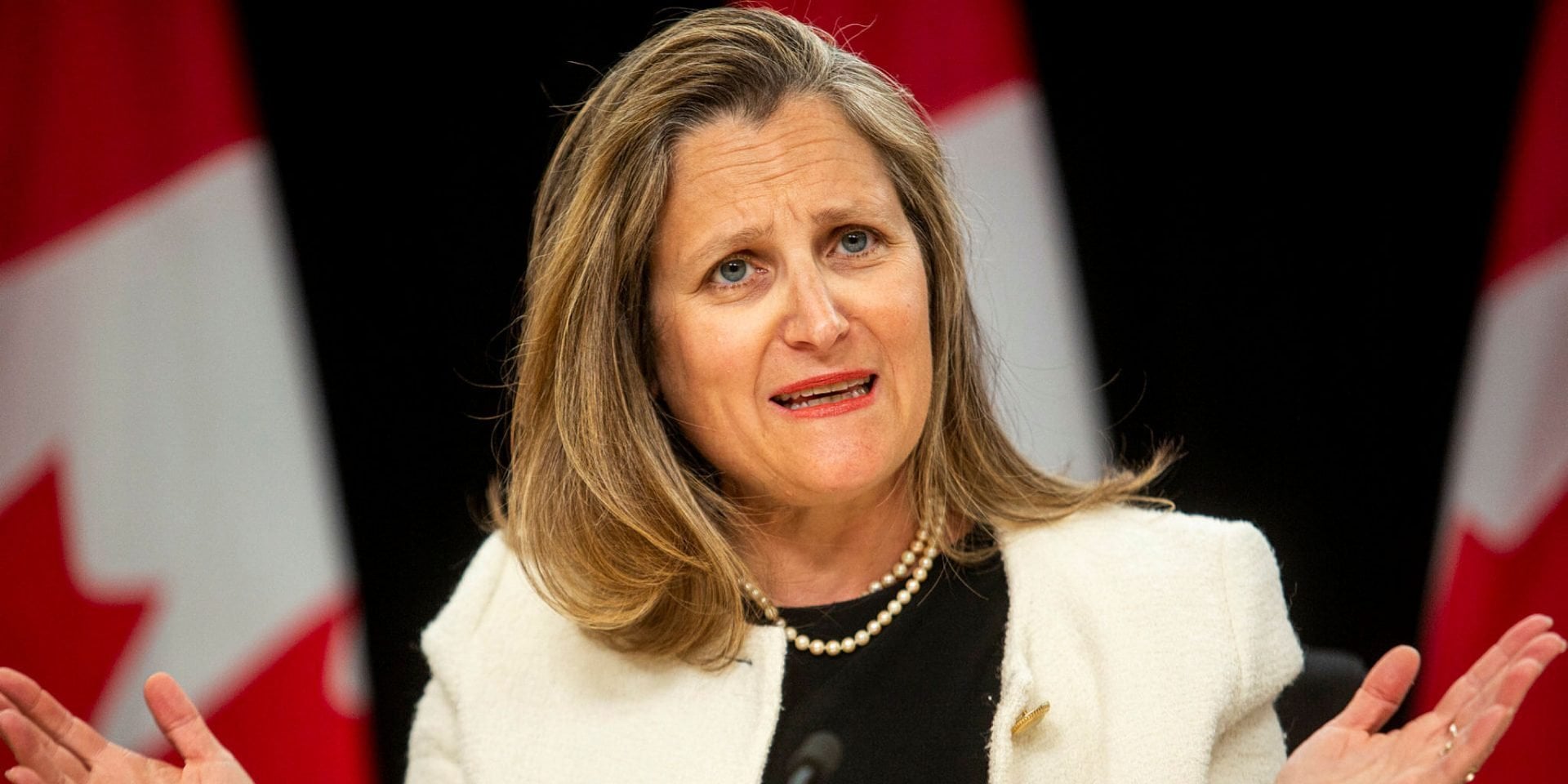
>These are all powerful arguments to suggest that Finance Minister Chrystia Freeland will follow the Americans’ lead when she gets around to it (as of this writing, there has been no announcement). Ontario Premier Doug Ford, Conservative Leader Pierre Poilievre, and auto-workers unions are all calling for steep tariffs. The environmentalists and free trade purists who might think otherwise are voices in the wilderness.
>
>[…]
>
>Beyond Freeland or any government, the Canadian and U.S. auto sectors have been entwined for decades with parts and vehicles constantly crossing the border. In fact, 95 per cent of Canadian-made auto parts go the the U.S. and make up our second largest export. That industry, one of a diminishing number of domestic success stories—and the jobs it provides—is not to be sniffed at although there is an argument that Chinese competition might spur the North American car industry to greater success.
>
>As it is, GM, Ford, and Stellantis appear to be slowing the promised transition to EVs, and churning out ever more light trucks and SUVs.
>
>For all that, almost four decades of free trade agreements with the U.S., and later Mexico, have definitely weakened Canada’s ability to take independent stands. Starting in 1988 with Brian Mulroney, and concluding most recently in the hard-won rewrite of NAFTA—the CUSMA deal negotiated after much angst with then-U.S. president Donald Trump—our two economies are ever more fused.
>
>[…]
>
>“Much-lamented” even by the likes of Poilievre with his treacly videos harkening back to a Norman Rockwell past of picket fences, enduring nuclear families, safe suburban streets, dads with big paycheques, grandparents pitching in with child care, and so on. It is an appealing image to many–it is, indeed, the way lucky people once lived and some live today. But it was never everybody, and not always as idyllic as portrayed.
>
>Fragments of this vision also cropped up in the rhetoric at last week’s Democratic National Convention in Chicago, Ill., as party presidential nominee Kamala Harris and her many fans and surrogates promised a safer America, a stronger middle class, better health care with more than a whiff of a protectionist sentiment, and a commitment to replace imported goods–from China, mainly–with stuff made in America.
>
>The “good news”—that Canadian inflation is down to 2.5 per cent, and there is strong employment in the U.S.—simply isn’t registering with disaffected voters in both countries, many of whom are drawn to Trump and Poilievre’s sour resentments, wild accusations and unreal promises. And, many of whom are not seeing grocery prices decline—although they have—or housing become more affordable, which it mostly hasn’t.
>
>Suffice it to say, both left and right appear to have turned on what was only yesterday neoliberal orthodoxy. Protectionism is having a moment in the face of the off-shoring of jobs, shrinking middle-class incomes, growing inequality, and soaring corporate profits. These ills are sapping the spirits and trying the patience of the victims of “free trade,” from workers whose jobs have been automated or shipped away, to a growing army of part-time employees with no benefits or prospects. Even if the statistics are true, no amount of happy talk can change the vibe.
>
>Meanwhile, hardly anyone—apart from the terminally tone-deaf plutocrats that write guest essays for financial pages—is extolling the benefits of open borders and globalized free trade these days. Former prime minister Jean Chrétien was an ardent free trader. His argument was that trading with emerging giants like China would not only benefit Canadian consumers, but also hasten the creation of a Chinese middle-class, which would inevitably lead to democratization of that powerful country. That, in turn, would spur harmonious relations with the rest of the world.
>
>That hasn’t happened, of course. On the contrary, China does have a much expanded middle-class, but is also being led by a pitiless authoritarian.
>
>For all that, it seems, either way, consumers lose. As we are reminded, tariffs are taxes. Restricting the entry of Chinese steel, aluminum, semi-conductors, and other base products will push up prices of many goods here. By some calculations, a Chinese-made BYD (Build Your Dream) electric car would sell for $C14,600 and offer a 305 kilometre range, compared to the cheapest current Japanese, European or American models, which sell for around $38,000.
>
>That said, it isn’t clear exactly how either the left or the right would revitalize the North American economy and restart manufacturing, much less create a sustainable, green future. The right appears as concerned with hammering people back into prescribed gender roles and policing what children are taught, and what they are allowed to think.
>
>There are a few sure bets, though in Trudeau’s, Freeland’s, and even Poilievre’s Ottawa, the economy will always trump the environment. And “free” trade is not free for everyone.
> Meanwhile, hardly anyone—apart from the terminally tone-deaf plutocrats that write guest essays for financial pages—is extolling the benefits of open borders and globalized free trade these days.
our strongest warriors 🫡
> Former prime minister Jean Chrétien was an ardent free trader. His argument was that trading with emerging giants like China would not only benefit Canadian consumers, but also hasten the creation of a Chinese middle-class, which would inevitably lead to democratization of that powerful country. That, in turn, would spur harmonious relations with the rest of the world. That hasn’t happened, of course.
Oh my God give it time. Demographic change is glacial. Only the youngest Chinese adults are highly educated. Wait a few generations. There is no quick fix to this issue.
WolfpackEng22 on
The lack of politicians and pundits loudly defending free trade in media of all types is a crisis of leadership. If you surrender the narrative to populists, of course you will lose. Protectionism is the easy story, the magic of trade is often counterinutuitve and requires people to think

3 Comments
Archived version: [https://archive.fo/nGxjq](https://archive.fo/nGxjq).
Summary:
## Protectionism is having a moment in the face of the off-shoring of jobs, shrinking middle-class incomes, growing inequality, and soaring corporate profits.
>At a critical moment for the economy and the environment, the Trudeau government has been facing an impossible choice.
>
>It can downplay lofty climate goals, and slap a punishing tariff on affordable Chinese EVs as U.S. President Joe Biden did in the spring. Or, less likely, it could let cheaper, emissions-free Chinese cars into our market, and risk counter-tariffs on Canadian goods flowing to the United States.
>
>There would also be the prospect of retaliatory tariffs from China—we’ve seen this movie before—on our agricultural products, including canola, wheat, peas, barley, and pork. Then there is the $43-billion foreign investment in Ontario’s auto industry since 2022, and the $53-billion in provincial and federal funding already committed to transform the sector from gas-powered to clean and green: would some or all of those investors flee in the face of low-cost Chinese competition?
>
>These are all powerful arguments to suggest that Finance Minister Chrystia Freeland will follow the Americans’ lead when she gets around to it (as of this writing, there has been no announcement). Ontario Premier Doug Ford, Conservative Leader Pierre Poilievre, and auto-workers unions are all calling for steep tariffs. The environmentalists and free trade purists who might think otherwise are voices in the wilderness.
>
>[…]
>
>Beyond Freeland or any government, the Canadian and U.S. auto sectors have been entwined for decades with parts and vehicles constantly crossing the border. In fact, 95 per cent of Canadian-made auto parts go the the U.S. and make up our second largest export. That industry, one of a diminishing number of domestic success stories—and the jobs it provides—is not to be sniffed at although there is an argument that Chinese competition might spur the North American car industry to greater success.
>
>As it is, GM, Ford, and Stellantis appear to be slowing the promised transition to EVs, and churning out ever more light trucks and SUVs.
>
>For all that, almost four decades of free trade agreements with the U.S., and later Mexico, have definitely weakened Canada’s ability to take independent stands. Starting in 1988 with Brian Mulroney, and concluding most recently in the hard-won rewrite of NAFTA—the CUSMA deal negotiated after much angst with then-U.S. president Donald Trump—our two economies are ever more fused.
>
>[…]
>
>“Much-lamented” even by the likes of Poilievre with his treacly videos harkening back to a Norman Rockwell past of picket fences, enduring nuclear families, safe suburban streets, dads with big paycheques, grandparents pitching in with child care, and so on. It is an appealing image to many–it is, indeed, the way lucky people once lived and some live today. But it was never everybody, and not always as idyllic as portrayed.
>
>Fragments of this vision also cropped up in the rhetoric at last week’s Democratic National Convention in Chicago, Ill., as party presidential nominee Kamala Harris and her many fans and surrogates promised a safer America, a stronger middle class, better health care with more than a whiff of a protectionist sentiment, and a commitment to replace imported goods–from China, mainly–with stuff made in America.
>
>The “good news”—that Canadian inflation is down to 2.5 per cent, and there is strong employment in the U.S.—simply isn’t registering with disaffected voters in both countries, many of whom are drawn to Trump and Poilievre’s sour resentments, wild accusations and unreal promises. And, many of whom are not seeing grocery prices decline—although they have—or housing become more affordable, which it mostly hasn’t.
>
>Suffice it to say, both left and right appear to have turned on what was only yesterday neoliberal orthodoxy. Protectionism is having a moment in the face of the off-shoring of jobs, shrinking middle-class incomes, growing inequality, and soaring corporate profits. These ills are sapping the spirits and trying the patience of the victims of “free trade,” from workers whose jobs have been automated or shipped away, to a growing army of part-time employees with no benefits or prospects. Even if the statistics are true, no amount of happy talk can change the vibe.
>
>Meanwhile, hardly anyone—apart from the terminally tone-deaf plutocrats that write guest essays for financial pages—is extolling the benefits of open borders and globalized free trade these days. Former prime minister Jean Chrétien was an ardent free trader. His argument was that trading with emerging giants like China would not only benefit Canadian consumers, but also hasten the creation of a Chinese middle-class, which would inevitably lead to democratization of that powerful country. That, in turn, would spur harmonious relations with the rest of the world.
>
>That hasn’t happened, of course. On the contrary, China does have a much expanded middle-class, but is also being led by a pitiless authoritarian.
>
>For all that, it seems, either way, consumers lose. As we are reminded, tariffs are taxes. Restricting the entry of Chinese steel, aluminum, semi-conductors, and other base products will push up prices of many goods here. By some calculations, a Chinese-made BYD (Build Your Dream) electric car would sell for $C14,600 and offer a 305 kilometre range, compared to the cheapest current Japanese, European or American models, which sell for around $38,000.
>
>That said, it isn’t clear exactly how either the left or the right would revitalize the North American economy and restart manufacturing, much less create a sustainable, green future. The right appears as concerned with hammering people back into prescribed gender roles and policing what children are taught, and what they are allowed to think.
>
>There are a few sure bets, though in Trudeau’s, Freeland’s, and even Poilievre’s Ottawa, the economy will always trump the environment. And “free” trade is not free for everyone.
Further reading:
[https://www.bnnbloomberg.ca/business/international/2024/08/26/canada-to-hit-china-with-tariffs-on-electric-vehicles-steel/](https://www.bnnbloomberg.ca/business/international/2024/08/26/canada-to-hit-china-with-tariffs-on-electric-vehicles-steel/)
[https://ycsg.yale.edu/sites/default/files/files/Murky_Protectionism.pdf](https://ycsg.yale.edu/sites/default/files/files/Murky_Protectionism.pdf)
!ping Can&Containers
> Meanwhile, hardly anyone—apart from the terminally tone-deaf plutocrats that write guest essays for financial pages—is extolling the benefits of open borders and globalized free trade these days.
our strongest warriors 🫡
> Former prime minister Jean Chrétien was an ardent free trader. His argument was that trading with emerging giants like China would not only benefit Canadian consumers, but also hasten the creation of a Chinese middle-class, which would inevitably lead to democratization of that powerful country. That, in turn, would spur harmonious relations with the rest of the world. That hasn’t happened, of course.
Oh my God give it time. Demographic change is glacial. Only the youngest Chinese adults are highly educated. Wait a few generations. There is no quick fix to this issue.
The lack of politicians and pundits loudly defending free trade in media of all types is a crisis of leadership. If you surrender the narrative to populists, of course you will lose. Protectionism is the easy story, the magic of trade is often counterinutuitve and requires people to think