
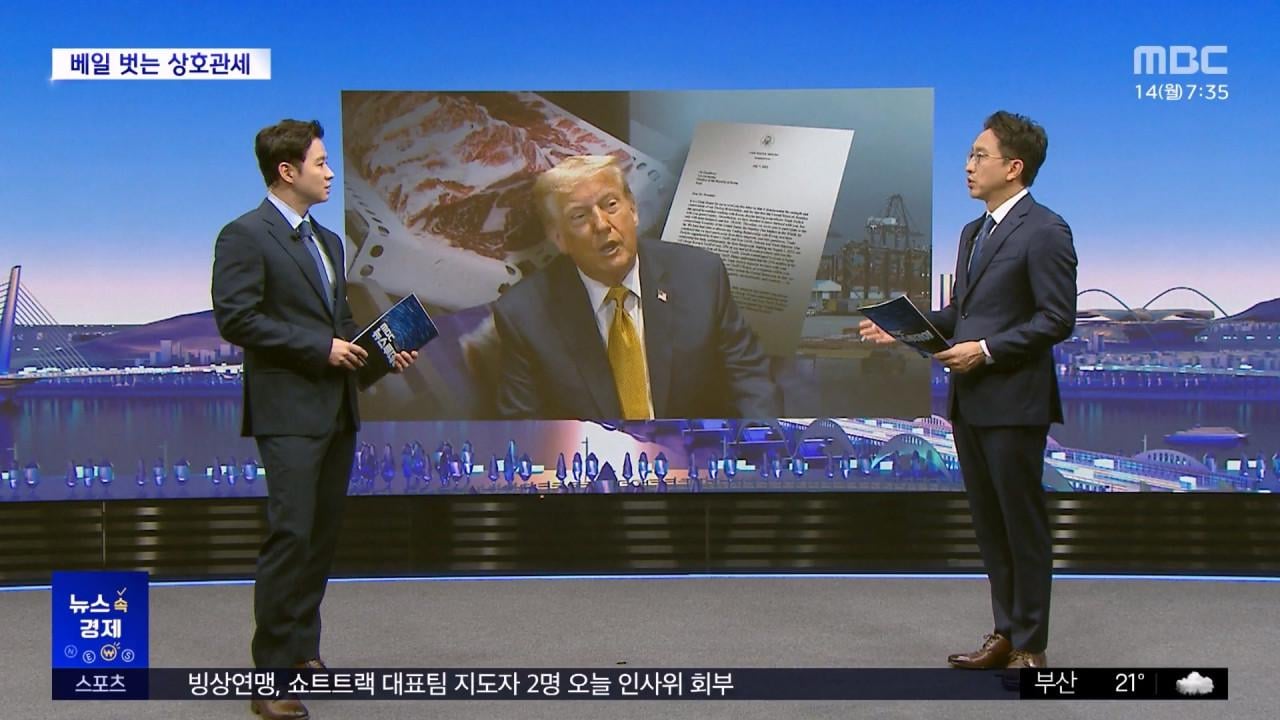
The deadline for South Korea-U.S. tariff negotiations is now about two weeks away, and we’ll discuss how the talks are progressing with economic correspondent Lee Sung-il.
Anchor:
President Trump even sent a letter to extend the deadline. How are the tariff negotiations progressing?
Lee Sung-il (Correspondent):
The letter specified the same 25% tariff rate that was announced back in April. The effective date is set for August 1, signaling the intention to continue negotiations.
From the U.S. perspective, this gives roughly 20 more days for negotiations without changing the originally stated deadline — essentially a way to save face.
There was one clear point clarified in the announcement. While there are tariffs on specific items like cars and steel, the reciprocal tariffs applied per country are not cumulative.
So, even though Korea faces 25% for reciprocal tariffs and cars also face 25%, it doesn’t add up to 50%. Instead, only the 25% tariff on cars applies — this was the explanation provided.
Anchor:
Given President Trump’s behavior, the deadline could be extended again, but as of now, we only have about two weeks left. Do we know what the U.S. is specifically demanding?
Lee Sung-il:
The details of the negotiations aren’t widely known yet. However, considering that the Korea-U.S. FTA already meant both countries were paying minimal tariffs, the U.S.’s primary demands have been on non-tariff barriers from the beginning.
Similar to the demands made of Europe regarding the digital economy, the U.S. has asked South Korea to reduce regulations on platform companies. They also requested that Google be allowed to export high-resolution map data.
In agriculture, just as the U.S. pressured Japan to open up its rice market, it’s suspected they are pressing South Korea to ease import restrictions on beef over 30 months old.
As trade tensions rise, the U.S. is reportedly seeking alternative agricultural markets in various regions to replace exports to China, which has halted some import approvals.
South Korea was the largest export market for U.S. beef last year, and notably, both the value and volume of imports increased — effectively making it the only major growth market.
Additionally, cooperation in the shipbuilding sector, reportedly offered by Korea as a negotiation card, is said to be contingent on South Korea joining U.S. efforts to counter China. Given that this involves not just economic but military cooperation, it’s a condition that may be understandable — but we’ll need to examine the specific details carefully to assess what burden Korea would actually bear.
Anchor:
From what you’ve described, this all sounds quite complicated and tough. Is this kind of negotiation approach even credible internationally? Can we trust that any deal would hold?
Lee Sung-il:
That’s a valid concern. Even if Korea agrees to U.S. demands in these negotiations, there’s worry that the U.S. might just come back with more demands later.
For example, if we accept the U.S.’s key demand of easing platform regulations, it wouldn’t directly affect the trade balance metrics that the U.S. uses to justify tariffs — so there’s no guarantee the U.S. won’t later argue for further negotiations.
Vietnam, which runs a larger trade surplus with the U.S. than Korea does, saw its tariff rate cut from an initial 40% to 20%. That was presented as a kind of achievement in exchange for eliminating import tariffs on U.S. goods — and notably, Vietnam was spared any tough demands beyond increased agricultural imports.
From Korea’s perspective, since we already have near-zero tariffs under the FTA and had significantly increased exports to the U.S. during the Biden administration, one could argue that Vietnam ended up with an easier negotiation and that Korea is facing a kind of reverse discrimination.
Anchor:
Given President Trump’s attitude, it seems other countries are probably facing similar situations. Are negotiations with other countries going smoothly?
Lee Sung-il:
As you mentioned, over the weekend the U.S. imposed 30% tariffs on the EU and Mexico. Compared to the 10% reciprocal tariff baseline announced in April, the starting point has now shifted to over 20%.
Interestingly, even Vietnam, which had accepted a lower 11% tariff through negotiations, is now voicing complaints. Negotiation insiders in the U.S. are saying that President Trump raised Vietnam’s tariff rate to 20% without prior notice.
As for Brazil, the U.S. reportedly demanded that it pardon its former president, who is on trial for plotting a coup — a move that has sparked strong backlash.
With such extreme negotiation tactics becoming public, Chinese media have already begun openly calling for these countries and China to improve their relations.
Anchor:
Even if other countries are in the same boat, considering Korea’s economic structure and its relationship with the U.S., wouldn’t these negotiations hit Korea particularly hard?
Lee Sung-il:
That’s right.
According to estimates by Fitch Ratings, Korea’s U.S. exports face about a 15% tariff burden — meaning that for every $10 billion Korea exports to the U.S., about $1.5 billion would go to tariffs.
Excluding China, which faces over 40%, Korea is among the countries hit hardest, similar to Japan. Before the Trump administration, Korea’s tariff burden was just 0.2%, so the difference is striking.
And this estimate is based on a 10% reciprocal tariff — meaning the actual burden could be even higher.
That’s why, from the perspective of Korean companies needing to defend their price competitiveness, they can’t afford to relax until the very end of these negotiations.
P.S. Opening up the rice market would be a political suicide for the current DPK government which has large base of rice farmers. Trump is demanding the impossible…this is not a serious negotiation.
Posted by Freewhale98