
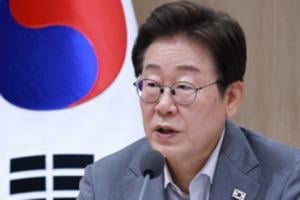
President Lee Jae-myung has raised the issue of so-called “reverse discrimination” perceived by men in their 20s and has instructed officials to prepare measures.
According to the minutes from a cabinet meeting held on the 10th of last month, released by the Ministry of the Interior and Safety on the 16th, President Lee, during a report by Shin Young-sook, Vice Minister of Gender Equality and Family, pointed out, “There are areas where men feel they are discriminated against, but there’s no official discussion happening on this anywhere.” He then directed, “Please check on ways to study and develop countermeasures for areas where men are facing discrimination.”
On that day, Vice Minister Shin had reported on plans to address low birth rates through family policies and to strengthen support and protection systems for victims of violence against women.
After hearing the report, President Lee brought up the cognitive limitations implied by the ministry’s name. He noted, “Because the ministry is called the Ministry of Gender Equality and Family, with the word ‘women’ in its name, it has become an object of intense dislike and political controversy among young men.”
President Lee further remarked, “Structurally, across society, women are undeniably a group that has suffered discrimination. But if you look only at people in their teens to early 30s, women are ahead in civil service exams and bar exams, so these young men (Lee Dae-nam) say, ‘Once we come back from military service, we’re bound to lose in the competition.’” He added, “In any case, because the total number of opportunities in society is lacking, such (gender) conflicts seem to be intensifying.”
President Lee also asked whether there was any department within the ministry in charge of handling issues where men experience discrimination.
In response, Vice Minister Shin said, “There’s no dedicated department, but we also recognize this as a serious issue and have been analyzing gender conflict.” She added, “Since within the ministry we’ve been actively pursuing policies to alleviate discrimination against women, perhaps that has led to some of these problems.”
The ministry also reflected on its shortcomings, acknowledging that even though the Framework Act on Women’s Development had been amended to the Framework Act on Gender Equality, it had failed to fully embrace the intent of gender equality or adapt its policies to changing social conditions.
Vice Minister Shin analyzed, “Women have learned about equality during their school years and enter society sensitive to discriminatory treatment in workplace culture, and when they marry, they become even more sensitive to career interruptions.” She continued, “Meanwhile, young men like Lee Dae-nam face a period of loss due to mandatory military service, and they’ve become sensitive about the fact that their own grievances remain unaddressed.”
President Lee reaffirmed his directive, saying, “Since we’ve decided to expand and reorganize into a Ministry of Gender Equality and Family, although you will primarily handle women’s policies, please also study areas where men face discrimination and come up with solutions.”
Posted by Freewhale98
3 Comments
Sexism against women in Korea is crazy and if Lee’s gonna do this can he just figure out how to make mandatory service apply to everyone please and thank you
I think he’s framing it correctly, but not extending conscription to women is only going to keep any worsening gender imbalances (and sexism as well)
Touchy topic. Not sure if this is the right sub to discuss this, since most people outside of Korea won’t be aware of some of these “male grievances”.
The DP is very unpopular with males aged 18-29. This demographic group was one of the few that propelled Yoon into power. They voted mostly for the Reform Party candidate this election. Part of Yoon’s campaign was the anti-feminist campaign promises like dismantling the Ministry of Gender Equality and Family (여성가족부), which as the article mentions has “female” in the Korean name.
Korean men are upset that they have to serve in the military for 18 months while their female peers get to graduate and then start their careers earlier.
Without being too dismissive, I think most of it comes from a zero-sum mindset combined with extreme short-term thinking. Any policies protecting women in the workplace, for instance, encourages female employment so therefore are taking away their own jobs. This is a fallacy because female employees are also consumers, so they will create demand for goods and services, which in turn creates more employment.
Also, what these men don’t realize how large the gender pay gap is in Korea, which means if they can secure a job for several years, they’ll earn way more than their female peers. Women are constantly passed over on promotion because it’s culturally expected that they will choose their family (esp. children) over their companies every time. They are expected to be the primary caregiver.
Youth unemployment (though lower than most OECD countries) is a problem for this demographic. Real estate is unaffordable without access to credit, which youth do not have. Job security is declining due to the gig economy.
The “discrimination” that men face is mostly perceived. That said, no persons should face discrimination in the workplace over gender.
Noteworthy is that Korea still does not have an anti-discrimination law. (Thanks in no small part to the conservative Christian lobby.)
The lack of economic opportunity is a larger driver of discontent and radicalization. Gender politics is a very nasty part of Korea’s partisan divide, imo.