
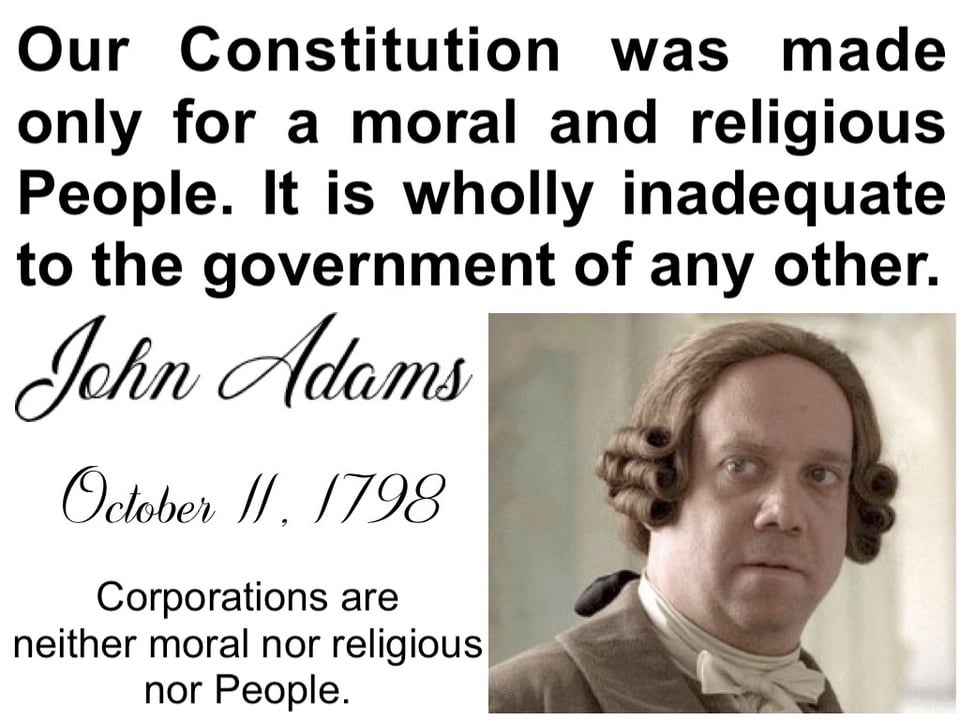
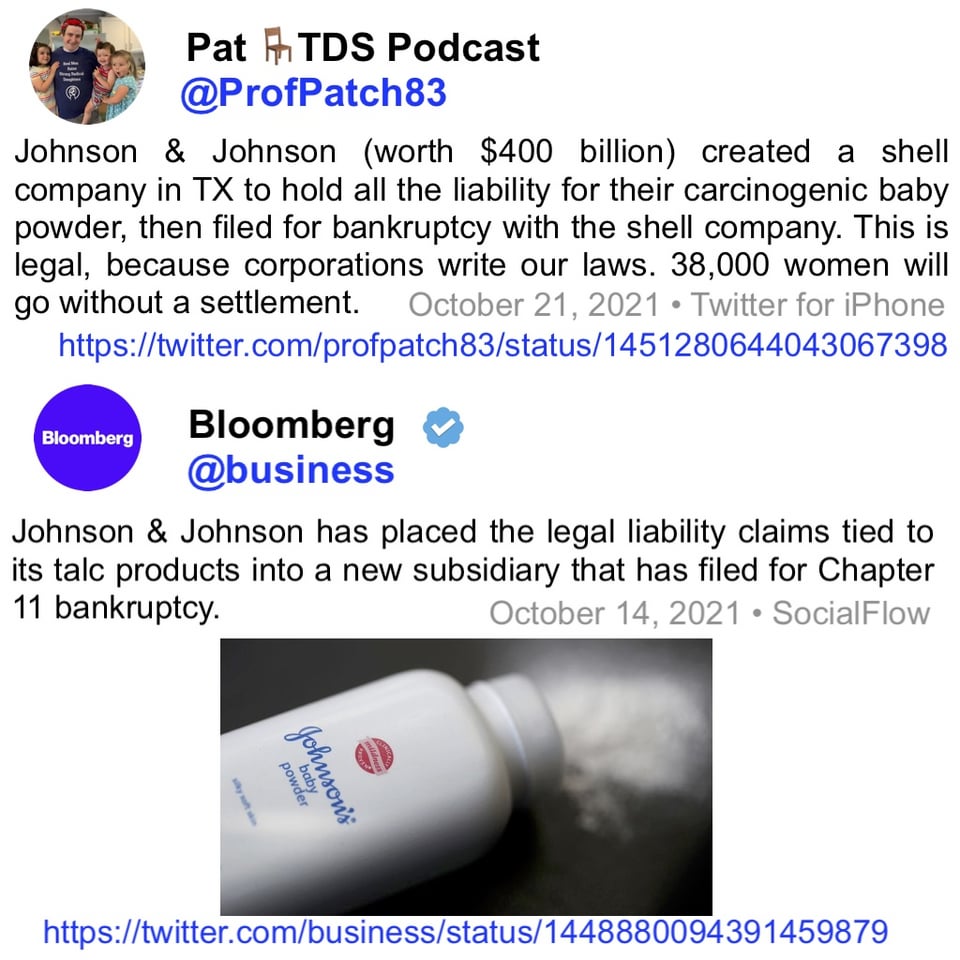
It is one thing to say that we need a framework of law to allow people to engage in commerce.
It is quite another to declare that corporations are "people" under the law with Constitutional rights.
Libertarians are seen as economically and socially Darwinistic, when most voters are not. This is absolutely the wrong way for us to win elections or advance policy.
This doesn't mean supporting redistributionism but instead redefining the bureaucracy and the establishment politicians as diametrically opposed to the interests of the poor, small businesses, minorities and the environment. The bigger and more powerful the government gets, the more powerful corporations and special interests become as well.
Like our intellectual forerunners, the classical liberals, we should have always been attacking corporations and monopolies as perversions of free markets. Corporations are government-created statuses that prevent the owners and managers from being liable and financially accountable for actions taken on behalf of the corporation. Adam Smith hated corporations as unaccountable and inefficient, and saw them as government market distortions. We should too.
– Nick Wilson, Libertarian Reform Caucus. Comment in response to "The End of Libertarianism and Other Adventures in Financial Policy Fantasy". Reason. October 21, 2008.
When pressed, libertarians will sidestep the issue, by saying something like "but it's not real capitalism" while adding something about being against "crony capitalism" or "corporate capitalism", without ever addressing the core problem.
Which is about as lame as Marxists saying "it wasn't real communism" while adding something about being against the Gulags and the Holodomor.
Instead of acknowledging that corporations are creatures of statute granting collectivist entities individual rights, the libertarian answer is to de-regulate corporations; i.e., government must facilitate the creation of corporations but then leave it to the magic of the Free Market to hold them accountable in the same way that individual natural persons are.
Below are a few proposals consistent with both big-"L" and small-"l" libertariansim principles of individual, not collectivist, liberty and rights.
Corporations are not natural entities, like Karner Blue butterflies or white pines. Corporations are artificial creations that are set up by state corporation codes. These state laws, plus a bunch of court cases, form the basis for the notion that corporations have powers and “rights.”
This law is Defining Law. This law is the script that corporate lawyers write for corporations.
Here is one cluster of ideas for rewriting the Defining Law of corporations. It’s not a 3-point plan and it’s not the beginning of a Twenty Point Plan — just some ideas to think about.
1 Prohibit corporations from owning stock in other corporations. Owning stock in other corporations enables corporations to control huge markets and shift responsibility, liability, resources, assets, and taxes back and forth among parent corporations, subsidiaries, and other members of their unholy families. By defining corporations in such a way to prohibit such ownership, much of the anti-trust regulatory law becomes unnecessary and superfluous.
2 Prohibit corporations from being able to choose when to go out of business (in legalese, no voluntary dissolution). This would prevent corporations from dissolving themselves when it came time to pay taxes, repay government loans, pay creditors, pay pensions, pay for health care, and pay for toxic cleanups.
3 Make stockholders liable for a corporation’s debts. People who want to be stockholders would reallocate their resources to corporations that they knew something about, that weren’t engaged in risky, toxic projects. (This would encourage local, sustainable businesses and healthy local economies. Imagine that.)
These three measures might seem “unrealistic” to some, but it beats the heck out of a voluntary code of conduct, or a wasted decade at a regulatory agency. All three of these provisions were once common features of state corporation codes.
These three measures were quite effective, which is why corporation lawyers worked so hard to get rid of them. But they address only a tiny portion of what needs to be done.
Here’s another cluster of ideas for ways to shape a democratic process that is about people. (The idea that corporations have “rights” would seem nonsensical to any but a colonized mind.)
1 No corporate participation in the democratic process. Democracy is for and about human beings. Corporations should be prohibited from paying for any political advertisements, making any campaign contributions, or seeking to influence the democratic process in any way.
2 Corporations have no Constitutional rights. A corporation is an artificial creation set up to serve a public need, not an independent entity with intrinsic “rights.”
3 Corporations should be prohibited from making any civic, charitable, or educational donations. Such donations are used to warp the entire social and economic fabric of society, and make people afraid to speak out against corporations.
These probably seem even more “unrealistic” than the first batch. Imagine how good it is for corporate executives that we find these ideas “impractical.” And by the way, these were all once law, too.
– Jane Anne Morris. "Help, I've been Colonized and I Can't Get Up". 1998.
Posted by 1776-2001
1 Comment
We need to work on representation first. When liberty becomes priority, items like this will fall into place.