>When President Trump complains that trade with China is killing jobs, it resonates in Indonesia. But it is Indonesian jobs that cannot compete: The country has been dealing with China’s outsize influence on every aspect of its economy for more than a decade.
>“The worst-case scenario is not that we can’t export,” said Redma Gita Wirawasta, the chairman of the Indonesian Fiber and Filament Yarn Producers Association, referring to Mr. Trump’s tariffs on Indonesian goods. “The worst-case scenario is that more and more Chinese goods will come to Indonesia.”
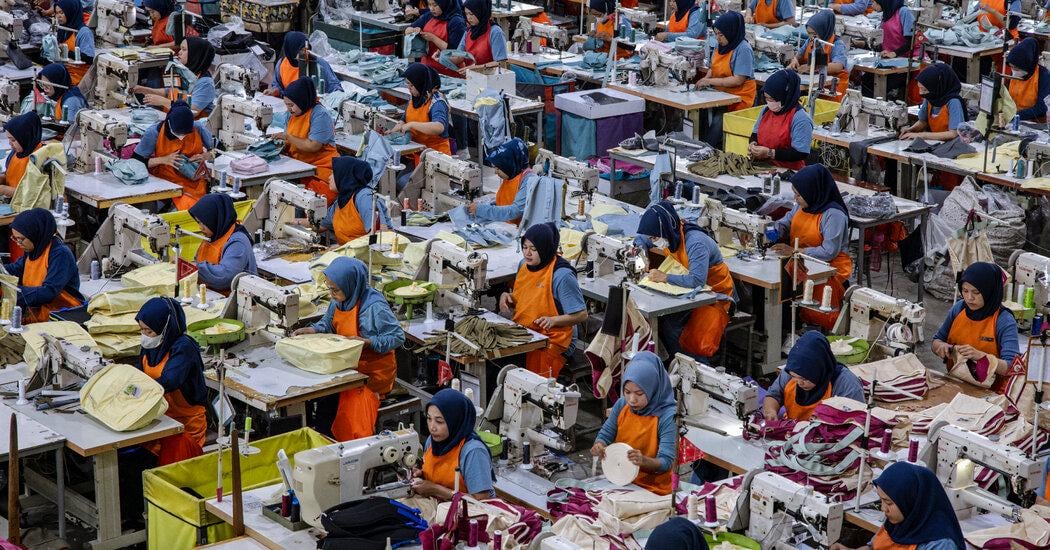
>The garment industry has felt it acutely over the past two years, as China has inundated Indonesian consumers with its clothes and taken over local factories. Ruthless competition from cheap Chinese goods has wiped out local factories and mills. The entire domestic supply chain is being dismantled. By Mr. Redma’s estimate, 300,000 people have lost their jobs since 2023.
>At another clothing stall near Mr. Rudi’s at Tanah Abang, Samuel Lie, 48, counts himself lucky if he can make $4,000 a month these days, less than half of what he used to make. Most of his clients stopped buying from him a few years ago. They tell him that it is cheaper to buy from China.
>“We can’t compete on quality,” he said.
>The pressure has become so severe that Indonesia’s last president threatened tariffs of up to 200 percent on Chinese goods. The current president, Prabowo Subianto, even called for the sinking of ships smuggling in textiles, the majority of them arriving from China.
>The solution for Indonesia, as it is for many other countries in this part of the world, is not necessarily putting up trade barriers against China.
>Indonesia has become dependent on China for investment to help build out its infrastructure. It’s also the biggest buyer of natural resources like palm oil and coal that drive the Indonesian economy.
>Indonesia’s economy has become so intertwined with China’s that, by one estimate, when China’s economy slows by one percentage point, it causes a 0.3-percentage-point decrease in Indonesia’s own economic growth.
>But China’s ability to make cheap goods at enormous scale, aided by generous government subsidies to exporters, has meant that Indonesia is more often the loser when trading with China.
!ping SEA
justsomen0ob on
The biggest threat Trump poses to China is his aggressive attempt to get rid of the US trade deficit. If he manages to significantly lower or even get rid of it, China’s trade tensions with other countries will get much worse, so China has to hope that Trump continues to be so incompetent.

2 Comments
>When President Trump complains that trade with China is killing jobs, it resonates in Indonesia. But it is Indonesian jobs that cannot compete: The country has been dealing with China’s outsize influence on every aspect of its economy for more than a decade.
>“The worst-case scenario is not that we can’t export,” said Redma Gita Wirawasta, the chairman of the Indonesian Fiber and Filament Yarn Producers Association, referring to Mr. Trump’s tariffs on Indonesian goods. “The worst-case scenario is that more and more Chinese goods will come to Indonesia.”
>The garment industry has felt it acutely over the past two years, as China has inundated Indonesian consumers with its clothes and taken over local factories. Ruthless competition from cheap Chinese goods has wiped out local factories and mills. The entire domestic supply chain is being dismantled. By Mr. Redma’s estimate, 300,000 people have lost their jobs since 2023.
>At another clothing stall near Mr. Rudi’s at Tanah Abang, Samuel Lie, 48, counts himself lucky if he can make $4,000 a month these days, less than half of what he used to make. Most of his clients stopped buying from him a few years ago. They tell him that it is cheaper to buy from China.
>“We can’t compete on quality,” he said.
>The pressure has become so severe that Indonesia’s last president threatened tariffs of up to 200 percent on Chinese goods. The current president, Prabowo Subianto, even called for the sinking of ships smuggling in textiles, the majority of them arriving from China.
>The solution for Indonesia, as it is for many other countries in this part of the world, is not necessarily putting up trade barriers against China.
>Indonesia has become dependent on China for investment to help build out its infrastructure. It’s also the biggest buyer of natural resources like palm oil and coal that drive the Indonesian economy.
>Indonesia’s economy has become so intertwined with China’s that, by one estimate, when China’s economy slows by one percentage point, it causes a 0.3-percentage-point decrease in Indonesia’s own economic growth.
>But China’s ability to make cheap goods at enormous scale, aided by generous government subsidies to exporters, has meant that Indonesia is more often the loser when trading with China.
!ping SEA
The biggest threat Trump poses to China is his aggressive attempt to get rid of the US trade deficit. If he manages to significantly lower or even get rid of it, China’s trade tensions with other countries will get much worse, so China has to hope that Trump continues to be so incompetent.