
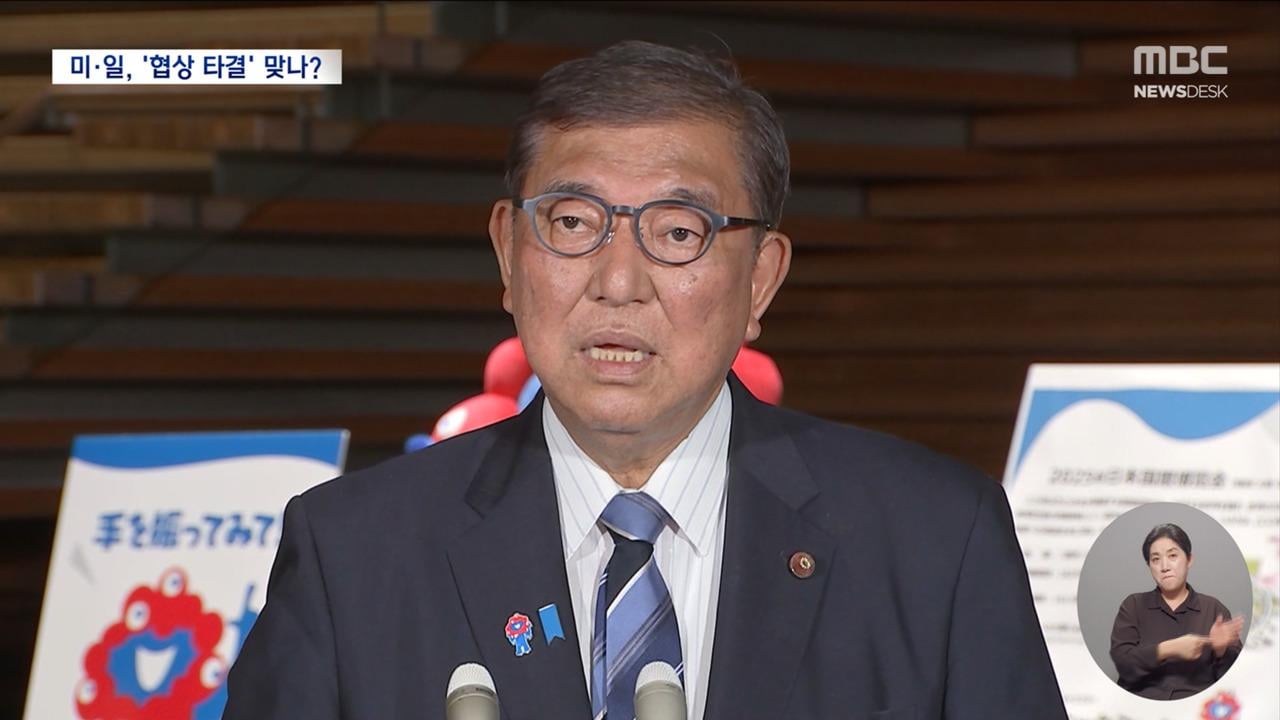
Following the announcement of the tariff agreement between the United States and Japan, even domestic (Korean) media have been simply relaying the information as it was provided.
As a result, these details are being taken as if they represent a clear standard. But when we look at the explanations given by both countries afterward, one can’t help but wonder whether they even agreed on the same terms.
Reporting from Tokyo, this is correspondent Shin Ji-young.
Here is the summary of the trade agreement released by the White House.
It states that a “15% tariff will be imposed on all Japanese imports,” but fails to mention when it will take effect.
[Ryosei Akazawa / Japanese Minister for Economic Revitalization (Yesterday)]
“I believe it will go into effect on August 1st.”
Additionally, the summary mentions that Japan is expected to purchase several billion dollars’ worth of U.S. defense equipment “in addition” to past purchases. However, the Japanese side says this was already part of existing plans, not a new purchase.
Then there’s the claim that a $550 billion investment vehicle will be established for investing in the U.S.—and this part is even more puzzling.
President Trump boasted that the money is like a “signing bonus” when a player signs with a team.
[Donald Trump / U.S. President (on the 22nd)]
“It’s like getting a signing bonus, you could say.”
But Japan explains that the number merely reflects the limit of capital contributions or loans from government-affiliated institutions—and that if there’s no actual investment into the U.S., the funds may not even be used.
Then there’s the statement from the U.S. Treasury Secretary warning that if Japan doesn’t follow through on the deal properly, the President could reinstate the 25% tariff.
Japan flatly denied this was ever even discussed at the negotiating table.
[Ryosei Akazawa / Japanese Minister for Economic Revitalization (Yesterday)]
“There was no discussion about that. The U.S. side didn’t express such an intention to me. I have no such awareness.”
In fact, there’s no joint agreement document between the two countries.
Moreover, the Japanese government says it doesn’t know when such a document might be drafted—and even if one is, it has no intention of signing a legally binding agreement.
[Ryosei Akazawa / Japanese Minister for Economic Revitalization (Yesterday)]
“We are not considering signing any legally binding agreement.”
Despite all these uncertainties and inconsistencies, this deal is now being perceived—especially in countries like Korea, which are preparing for negotiations—as a kind of benchmark or standard.
Some critics argue that this so-called agreement, which lacks both detail and feasibility, is simply rhetoric aimed at showcasing President Trump’s achievements.
Reporting from Tokyo, this is Shin Ji-young, MBC News.
P.S. There seems to be changes in the tone of reporting in Korean media as more news from Japan is coming in. They are now questioning whether there is even a US-Japan trade deal agreed by two side. Sorry for the last post which I accused Japanese government of lying.
Posted by Freewhale98
1 Comment
I haven’t seen your last post, but accusing Japan’s government of lying over the Trump administration is a choice. I completely fail to grasp how anyone who has ever conducted themselves with an iota of professionalism in their life can back this embarrassment of an administration. This exact story is now a dime a dozen and I am only talking about trade deal “announcements”.