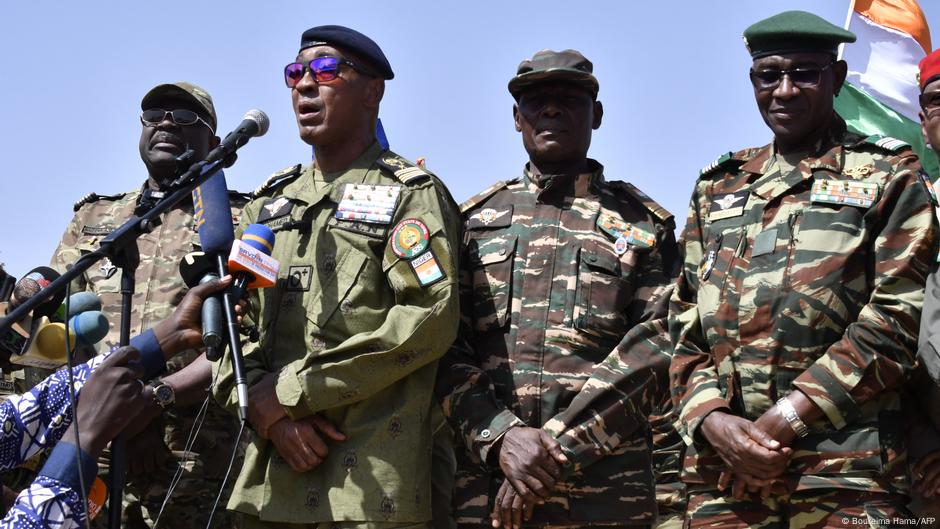
Two years after General Abdourahamane Tiani’s coup d’etat against the civilian government of Niger, local NGOs and international observers warn that the Sahelian country’s human rights situation has sharply deteriorated.
On July 26, 2023, elements of the Presidential Guard under the commandment of Abdourahamane Tiani launched a coup against democratically elected President Mohamed Bazoum, triggering an unprecedented regional crisis that saw ECOWAS cut off nearly all power to Niger and threaten military action if the coup were not reversed.
Following a months-long standoff between the coup leaders, supported by Russia and the military juntas of Mali and Burkina Faso, and ECOWAS countries, supported by France and the US, ECOWAS backed down and lifted sanctions on Niger.
The coup was the latest in the so-called “Coup Belt” that saw pro-West civilian governments in Mali and Burkina Faso be overthrown by elements of the military, which formed allied juntas and pivoted towards Russia, expelling international forces and replacing them with Russian paramilitaries. In Niger, a $100 million airbase built and paid for by the US in Agadez was repossessed by the junta following their termination of military cooperation with the US in 2024.
One of the poorest countries in the world, Niger experienced several military regimes until a chaotic democratization process in the late 1990s – in 2018, the first peaceful transition of power between two Nigerien leaders occurred when former Marxist rebel and member of the Arab minority Mohamed Bazoum succeeded to Mahamadou Issoufou following his victory in the presidential election.
Mohamed Bazoum remains to this day a prisoner of the junta, whose forces have also carried out dozens of arrests among former government officials, reporters and legal practitioners. The country’s media umbrella organization Maison de la Presse was dissolved in 2024, and media placed under the control of the military government. Since 2023, Niger dropped by 1.50 pts in the EIU’s Democracy Index.
On the economic front, uncertainty and ECOWAS sanctions following the coup, as well as the junta’s hostility towards international NGOs – accused of being pro-West infiltrators – have harshly impacted vast portions of the population, in the fifth-least developed country in the world.
As for security, violence remains widespread in three areas: the south-east, where Boko Haram’s insurgency routinely claims the lives of soldiers and civilians around Lake Chad, the southwest, where banditry from Nigeria’s northwest has spilled over the border, and more crucially, the west, where the Islamist group JNIM has conquered territories along the “Three-Borders” region with Mali and Burkina Faso. For months, experts have warned that JNIM, benefitting from the juntas’ brutal response, lack of perspectives for the local populations, and connections to international jihadi groups, could soon become a proto-state akin to ISIS in 2014-17.

1 Comment
!ping AFRICA
Two years after General Abdourahamane Tiani’s coup d’etat against the civilian government of Niger, local NGOs and international observers warn that the Sahelian country’s human rights situation has sharply deteriorated.
On July 26, 2023, elements of the Presidential Guard under the commandment of Abdourahamane Tiani launched a coup against democratically elected President Mohamed Bazoum, triggering an unprecedented regional crisis that saw ECOWAS cut off nearly all power to Niger and threaten military action if the coup were not reversed.
Following a months-long standoff between the coup leaders, supported by Russia and the military juntas of Mali and Burkina Faso, and ECOWAS countries, supported by France and the US, ECOWAS backed down and lifted sanctions on Niger.
The coup was the latest in the so-called “Coup Belt” that saw pro-West civilian governments in Mali and Burkina Faso be overthrown by elements of the military, which formed allied juntas and pivoted towards Russia, expelling international forces and replacing them with Russian paramilitaries. In Niger, a $100 million airbase built and paid for by the US in Agadez was repossessed by the junta following their termination of military cooperation with the US in 2024.
One of the poorest countries in the world, Niger experienced several military regimes until a chaotic democratization process in the late 1990s – in 2018, the first peaceful transition of power between two Nigerien leaders occurred when former Marxist rebel and member of the Arab minority Mohamed Bazoum succeeded to Mahamadou Issoufou following his victory in the presidential election.
Mohamed Bazoum remains to this day a prisoner of the junta, whose forces have also carried out dozens of arrests among former government officials, reporters and legal practitioners. The country’s media umbrella organization Maison de la Presse was dissolved in 2024, and media placed under the control of the military government. Since 2023, Niger dropped by 1.50 pts in the EIU’s Democracy Index.
On the economic front, uncertainty and ECOWAS sanctions following the coup, as well as the junta’s hostility towards international NGOs – accused of being pro-West infiltrators – have harshly impacted vast portions of the population, in the fifth-least developed country in the world.
As for security, violence remains widespread in three areas: the south-east, where Boko Haram’s insurgency routinely claims the lives of soldiers and civilians around Lake Chad, the southwest, where banditry from Nigeria’s northwest has spilled over the border, and more crucially, the west, where the Islamist group JNIM has conquered territories along the “Three-Borders” region with Mali and Burkina Faso. For months, experts have warned that JNIM, benefitting from the juntas’ brutal response, lack of perspectives for the local populations, and connections to international jihadi groups, could soon become a proto-state akin to ISIS in 2014-17.