As trade tensions push Chinese exporters to look beyond the U.S., vendors in the manufacturing hub are turning to Arabic and Spanish to connect with Latin America, the Middle East, and Africa.
Entregar … Bodega … Internacional.”
The words echo off the concrete about an hour before the world’s largest wholesale market stirs awake.
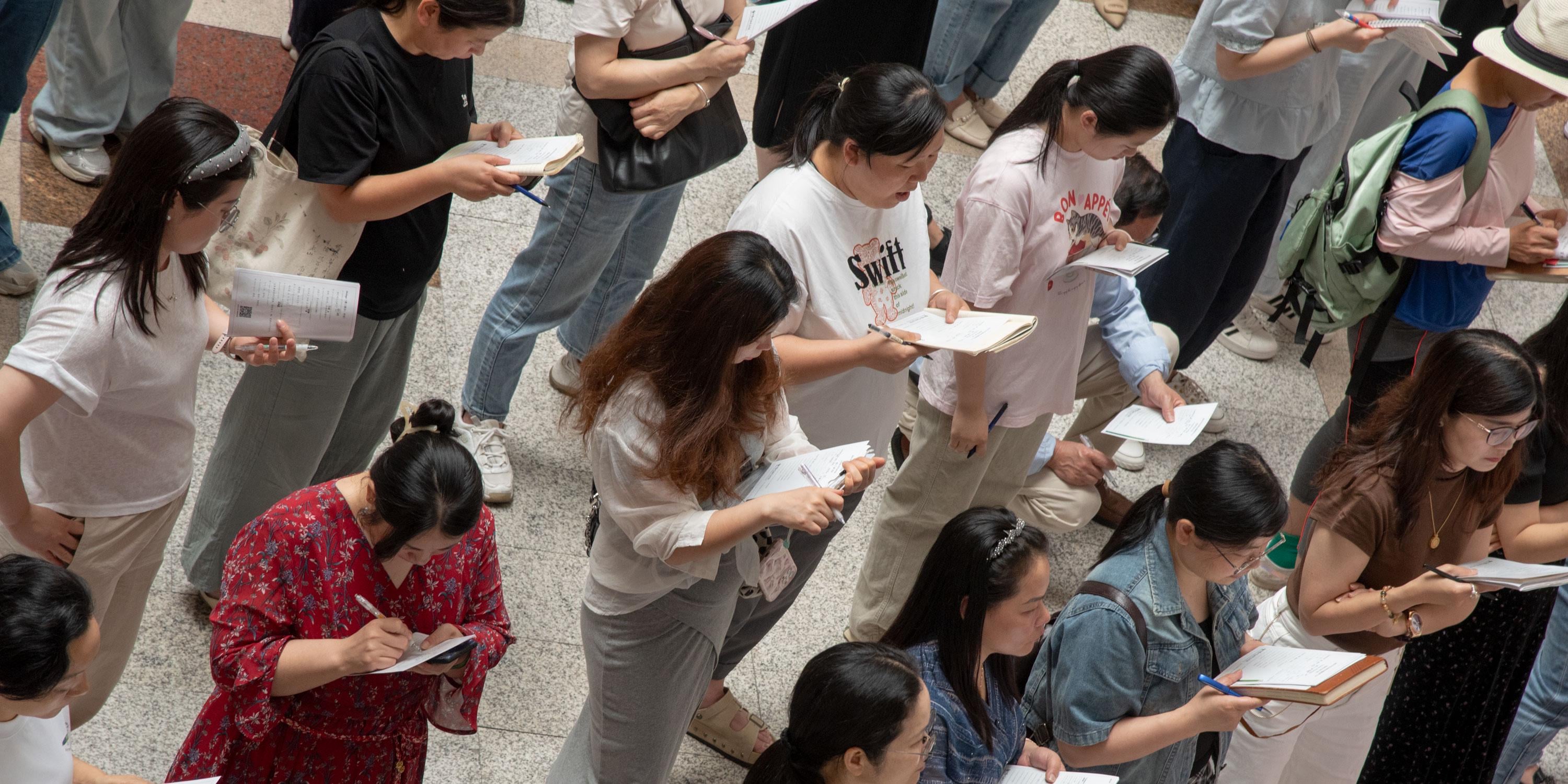
The teacher hasn’t arrived yet. But in a plaza between warehouse blocks, dozens of traders already stand in rows, Spanish phrases repeating on loop from a loudspeaker. Some nod and mouth the words. Some flip through flashcards. Others scribble in old notebooks
Near the front, 55-year-old Yao Baojuan mouths each word as she copies it into a small notebook — Spanish for deliver, warehouse, international. The words come up often in her business. She wants to say them right.
She’s part of a growing group of traders in the eastern Chinese city of Yiwu adapting to markets where English no longer dominates. “Just learning English isn’t enough,” Yao tells Sixth Tone. “We’re not doing business with just one country but with the world.”
And after 19 years of offering free morning English classes, the China Commodities City Business School is expanding its focus too, to meet demand from vendors shifting toward Latin America, the Middle East, and Africa. While the school launched its first Arabic course in April, Spanish followed in May.
The strategic pivot comes amid increasingly uncertain trade ties with the United States. While a 90-day tariff reprieve is currently in effect, rates had climbed as high as 145% earlier this year — enough to stall orders, strand inventory, and force exporters to reassess.
Many have begun looking beyond the U.S. toward Latin America, the Middle East, and Africa. In 2024, nearly two-thirds of Yiwu’s exports went to Belt and Road countries, with double-digit growth in both Latin America and the Gulf — regions where English is less commonly used in day-to-day business.
Traders tell Sixth Tone that holding onto clients, or reaching new ones, increasingly means going beyond translation apps. Even a handful of phrases, they say, can shift the mood. A well-placed “marhaba” or “hola” — hello in Arabic and Spanish — can soften a room, or seal an order.
Say it right
On June 4, Yao rode her 20-year-old bicycle to the market, as she does most mornings. By 8:40 a.m., she had taken her usual spot near the front of the plaza for her 18th Spanish class of the month.
Classes start with basic pronunciation, then move quickly to business talk — greetings, price, logistics, after-sales support. That day’s focus: cargo delivery.
For Yao, the class was a chance to refresh skills she first picked up over a decade ago. Since launching her export business in Yiwu in 2007, she’s sold daily necessities to buyers across Europe, the Middle East, South America, Southeast Asia — and the U.S., which still makes up about 20% of her revenue.
She started with English in 2006, then added Spanish and Arabic in 2011, as more clients arrived who spoke neither.
Some of my clients speak English, while others speak Spanish,” she says. “I want to reach more customers, so I need to learn Spanish … it opens the door to more business opportunities.”
Yao still rereads the notebooks she filled years ago — careful pages of Spanish phrases and grammar copied by hand. After each class, she rewrites everything from memory. “Reviewing the old to learn the new,” she says, “helps it stick.”
Nearby, Zhu, who now runs his family’s rainwear business, started studying Spanish and Arabic this spring for the first time. After just a few weeks of classes, he can now greet buyers, quote prices, and discuss delivery schedules.
“One class a day isn’t really enough,” Zhu tells Sixth Tone. “But if you take good notes and practice afterward, the phrases are useful.”
He says Spanish feels more accessible than English — the teacher avoids dense grammar and focuses on phrases traders can use right away.
Others, like Hu Baochun, take a more hands-on route. Hu, who sells outdoor barbecue equipment to buyers in the Middle East, South America, and Africa, memorizes new phrases by writing them out phonetically in Chinese.
In May, she greeted an Arabic-speaking customer in his language — and closed a 10,000-yuan ($1,395) deal. “After a month of Arabic, I can say ‘good morning’ and quote a price — and the customer understands. It’s already helped with communication and taking orders.”

1 Comment
As trade tensions push Chinese exporters to look beyond the U.S., vendors in the manufacturing hub are turning to Arabic and Spanish to connect with Latin America, the Middle East, and Africa.
Entregar … Bodega … Internacional.”
The words echo off the concrete about an hour before the world’s largest wholesale market stirs awake.
The teacher hasn’t arrived yet. But in a plaza between warehouse blocks, dozens of traders already stand in rows, Spanish phrases repeating on loop from a loudspeaker. Some nod and mouth the words. Some flip through flashcards. Others scribble in old notebooks
Near the front, 55-year-old Yao Baojuan mouths each word as she copies it into a small notebook — Spanish for deliver, warehouse, international. The words come up often in her business. She wants to say them right.
She’s part of a growing group of traders in the eastern Chinese city of Yiwu adapting to markets where English no longer dominates. “Just learning English isn’t enough,” Yao tells Sixth Tone. “We’re not doing business with just one country but with the world.”
And after 19 years of offering free morning English classes, the China Commodities City Business School is expanding its focus too, to meet demand from vendors shifting toward Latin America, the Middle East, and Africa. While the school launched its first Arabic course in April, Spanish followed in May.
The strategic pivot comes amid increasingly uncertain trade ties with the United States. While a 90-day tariff reprieve is currently in effect, rates had climbed as high as 145% earlier this year — enough to stall orders, strand inventory, and force exporters to reassess.
Many have begun looking beyond the U.S. toward Latin America, the Middle East, and Africa. In 2024, nearly two-thirds of Yiwu’s exports went to Belt and Road countries, with double-digit growth in both Latin America and the Gulf — regions where English is less commonly used in day-to-day business.
Traders tell Sixth Tone that holding onto clients, or reaching new ones, increasingly means going beyond translation apps. Even a handful of phrases, they say, can shift the mood. A well-placed “marhaba” or “hola” — hello in Arabic and Spanish — can soften a room, or seal an order.
Say it right
On June 4, Yao rode her 20-year-old bicycle to the market, as she does most mornings. By 8:40 a.m., she had taken her usual spot near the front of the plaza for her 18th Spanish class of the month.
Classes start with basic pronunciation, then move quickly to business talk — greetings, price, logistics, after-sales support. That day’s focus: cargo delivery.
For Yao, the class was a chance to refresh skills she first picked up over a decade ago. Since launching her export business in Yiwu in 2007, she’s sold daily necessities to buyers across Europe, the Middle East, South America, Southeast Asia — and the U.S., which still makes up about 20% of her revenue.
She started with English in 2006, then added Spanish and Arabic in 2011, as more clients arrived who spoke neither.
Some of my clients speak English, while others speak Spanish,” she says. “I want to reach more customers, so I need to learn Spanish … it opens the door to more business opportunities.”
Yao still rereads the notebooks she filled years ago — careful pages of Spanish phrases and grammar copied by hand. After each class, she rewrites everything from memory. “Reviewing the old to learn the new,” she says, “helps it stick.”
Nearby, Zhu, who now runs his family’s rainwear business, started studying Spanish and Arabic this spring for the first time. After just a few weeks of classes, he can now greet buyers, quote prices, and discuss delivery schedules.
“One class a day isn’t really enough,” Zhu tells Sixth Tone. “But if you take good notes and practice afterward, the phrases are useful.”
He says Spanish feels more accessible than English — the teacher avoids dense grammar and focuses on phrases traders can use right away.
Others, like Hu Baochun, take a more hands-on route. Hu, who sells outdoor barbecue equipment to buyers in the Middle East, South America, and Africa, memorizes new phrases by writing them out phonetically in Chinese.
In May, she greeted an Arabic-speaking customer in his language — and closed a 10,000-yuan ($1,395) deal. “After a month of Arabic, I can say ‘good morning’ and quote a price — and the customer understands. It’s already helped with communication and taking orders.”