
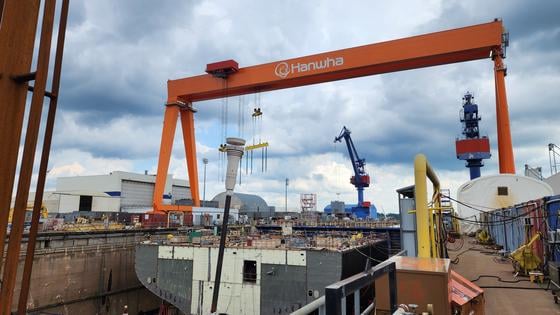
The South Korean government has proposed a bold initiative called the “MASGA” (Make American Shipbuilding Great Again) project as a key bargaining chip in tariff negotiations with the United States. MASGA, inspired by Donald Trump’s slogan “MAGA” (Make America Great Again), is a large-scale shipbuilding cooperation project valued at tens of billions of dollars, aimed at revitalizing the U.S. shipbuilding industry.
According to the presidential office and relevant ministries on the 28th, South Korean Minister of Trade, Industry and Energy Kim Jung-kwan proposed the MASGA project on the 25th (local time) during tariff negotiations at U.S. Secretary of Commerce Howard Lutnick’s home in New York.
The MASGA project includes not only local investments in the U.S. by South Korean private shipbuilders but also comprehensive financial support, such as loans and guarantees. It is reported that the South Korean government proposed a concrete financial package worth several tens of trillions of won (hundreds of billions of dollars) to the U.S. side. Secretary Lutnick reportedly expressed satisfaction after hearing the details from Minister Kim.
To support Korean shipbuilders entering the U.S. market, the government is also reviewing the involvement of public financial institutions such as the Export-Import Bank of Korea and the Korea Trade Insurance Corporation. A senior official from an export finance agency stated, “Once a specific project is confirmed, we will actively support Korean investors in the shipbuilding and related sectors.”
The U.S. side has particularly requested not just local investment from Korean shipbuilders but also technology transfer and workforce training. Accordingly, the Korean government is reportedly preparing a comprehensive human resources training program in collaboration with domestic shipbuilders, including workshops, certification programs, and vocational education initiatives.
Reviving the U.S. shipbuilding industry is a major goal of the Trump administration. Since the 1980s, the industry has lost global competitiveness due to reduced subsidies and excessive protectionist policies. As a result, its current global market share has fallen below 1%, and the entire industrial ecosystem—from equipment to infrastructure, parts, and skilled labor—requires rebuilding.
Meanwhile, the government is still negotiating internally on how much to concede on sensitive issues such as opening Korea’s agricultural and livestock markets and increasing defense spending. At a briefing, Woo Sang-ho, Senior Presidential Secretary for Political Affairs, acknowledged strong pressure from the U.S. on agricultural market access, saying, “It is true that the U.S. is demanding market opening for agricultural and livestock products,” but added, “We are doing our best to minimize concessions to protect domestic industries.” The U.S. is particularly pressing Korea to increase imports of U.S. rice and beef from cattle over 30 months old.
When asked whether “increased defense spending” and “purchases of U.S. weapons” are also part of the negotiations, Woo responded, “Those issues are also part of the discussion.” The South Korean government is pursuing a “security-trade package deal” that includes both tariff/non-tariff issues and security matters.
Minister Kim and Trade Minister Yeo Han-koo, who were in the U.S., left for Europe to create additional negotiation opportunities with Secretary Lutnick, who had traveled to Scotland for trade talks with the EU. Since Lutnick was reportedly not participating in the July 28–29 U.S.–China trade negotiations, there is speculation that more discussions may be possible. Deputy Prime Minister for Economic Affairs Koo Yoon-chul is also scheduled to leave on the 29th for talks with U.S. Treasury Secretary Scott Besant on the 31st.
Unlike advanced military ships such as nuclear aircraft carriers and Aegis destroyers, which have barely maintained continuity, the U.S. has virtually lost its capacity to build commercial ships. Out of 1,910 vessels ordered globally last year, U.S. shipyards secured only two. As such, rebuilding the capacity to construct commercial ships is now a key national task for the U.S. Professor Lee Shin-hyung of Seoul National University’s Department of Naval Architecture and Ocean Engineering noted, “While the U.S. has sustained military shipbuilding through government funding, its commercial shipbuilding capability has vanished due to high production costs. Korean shipbuilders, with strengths in cost optimization, could be ideal partners for the U.S. in reviving its shipbuilding industry.”
There is also speculation that making shipbuilding cooperation a key negotiation card may help Korea reduce the overall burden of investment in the U.S. Japan agreed to invest $550 billion, and the EU $600 billion, in the U.S. as part of their respective tariff negotiations. The U.S. has reportedly asked South Korea to establish a $400 billion investment fund. Park Sung-hoon, Professor Emeritus at Korea University’s Graduate School of International Studies, said, “Given the size of Korea’s economy, meeting the $400 billion demand is difficult. But since the U.S. wants to revive shipbuilding capabilities, Korea could use this to reduce the overall investment amount.”
However, some argue that shipbuilding alone is not enough as a negotiating tool. A trade official remarked, “While U.S. interest in reviving its shipbuilding industry makes it a valid negotiation item, there is a perception among working-level U.S. officials that cooperation in this area would primarily benefit Korean shipbuilders. So our investment scale will still need to be significant.”
Additionally, expanding purchases of U.S. energy has emerged as a key negotiation item. The EU agreed to lower tariffs to 15% in exchange for purchasing $750 billion worth of U.S. energy over three years ($250 billion per year). Last year, Korea imported 46.33 million tons of LNG, of which U.S. LNG accounted for only 5.64 million tons (12%). Considering that the U.S. was the world’s top LNG exporter in 2023, Korea’s share is relatively low.
Jang Sang-sik, Director of the Korea International Trade Association’s Institute for International Trade and Commerce, said, “While we expected the EU to offer a larger investment package due to its economic size, they seem to have reached a Japan-level agreement by leveraging large-scale U.S. energy purchases. Korea could adopt a similar strategy—using cooperation in shipbuilding and energy sectors to minimize its investment obligations.”
Posted by Freewhale98
4 Comments
This admin is allergic to good ideas even when they’re not ideological ideas
1 billion American ships
> one of your strongest allies proposes to shore up a critical national security risk with one of their areas of expertise and provide jobs and economic growth
> throw a temper tantrum
ffs when Orange Man’s boneheaded extortion campaign is about to hand him a win, he and his idiot cronies still can’t make intelligent decisions.
If Trump throws this out, I’d love for Dems to take Korea up on this offer.