Great article – I tried to submit it at the same time as you apparantly haha.
There are a few things I would push back on a bit but it’s an interesting take nonetheless.
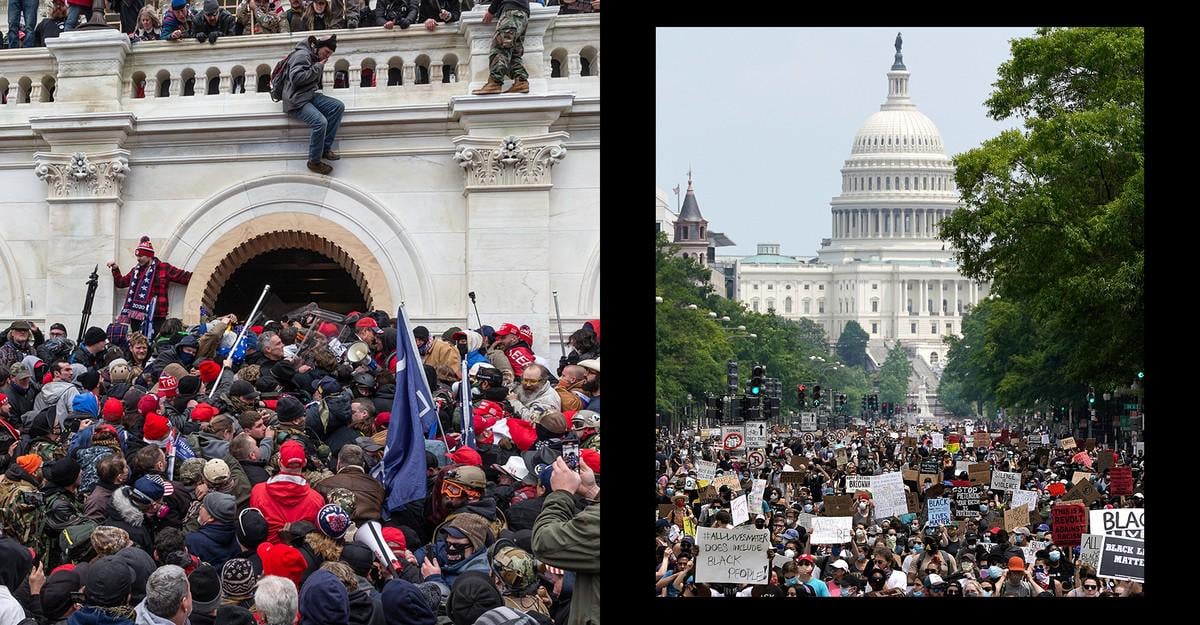
>Floyd’s killing inspired a summer of revolt that seemed, to much of the country, obviously justified. The postracial promise of the Barack Obama era had subsided. Some Black Americans and many more of their supporters saw little hope of achieving equality, let alone safety, without rebellion. The following January, this same underlying idea—that the unheard must speak through violence—was used to justify terrible wrong. (A different group of Americans naturally regarded that wrong as indisputably right.) In this way, the summer of 2020 and the siege of the Capitol are fratricidal twins. They imbued all factions of American society with antipathy and certitude, a perilous combination that continues to touch virtually every aspect of our public lives, and much of our private ones also.
The connection is tenuous but there is definitely a common thread.
>While Trump and his supporters rebelled against stay-at-home orders, progressives found their own outlet for rebellion in the protest against police brutality. They saw their opponents on the right as exacerbating a scourge that disproportionately killed Black people, whose lives they saw themselves as fighting to save. This dichotomy opened a furious new front in intra-white status jockeying. It created a renewed opportunity for “those who see themselves as (for lack of a better term) upper-whites,” as Reihan Salam wrote in 2018, “to disaffiliate themselves from those they’ve deemed lower-whites.”
This is a pretty brazenly bizarre assertion to make. It was clearly much more partisan than it was classist.
>The right-wing insurrection on January 6 was but the intensification of a pattern already visible on the social-justice left: the belief that one’s own moral clarity confers the license to storm the streets the moment political institutions disappoint us. **It was a form of hubris for the left to cast its own cause as so righteous that even lawlessness became a kind of virtue. One can easily imagine that the populist right learned from this tendency—or found justification in it—after having endured the previous summer’s unrelenting mayhem.**
>Today, lawlessness and spectacle have become a philosophy of government. The second Trump administration has deported American citizens and turned undocumented immigrants into grotesque fodder for the basest social-media engagement. While the president defies court orders and usurps congressional authority, his supporters excuse him with apparent ethical certitude.
>The arc of the American moral universe, wherever it ultimately bends, has been warped by the competing pressure of a social-justice movement that has grown impatient with the liberal project, and a reactionary populism that both feeds off and weaponizes that impatience. The result is a politics—and a society—dominated by grief and fury. One day, these passions erupt in Minnesota. Later, they rage through Washington, D.C. They can blind as well as ennoble, and we typically don’t know which until the hour is late.
Nail on the head at the end of the article though.
In particular you can see echoes of that bolded portion in the killing of the United Healthcare CEO. Excusing extrajudicial vigilante murder as righteous in any context is dangerous as hell.

2 Comments
good lord 2020 was 5 years ago
Great article – I tried to submit it at the same time as you apparantly haha.
There are a few things I would push back on a bit but it’s an interesting take nonetheless.
>Floyd’s killing inspired a summer of revolt that seemed, to much of the country, obviously justified. The postracial promise of the Barack Obama era had subsided. Some Black Americans and many more of their supporters saw little hope of achieving equality, let alone safety, without rebellion. The following January, this same underlying idea—that the unheard must speak through violence—was used to justify terrible wrong. (A different group of Americans naturally regarded that wrong as indisputably right.) In this way, the summer of 2020 and the siege of the Capitol are fratricidal twins. They imbued all factions of American society with antipathy and certitude, a perilous combination that continues to touch virtually every aspect of our public lives, and much of our private ones also.
The connection is tenuous but there is definitely a common thread.
>While Trump and his supporters rebelled against stay-at-home orders, progressives found their own outlet for rebellion in the protest against police brutality. They saw their opponents on the right as exacerbating a scourge that disproportionately killed Black people, whose lives they saw themselves as fighting to save. This dichotomy opened a furious new front in intra-white status jockeying. It created a renewed opportunity for “those who see themselves as (for lack of a better term) upper-whites,” as Reihan Salam wrote in 2018, “to disaffiliate themselves from those they’ve deemed lower-whites.”
This is a pretty brazenly bizarre assertion to make. It was clearly much more partisan than it was classist.
>The right-wing insurrection on January 6 was but the intensification of a pattern already visible on the social-justice left: the belief that one’s own moral clarity confers the license to storm the streets the moment political institutions disappoint us. **It was a form of hubris for the left to cast its own cause as so righteous that even lawlessness became a kind of virtue. One can easily imagine that the populist right learned from this tendency—or found justification in it—after having endured the previous summer’s unrelenting mayhem.**
>Today, lawlessness and spectacle have become a philosophy of government. The second Trump administration has deported American citizens and turned undocumented immigrants into grotesque fodder for the basest social-media engagement. While the president defies court orders and usurps congressional authority, his supporters excuse him with apparent ethical certitude.
>The arc of the American moral universe, wherever it ultimately bends, has been warped by the competing pressure of a social-justice movement that has grown impatient with the liberal project, and a reactionary populism that both feeds off and weaponizes that impatience. The result is a politics—and a society—dominated by grief and fury. One day, these passions erupt in Minnesota. Later, they rage through Washington, D.C. They can blind as well as ennoble, and we typically don’t know which until the hour is late.
Nail on the head at the end of the article though.
In particular you can see echoes of that bolded portion in the killing of the United Healthcare CEO. Excusing extrajudicial vigilante murder as righteous in any context is dangerous as hell.