
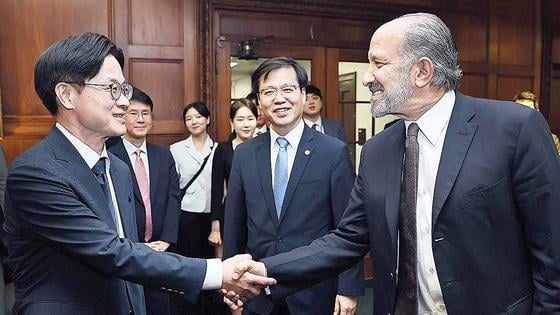
The final breakthrough in the tariff negotiations was driven by a joint Korea-U.S. shipbuilding industry project called “MASGA” (Make American Shipbuilding Great Again). According to government officials, the idea of revitalizing American shipbuilding with South Korean capital and technology was compelling enough to win over even President Donald Trump.
Kim Jung-kwan Shows MASGA Presentation: Lutnick Responds, “Great Idea”
On the 24th (local time), South Korea’s Minister of Trade, Industry and Energy Kim Jung-kwan and Chief Trade Negotiator Yeo Han-koo met with U.S. Commerce Secretary Howard Lutnick in Washington, D.C. to present the MASGA initiative for the first time. This came shortly after Deputy Prime Minister and Finance Minister Koo Yoon-cheol had to cancel a scheduled meeting with U.S. Treasury Secretary Scott Bessent after being notified just before departure that Bessent would not attend—forcing Koo to turn back at the airport.
Secretary Lutnick, often referred to as Trump’s “tariff strategist,” is known as a hardliner on trade and was initially viewed as a difficult counterpart by the Korean negotiation team. However, after the MASGA proposal was delivered, Lutnick not only showed interest but also provided guidance on how to present the idea to President Trump, becoming a “key man” in the negotiations, according to Korean officials. One official explained, “Minister Kim prepared a detailed presentation board explaining MASGA and showed it directly to Secretary Lutnick, who responded positively, saying it was a ‘great idea.’”
Presentation Boards Made on Site, ‘MASGA’ Hats Inspired by MAGA
The Korean negotiation team even created MASGA-branded hats, modeled after Trump’s iconic campaign slogan “MAGA” (Make America Great Again), to help frame the project in politically favorable terms. A senior official from the presidential office said, “We made 20 hats with ‘MASGA’ printed on them.”
The strategy was not merely about offering economic benefits, but about presenting Trump with a political gift as well—carefully calculated to appeal to his branding. The MASGA name itself was coined by working-level staff from the Ministry of Trade, Industry and Energy’s Shipbuilding and Offshore Plant Division, taking direct inspiration from MAGA.
The negotiation team, under Minister Kim’s directive, even produced a presentation board on-site to clearly and visually convey the MASGA concept. This level of meticulous preparation reportedly satisfied President Trump and became a crucial leverage point in the subsequent negotiations. Chief Trade Negotiator Yeo Han-koo stated, “What is something that only Korea excels at compared to other countries? That was shipbuilding.”
Negotiation Team Traveled from Lutnick’s New York Residence to Scotland
The negotiation team closely followed Secretary Lutnick’s movements to maintain pressure during the talks. The day after their initial meeting in Washington, Lutnick said he could only meet at his home due to personal commitments—so the team visited his New York residence late at night. When Lutnick announced he was heading to Scotland the next day, the team followed him there as well, holding two more rounds of talks.
According to government officials, it was during the meeting in Scotland that Lutnick proposed the size of the investment fund, which became the centerpiece of the tariff agreement. The Korean team had originally proposed a $100 billion fund, but after Lutnick countered with a $400 billion figure, the final amount was settled at $350 billion.
Minister Kim commented, “In life, sincerity moves even the heavens. I believe the Scotland trip was the turning point in the negotiations.”
No Gains on Autos and Steel Due to U.S. Hardline Stance
One disappointing aspect of the negotiations was the failure to further reduce tariffs on automobiles and steel. Unlike Japan and the European Union (EU), which were subject to a 2.5% tariff, South Korea had enjoyed a 0% tariff under the FTA. Based on this, the Korean government had requested a 12.5% tariff—lower than the 15% imposed on Japan and the EU—but ultimately, the automobile tariff was also set at 15%.
The government had also continuously pushed for a reduction in the 50% tariffs on steel and aluminum, but those efforts were unsuccessful.
Chief Trade Negotiator Yeo Han-koo stated, “If there had been backlash from U.S. auto unions or the political establishment, we wouldn’t have even secured the 15% rate,” adding, “President Trump holds a very strong stance on steel tariffs.”
Posted by Freewhale98
3 Comments
Lol
I wish we could still use the r-slur sometimes. I would like to use it to describe the president of the United States.
America is being run into the ground by 80 yr old children. This is too ridiculous to laugh about.