On Tuesday evening, The New York Times quietly added an editors’ note amending their front-page story on hunger in Gaza from last week. The note and what it admits—about the story, the paper, and how this war has been covered by the media—deserves a lot more attention than it’s received, as does the actual state of hunger in Gaza.
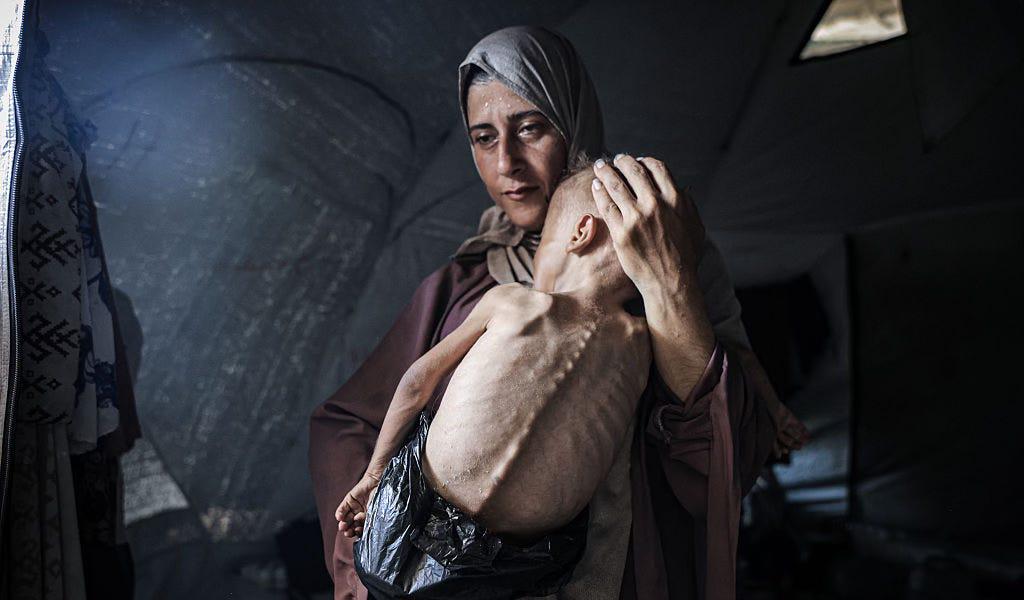
The initial story, titled “Gazans Are Dying of Starvation,” quickly rocketed around the internet when it was published on July 24. It was featured on the front page of the paper the following day, with a photo of a sick child being cradled in his mother’s arms.
The gist of the article is a now-familiar one: Israel is immiserating Gazans, leading to famine-like conditions in Gaza. The Gaza Ministry of Health, which is controlled by Hamas and has lied repeatedly throughout the war, is used as a key source in the story. But the most memorable detail, far and away, was that picture.
READ
When the Misinformation Comes From Inside the House
The story’s reach was tremendous. It was posted to X by former president Barack Obama, who said that it “underscore[s] the immediate need for action to be taken to prevent the travesty of innocent people dying of preventable starvation.”
“This is a horror and Israel is to blame,” wrote former senator Al Franken of Minnesota. “There needs to be a ceasefire and Gaza flooded with food and water.”
Rep. Lloyd Doggett, a Texas Democrat, said the story showed “the children who are paying the price for [Benjamin] Netanyahu’s war by starvation in Gaza, just as the families of Israeli hostages are paying the price for his abandonment of their loved ones.”
Then the story began to unravel. The New York Times had not reported crucial information about one of its key subjects. It cropped photos in such a way that pushed a deceptive narrative.
We’ll start with the central character of this very sad tale: Muhammad Zakariya Ayyoub al-Matouq. He’s the sick young boy who was photographed, and who Matti Friedman wrote about earlier this week. The Times, in its viral version of the story from last week, reported that his mother said that 18 months ago he “was born a healthy child,” not long after Hamas’s October 7, 2023 attack on Israel triggered the current war.
His mother’s claim has since been removed from the piece, without noting that an earlier version of the story misled readers about the child’s true condition. The story now reads: “Muhammad, according to this doctor, had pre-existing health problems affecting his brain and muscle development.” It goes into no further detail about those problems. Nor does the note appended at the end of the story.
Notification about the amendments to the article appeared via the Times’s PR division’s X account, rather than via the Times’s main channels. Then the Times buried the editors’ note at the bottom of the article in question, instead of placing it, as is more usual, at the top.
We’ve seen this play out since the beginning of the war, particularly at the Times. The paper misreports something, the story flies around the world, and a few days later there’s a correction or editors’ note that few will ever see.
What’s more: A cursory search of the article’s archival history reveals that the first published iteration of this story included no mention of Muhammad at all. Only five hours after first publication was his story, and his mother’s testimony, added, which adds to the complexity of—and raises questions about—how the paper got this story so wrong. Did the paper have Muhammad’s story, and there were questions about whether it was appropriate to include it?
What has happened to this child and his family is tragic. Hamas has immiserated some two million Gazans for more than a decade; we should not lose sight of the terror group’s ultimate culpability for the tragic situation in the Gaza Strip—both before October 7 and by starting this terrible war that has seen widespread destruction across the strip.
But insisting his malnourished frame is emblematic of what is happening to the children of Gaza is dishonest. Photos of young Muhammad being cradled in his mother’s arms are everywhere, from the front page of The New York Times to CNN to just about every British publication.
However, according to journalist David Collier, Muhammad is a child suffering from cerebral palsy, a devastating disease under the best of circumstances, and may have other genetic disorders as well. Those illnesses have nothing to do with the Israeli counteroffensive against Hamas. And his older brother, conveniently cropped out of these photos, appears healthy—and is left out of the Times report.
There is a growing hunger problem in Gaza. Americans and Israelis should be aware of this fact. There are important questions to answer about aid delivery, and what Israel, the UN, and other organizations can do to minimize the suffering.
It’s those high stakes that make the sloppy journalism that’s become so common in this conflict so inexcusable—especially when the mistakes are always going in one direction.
We’ve seen this play out since the beginning of the war, particularly at the Times. The paper misreports something, the story flies around the world, and a few days later there’s a correction or editors’ note that few will ever see. And it’s not just the Times. A similar situation occurred this week, when the United Nations, Al Jazeera, and the Canadian national broadcaster CBC widely circulated images of 5-year-old Osama al-Rakab, purporting to show him in a malnourished state. However, an Israeli government entity revealed that Osama suffered from cystic fibrosis and was evacuated to Italy for treatment.
It appears that the deliberate campaign to use children with genetic disorders as tools of propaganda is working. As a result, we have a widespread and wildly inaccurate belief that’s become commonplace, that Israel is committing a genocide in Gaza, wantonly murdering children, and starving the people who live there.
READ
Matti Friedman: Is Gaza Starving? Searching for the Truth in an Information War.
The photo of Muhammad on the front of The New York Times was seen by millions of people. As was the one of Osama al-Rakab. Presented as they were, they drew readers further away from the truth. They were, in effect, atrocity propaganda.
The Times should respect its readers by bringing them news that reflects complicated reality, not propaganda. And the most fundamental fact of all is that anyone who wants this war to end must insist that Hamas return the 50 hostages that still remain in its captivity.
The Times should treat its readers better than this. But after 21 months of its reporters taking its cues from Hamas’s public relations operations, we should not expect that they will anytime soon.
ITrCool on
I’d love to see multiple publications and independent networks begin to scrutinize and discredit the NYT regularly. Like every day. Start publishing hit pieces on its editors, reporters, and chief editor. Introduce inside folks to pose as employees, taking jobs there, then providing information from the inside as to its operations and methods to create news, letting that out to the world. Editors demanding details be omitted or changed, details being ignored, custom narratives being created, pictures being intentionally cropped due to inconvenience to said narratives, etc.
The NYT has sunk to tabloid status and has wholly abandoned its duty to the truth. They need to be bankrupted and closed up entirely. They’ve sunk to new lows with this false narrative about a starving people. It’s akin to claiming the Holocaust didn’t happen or that it happened but not as people claim it did and changing the facts around it to match a custom-tailored narrative instead, in defense of Nazi Germany.

2 Comments
On Tuesday evening, The New York Times quietly added an editors’ note amending their front-page story on hunger in Gaza from last week. The note and what it admits—about the story, the paper, and how this war has been covered by the media—deserves a lot more attention than it’s received, as does the actual state of hunger in Gaza.
The initial story, titled “Gazans Are Dying of Starvation,” quickly rocketed around the internet when it was published on July 24. It was featured on the front page of the paper the following day, with a photo of a sick child being cradled in his mother’s arms.
The gist of the article is a now-familiar one: Israel is immiserating Gazans, leading to famine-like conditions in Gaza. The Gaza Ministry of Health, which is controlled by Hamas and has lied repeatedly throughout the war, is used as a key source in the story. But the most memorable detail, far and away, was that picture.
READ
When the Misinformation Comes From Inside the House
The story’s reach was tremendous. It was posted to X by former president Barack Obama, who said that it “underscore[s] the immediate need for action to be taken to prevent the travesty of innocent people dying of preventable starvation.”
“This is a horror and Israel is to blame,” wrote former senator Al Franken of Minnesota. “There needs to be a ceasefire and Gaza flooded with food and water.”
Rep. Lloyd Doggett, a Texas Democrat, said the story showed “the children who are paying the price for [Benjamin] Netanyahu’s war by starvation in Gaza, just as the families of Israeli hostages are paying the price for his abandonment of their loved ones.”
Then the story began to unravel. The New York Times had not reported crucial information about one of its key subjects. It cropped photos in such a way that pushed a deceptive narrative.
We’ll start with the central character of this very sad tale: Muhammad Zakariya Ayyoub al-Matouq. He’s the sick young boy who was photographed, and who Matti Friedman wrote about earlier this week. The Times, in its viral version of the story from last week, reported that his mother said that 18 months ago he “was born a healthy child,” not long after Hamas’s October 7, 2023 attack on Israel triggered the current war.
His mother’s claim has since been removed from the piece, without noting that an earlier version of the story misled readers about the child’s true condition. The story now reads: “Muhammad, according to this doctor, had pre-existing health problems affecting his brain and muscle development.” It goes into no further detail about those problems. Nor does the note appended at the end of the story.
Notification about the amendments to the article appeared via the Times’s PR division’s X account, rather than via the Times’s main channels. Then the Times buried the editors’ note at the bottom of the article in question, instead of placing it, as is more usual, at the top.
We’ve seen this play out since the beginning of the war, particularly at the Times. The paper misreports something, the story flies around the world, and a few days later there’s a correction or editors’ note that few will ever see.
What’s more: A cursory search of the article’s archival history reveals that the first published iteration of this story included no mention of Muhammad at all. Only five hours after first publication was his story, and his mother’s testimony, added, which adds to the complexity of—and raises questions about—how the paper got this story so wrong. Did the paper have Muhammad’s story, and there were questions about whether it was appropriate to include it?
What has happened to this child and his family is tragic. Hamas has immiserated some two million Gazans for more than a decade; we should not lose sight of the terror group’s ultimate culpability for the tragic situation in the Gaza Strip—both before October 7 and by starting this terrible war that has seen widespread destruction across the strip.
But insisting his malnourished frame is emblematic of what is happening to the children of Gaza is dishonest. Photos of young Muhammad being cradled in his mother’s arms are everywhere, from the front page of The New York Times to CNN to just about every British publication.
However, according to journalist David Collier, Muhammad is a child suffering from cerebral palsy, a devastating disease under the best of circumstances, and may have other genetic disorders as well. Those illnesses have nothing to do with the Israeli counteroffensive against Hamas. And his older brother, conveniently cropped out of these photos, appears healthy—and is left out of the Times report.
There is a growing hunger problem in Gaza. Americans and Israelis should be aware of this fact. There are important questions to answer about aid delivery, and what Israel, the UN, and other organizations can do to minimize the suffering.
It’s those high stakes that make the sloppy journalism that’s become so common in this conflict so inexcusable—especially when the mistakes are always going in one direction.
We’ve seen this play out since the beginning of the war, particularly at the Times. The paper misreports something, the story flies around the world, and a few days later there’s a correction or editors’ note that few will ever see. And it’s not just the Times. A similar situation occurred this week, when the United Nations, Al Jazeera, and the Canadian national broadcaster CBC widely circulated images of 5-year-old Osama al-Rakab, purporting to show him in a malnourished state. However, an Israeli government entity revealed that Osama suffered from cystic fibrosis and was evacuated to Italy for treatment.
It appears that the deliberate campaign to use children with genetic disorders as tools of propaganda is working. As a result, we have a widespread and wildly inaccurate belief that’s become commonplace, that Israel is committing a genocide in Gaza, wantonly murdering children, and starving the people who live there.
READ
Matti Friedman: Is Gaza Starving? Searching for the Truth in an Information War.
The photo of Muhammad on the front of The New York Times was seen by millions of people. As was the one of Osama al-Rakab. Presented as they were, they drew readers further away from the truth. They were, in effect, atrocity propaganda.
The Times should respect its readers by bringing them news that reflects complicated reality, not propaganda. And the most fundamental fact of all is that anyone who wants this war to end must insist that Hamas return the 50 hostages that still remain in its captivity.
The Times should treat its readers better than this. But after 21 months of its reporters taking its cues from Hamas’s public relations operations, we should not expect that they will anytime soon.
I’d love to see multiple publications and independent networks begin to scrutinize and discredit the NYT regularly. Like every day. Start publishing hit pieces on its editors, reporters, and chief editor. Introduce inside folks to pose as employees, taking jobs there, then providing information from the inside as to its operations and methods to create news, letting that out to the world. Editors demanding details be omitted or changed, details being ignored, custom narratives being created, pictures being intentionally cropped due to inconvenience to said narratives, etc.
The NYT has sunk to tabloid status and has wholly abandoned its duty to the truth. They need to be bankrupted and closed up entirely. They’ve sunk to new lows with this false narrative about a starving people. It’s akin to claiming the Holocaust didn’t happen or that it happened but not as people claim it did and changing the facts around it to match a custom-tailored narrative instead, in defense of Nazi Germany.
Can’t have Hamas look bad, right?