
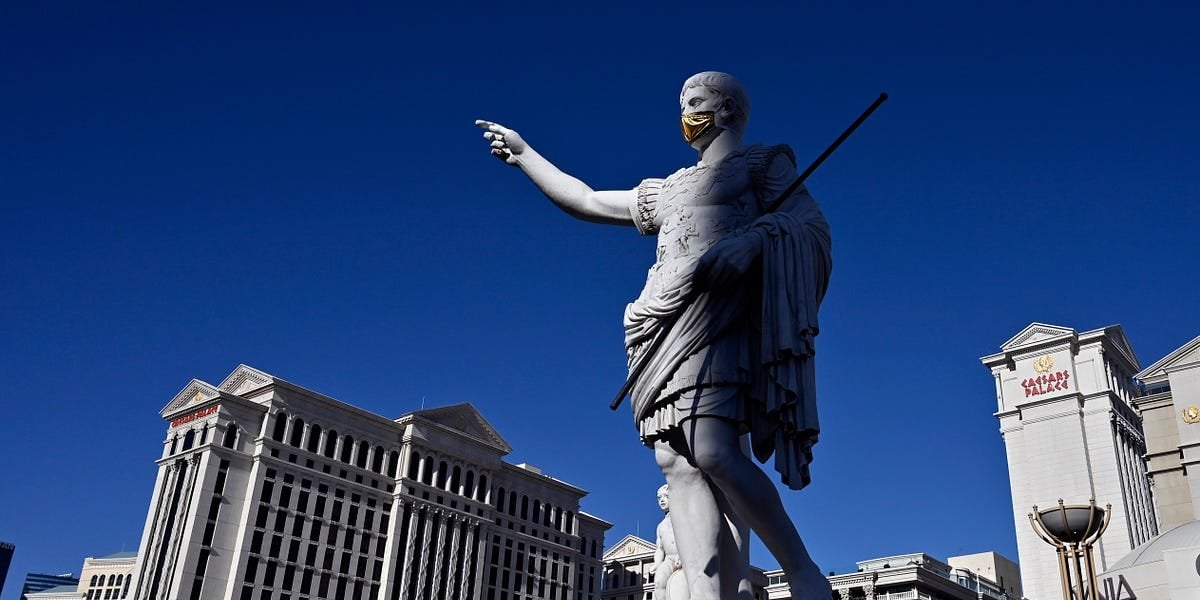
The Americans Who Long for Caesar: The new right views strongman rule as the medicine for our times. Here’s why they’re wrong.
Posted by PersuasionCommunity
The Americans Who Long for Caesar: The new right views strongman rule as the medicine for our times. Here’s why they’re wrong.
Posted by PersuasionCommunity
1 Comment
Right-wing intellectuals such as Charles Haywood and Curtis Yarvin are looking to Caesar and Augustus as inspirations for the ailing state of polarization and gridlock in American politics. Whilst one could argue that little attention should be paid to ivory tower cranks, this line of thinking has influenced many powerful figures such Blake Masters, Peter Thiel, J.D. Vance, and other darlings of the so-called “new right.” As a result, it would be wrong to ignore the recent resurgence of Caesarist thought in the Western world.
However, whilst the arguments in favor of Caesarism could be compelling due to the current bleakness of American politics, Jeffery Tyler Syck still thinks this form of thinking is highly misguided even from a historical position.
1. The “reforms” of strongmen quite often plunge the state into total chaos. Under Julius Caesar’s rule, the Roman Republic was split by near constant civil war and the upheaval of continuous attempts to overthrow the tyrant. His expansion of the empire stretched the Roman bureaucracy almost to breaking point.
2. Even if we take the accomplishments of Caesar’s successor, Augustus into consideration, the Roman historian Tacitus made it clear that Augustus did not meaningfully improve a crumbling Roman society—he simply painted over the cracks.
3. Many people today on the political extremes believe that virtue must be enforced by the state. But the very[ opposite](https://lawliberty.org/recovering-virtue-means-recovering-self-government/) is true. Virtue requires a transformation of the human soul that cannot be imposed from without, but must be developed through reflection and free choice. Imposing virtue may force people to behave well—they may *pretend* to believe something in order to please a higher authority—but in the end, it does not cause the internal shift that defines virtue. The result is that the moment the force that is imposing virtue is removed, people descend to become the very worst sort of citizens, since they have no inbuilt mechanism to behave better.
4. The situation is not quite as dire as the Caesarists would have us believe. If anything, their ability to widely disseminate their arguments proves the establishment does not, as the Caesarists claim, tyrannically control every lever of power. There are out of touch elites, but they effect is largely benign and incompetent.
!ping HISTORY&DEMOCRACY&EXTREMISM