
On Friday, August 1, Donald Trump fired Erika McEntarfer, the head of the Bureau of Labor Statistics (BLS). The firing was predicated by a BLS report that employment in the US has not been as strong as previously thought.
The news of McEntarfer’s firing set off a cascade of concern among economists, public policy researchers, and others who rely on official data from the government to understand the current state of the nation—the state of the economy, the state of our population, the state of our health, and so on.
The BLS is an office within the Department of Labor that produces official economic statistics, including the current rate of unemployment and the consumer price index (CPI). The Fed uses BLS employment statistics as it considers whether to raise or lower interest rates. The CPI is used by the Social Security Administration to set cost-of-living adjustments, or COLAs. Public trust in the numbers reported by the BLS is paramount to trust in the US economy and US economic and welfare policy. Firing the head of the BLS just because of a bad report erodes trust in future data releases.1
The firing of the BLS Commissioner is perhaps the sharpest indication that the Trump Administration is considering interfering with the US statistical offices and US information policy, but it is not the only—or the first.
1The new Acting Commissioner of the BLS is William Wiatrowski, who has served in the role previously and is widely respected. The concern is not so much with him and his replacement and the top-down pressure that might come from the White House in future reports.
—
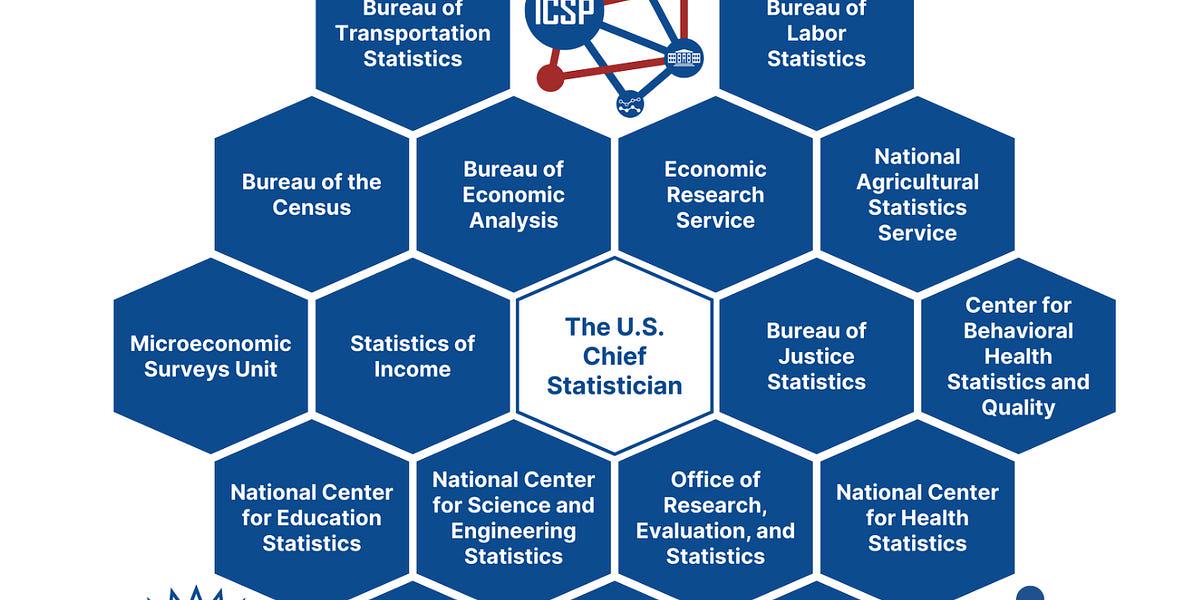
The BLS one of a number of data and statistical offices across the US government that are collectively known as the Federal Statistical System. The offices are represented centrally by the Interagency Council on Statistical Policy, whose members include the heads of the statistical offices. The Council is chaired by the Chief Statistician of the United States, who is part of the Office of Management and Budget (OMB).
For the most part, the high-ranking statisticians and data officers in the federal government are well-respected researchers and policy professionals. Most of them have “risen through the ranks” of the federal government and have worked across multiple agencies and administrations. They and those they manage are expected to be data-driven and party-neutral*. They are the epitome of the type of government employee that, when in a tense policy or political discussion, squints their eyes, pushes up their glasses, and interrupts the conversation with a “well ackshually” to ensure that everyone present is aware of the facts.
If a hyperpartisan presidential administration were to corrupt the U.S. statistical offices, that would be super bad news. These offices are “how we know what we know” about the United States. They underlie all fact-based conversations about US policy. Without these offices, fact-based policy will be more of a mirage than it already is.
Wikipedia list of Principal Statistical Agencies
—
Under Trump 2.0, OMB is headed by the infamous Russ Vought, a primary architect of Project 2025. (Vought is a perennial bogeyman. I’ve previously written about his efforts to restrict congressionally appropriated funding.) Vought has also led DOGE since Elon tucked tail and ran back to Tesla.
Vought recently surprised the statistics community by naming a new Chief Statistician1: Mark Calabria, who formerly worked for VP Pence and the Cato Institute.
The replacement of the former Chief Statistician, who had only served for a few years, was almost as odd as the dismissal of the BLS Commissioner, although it received much less hullabaloo in the press. Politico reported:
1Interestingly, as of today, the official website of the Federal Statistical System (statspolicy.gov) has not updated the name of the US Chief Statistician. It has updated the name of the head of BLS, even though that firing was much more recent.
—
Trump is continuing to threaten to mess with the US Census, the cornerstone of US statistical information.
The US Census is the decennial count of “persons in each state"2 that determines the number of congressional districts in each state. The Census Bureau also provides other critical information on the demographics and economy of the US. This data is then used by planning agencies across state and local governments as well as by industry. It would be difficult to underestimate how important the US Census is. Without the census, we would be almost completely blind to reality when it comes to policy and planning.
Trump’s big issue is that he doesn’t want the US Census to count undocumented people living in the United States, a change of protocol that goes all the way back to the first census in 17902. This has been a perennial bugaboo for Trump: in his first term, he tried to add a question on citizenship to the 2020 Census survey but was defeated at the Supreme Court. (The ruling was against the justification for the question, not the question itself.)
1The Fourteenth Amendment outlines the requirements of the Census and specifies “persons in each state”, not “citizens in each state”.
2Which did not ask about citizenship and thus had no way of counting citizens vs. non-citizens.
—
The Department of Defense has a new Chief Digital and Artificial Intelligence Officer: Doug Matty. (In this position, Matty also represents the DOD on the Interagency Council on Statistical Policy.) He has an extensive background in military technology and appears eminently qualified for the position.
This position was created relatively recently yet has had a few different office holders. The previous one left for IBM. So it’s not all that strange that the Trump admin would need to place someone new.
Nonetheless, it is notable that one of this Trump admin recruit’s first moves was granting unprecedented access to AI companies, including Musk’s Grok.
—
The National Center for Education Statistics (NCES) has been left with a meager staff after the major Department of Education layoffs earlier this year. The entire Department is set for closure (by executive order), with any congressionally mandated programs moved to other agencies.
NCES produces reports like the “Condition of Education” which “compiles a set of ‘indicators’ of the condition of education in the United States at all levels, from prekindergarten through postsecondary, as well as labor force outcomes and international comparisons.” Former staff believe that the severe staffing shortages will impact the delivery of future NCES reports, including the upcoming 2025 release of the “Nation’s Report Card”.
Many functions of NCES are mandated by law, so it is unclear what the Trump administration proposes to do with the office once the Department is closed.
—
Assaults on information are taking place across the federal government, not just at the statistical agencies. NASA will no longer publish a report on climate change on its website and is considering ending satellite missions that measure atmospheric carbon. The Environmental Protection Agency is getting rid of its research and development office. The Smithsonian National Museum of American History has made changes to a display on Trump’s impeachments. The Trump admin has put pressure on the Smithsonian to present a more positive view of American history. Funding for research into extraordinarily promising mRNA medical technology has been canceled. Political appointees must now review all federal grants.
In short, the administration is looking to exert control over information across all government sectors. This will have severe impacts on what the general public learns, especially in areas where the federal government has been a traditional steward and promoter of information dissemination, like in economics and the sciences.
—
Historically, authoritarian and corrupt regimes have deeply understood the importance of control over the release of national statistics1.
As Prime Minister, Mussolini oversaw the founding of a new statistical agency in Italy, one that exemplified the fascist interest in demography and that would give his government more centralized control over the statistical research2.
Part of Stalin’s “Great Purge” was imprisoning and executing the statisticians who led the 1937 Soviet census. A new census was ordered, the results of which were highly manipulated.
The Argentinian government under Cristina Fernández was notorious for corruption and “cooking the books”. Argentina entered an inflationary crisis stemming from poor government policies, during which the government reported false measures of inflation in an attempt to assuage the public. The head of the national statistics institute was forced out for refusing to go along with the plan. Argentines continue to deal with the economic fallout.
1 This intriguing paper uses satellite measurement of nighttime lighting as a correlate for GDP, and estimates that the GDP of authoritarian regimes is artificially inflated by ~15-30%.
2First led by Corrado Gini, of the “Gini Index”, a common measure of income inequality.
Posted by hypsignathus
1 Comment
Whoops the Politico reporting that’s supposed to be in there in the section on Mark Calabria is this quote:
“This is like nothing we’ve seen before to this degree,” said PAUL SCHROEDER, executive director of the Council of Professional Associations on Federal Statistics, a nonpartisan group that advocates for the federal statistical system on behalf of professional organizations and industry. U.S. government data is widely respected as nonpartisan and high-caliber.
“The autonomy and independence by which the system operates, as well as the decentralized nature of their processes, is all meant to build trust with the American public and the business communities and those who rely on these data,” Schroeder added. “These actions undermine that trust.”