
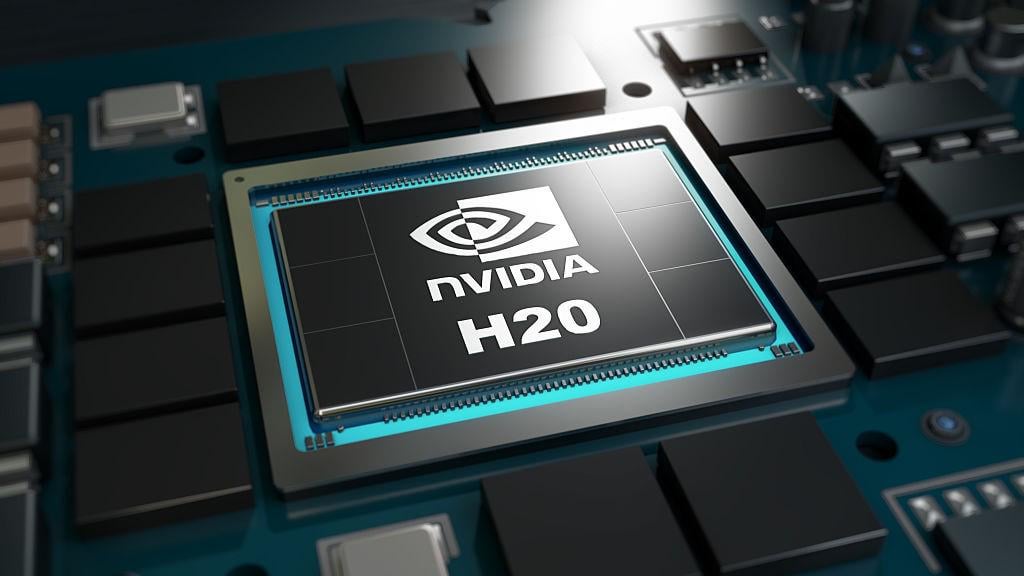
Beijing has urged local companies to avoid using Nvidia Corp.’s H20 processors, particularly for government-related purposes, complicating the chipmaker’s attempts to recoup billions in lost China revenue after the Trump administration reversed an effective US ban on such sales.
Over the past few weeks, Chinese authorities have sent notices to a range of firms discouraging use of the less-advanced semiconductors, people familiar with the matter said, asking not to be named discussing sensitive information. The guidance was particularly strong against the use of H20s for any government or national security-related work by state enterprises or private companies, the people said.
The letters did not, however, constitute an outright ban on H20 use, according to the people. Industry analysts broadly agree that Chinese companies still covet those chips, which perform quite well in certain crucial AI applications. President Donald Trump said Monday that the processor — which he called “obsolete” — “still has a market” in the Asian country.
Nvidia and Advanced Micro Devices Inc. both recently secured Washington’s approval to resume lower-end AI chip sales to China, on the controversial and legally questionable condition that they give the US government a 15% cut of the related revenue. But even with Trump’s team on board, the two companies face the challenge that their Chinese customers are under Beijing’s pressure to purchase domestic chips instead. Beijing’s overall push affects AI accelerators from AMD in addition to Nvidia, one of the people said, though it’s unclear whether any letters specifically mentioned AMD’s MI308 chip.
Beijing’s stance could limit Trump’s ability to turn his export control about-face into a windfall for government coffers, a deal that highlighted his administration’s transactional approach to national security policies long treated as non-negotiable. Still, Chinese companies may not be ready to jump ship to local semiconductors. “Chips from domestic manufacturers are improving dramatically in quality, but they might not be as versatile for specific workloads that China’s domestic AI industry hopes to focus on,” said Homin Lee, a senior macro strategist at Lombard Odier in Singapore. Lee added that he anticipates “strong” demand for the chips the Trump administration is allowing Nvidia and AMD to sell.
Right now, the people said, China’s most stringent chip guidance is limited to sensitive applications, a situation that bears similarities to the way Beijing restricted Tesla Inc. vehicles and Apple Inc. iPhones in certain institutions and locations over security concerns. China’s government also at one point barred the use of Micron Technology Inc. chips in critical infrastructure.
The Chinese government’s posture raises questions about the Trump administration’s explanation for why the US is allowing those exports mere months after effectively banning such sales. Multiple senior US officials have said their policy reversal was the result of trade talks with China, but Beijing has publicly indicated that the resumed H20 shipments were not part of any bilateral deal. China’s recent notices to companies suggest that the Asian country may not have sought such a concession from Washington in the first place.
Posted by John3262005
2 Comments
lol
The rumor has been in the air for a while and it’s a signal the Chinese government believes the huawei cluster is a good enough replacement for inference. The goal is to give huawei more money to invest in designing and deploying chips that are useful for training since that’s the current bottleneck in China at the moment.