Since 2012, the government has been led by a conservative political party named Georgian Dream, or G.D. Founded by a shadowy billionaire, Georgian Dream assumed many of the same accouterments of the new right-wing formations popping up in Europe at the time: an aspirational name; a gauzy appeal to nationalism and traditional values; nostalgia joined to slick modern messaging and optics heavy on oversize, undulating flags. The party put cosmopolitans at ease by declaring that it strongly supported the country’s pending application for E.U. membership while also averring that the nation’s future lay squarely in the West.
But little by little, things appeared to shift: Georgian Dream officials talked of recognizing the Orthodox Church as the state religion and backed away from the party’s earlier support of progressive causes like L.G.B.T.Q. rights, neatly mirroring the same trends in Vladimir Putin’s Russia.
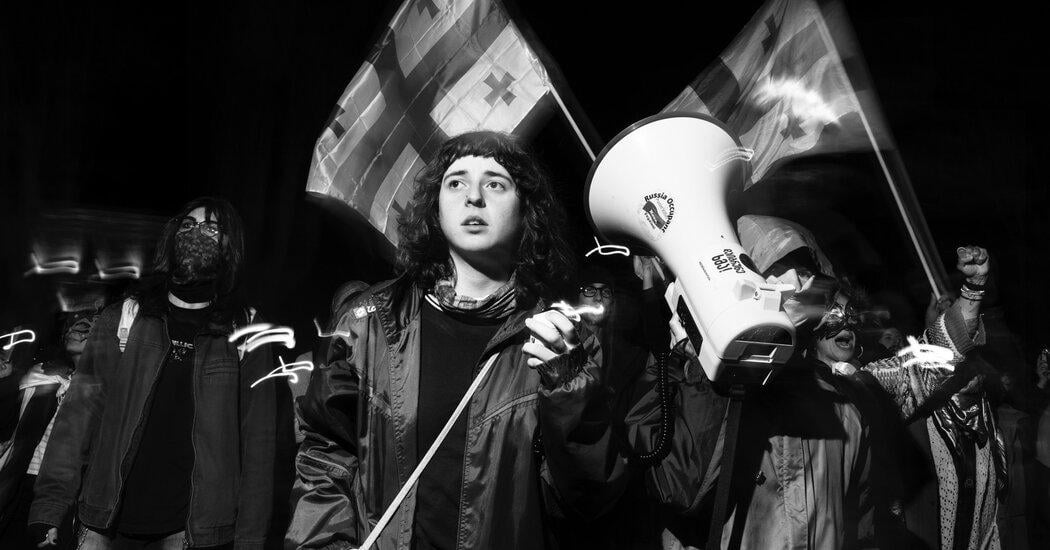
What had been a trickle became a torrent. In early 2023, the Georgian Dream-controlled Parliament proposed a law requiring nongovernmental groups and media outlets that received more than 20 percent of their funding from foreign sources to register as foreign agents. Known as “the Russian law,” because it was largely similar to a 2012 decree that Putin used to eviscerate his domestic opposition, it provoked such ferocious opposition, with tens of thousands of protesters taking to the streets, that the proposal was shelved — at least for a time. In national elections the following year, Georgian Dream was returned to power despite exit polls showing it was headed for a resounding defeat and reports of significant and systemic fraud.
[…]
In carrying all this out, the party has also been greatly assisted by two critical developments beyond Georgia’s borders. As counterintuitive as it might seem, the Russian invasion of Ukraine in 2022 helped propel Georgia back into the clutches of its historical nemesis. More recently, the return to the American presidency of Donald Trump has hastened the process. In observing the avalanche of foreign-policy changes adversely affecting Georgia initiated by the Trump administration this spring, one veteran protester told me: “Before I believed we might still be able to change things back. Now I think we’re finished.”
!ping Democracy&Europe
Mental-Algae-4785 on
Makes me sad that Lasha, the greatest weightlifter ever, backs this

2 Comments
Archived version: [https://archive.fo/qZ2g6](https://archive.fo/qZ2g6).
Since 2012, the government has been led by a conservative political party named Georgian Dream, or G.D. Founded by a shadowy billionaire, Georgian Dream assumed many of the same accouterments of the new right-wing formations popping up in Europe at the time: an aspirational name; a gauzy appeal to nationalism and traditional values; nostalgia joined to slick modern messaging and optics heavy on oversize, undulating flags. The party put cosmopolitans at ease by declaring that it strongly supported the country’s pending application for E.U. membership while also averring that the nation’s future lay squarely in the West.
But little by little, things appeared to shift: Georgian Dream officials talked of recognizing the Orthodox Church as the state religion and backed away from the party’s earlier support of progressive causes like L.G.B.T.Q. rights, neatly mirroring the same trends in Vladimir Putin’s Russia.
What had been a trickle became a torrent. In early 2023, the Georgian Dream-controlled Parliament proposed a law requiring nongovernmental groups and media outlets that received more than 20 percent of their funding from foreign sources to register as foreign agents. Known as “the Russian law,” because it was largely similar to a 2012 decree that Putin used to eviscerate his domestic opposition, it provoked such ferocious opposition, with tens of thousands of protesters taking to the streets, that the proposal was shelved — at least for a time. In national elections the following year, Georgian Dream was returned to power despite exit polls showing it was headed for a resounding defeat and reports of significant and systemic fraud.
[…]
In carrying all this out, the party has also been greatly assisted by two critical developments beyond Georgia’s borders. As counterintuitive as it might seem, the Russian invasion of Ukraine in 2022 helped propel Georgia back into the clutches of its historical nemesis. More recently, the return to the American presidency of Donald Trump has hastened the process. In observing the avalanche of foreign-policy changes adversely affecting Georgia initiated by the Trump administration this spring, one veteran protester told me: “Before I believed we might still be able to change things back. Now I think we’re finished.”
!ping Democracy&Europe
Makes me sad that Lasha, the greatest weightlifter ever, backs this