The author argues that India will profit little from turning to China. He may very well be right.
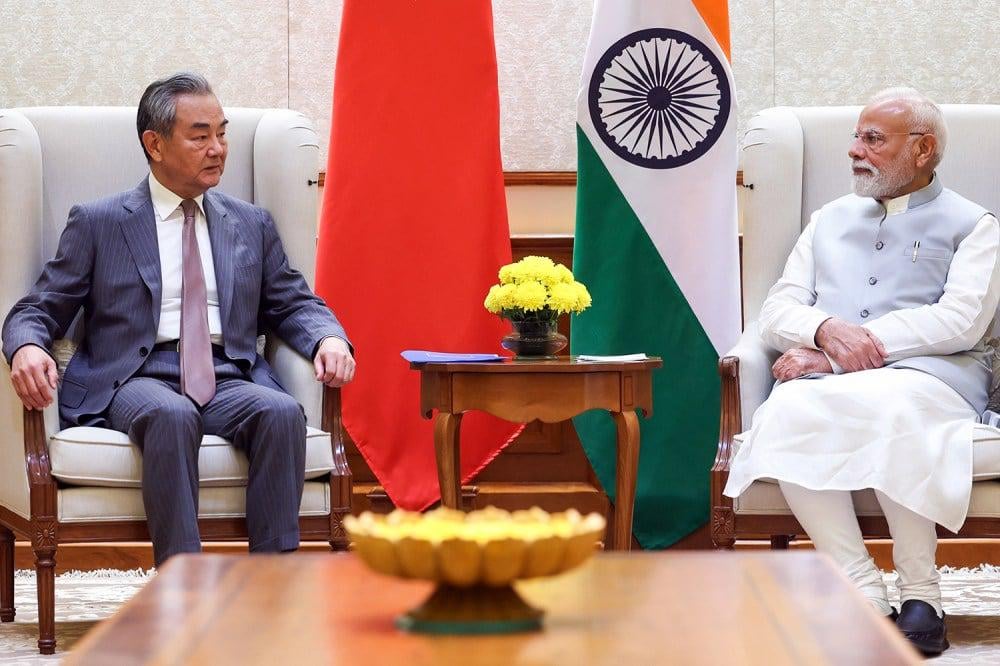
> Unfortunately, India is making a bad bet on China, and it will not end well. New Delhi is locked into an intractable rivalry with Beijing: The two states have differing visions of political order in Asia and beyond, they have a border dispute on which they have made glacial progress, and the asymmetries in their economic and military capabilities are glaring and getting worse. Under these circumstances, India would be foolish to assume that Wang’s visit can lead to genuine rapprochement with China.
> New Delhi’s frustration with Washington is understandable. The Trump administration’s choices could undermine decades of bipartisan efforts to improve and shore up U.S.-India ties. However, India’s effort to court China as a possible counterweight to the United States may turn out to be an infelicitous choice. There is no sound basis for New Delhi making common cause with Beijing, and this seeming convergence of interests is bound to be fleeting.
> India is accommodating China not because it underestimates the risks of such a posture but because it calculates that the cost of resistance without U.S. support is simply too high. This approach is as much capitulation born of military and technological weakness after 11 years of Modi’s rule as it is realpolitik under duress. India hopes to manage Chinese coercion just short of humiliation while waiting out a U.S. election cycle that might restore equilibrium.
> From India’s perspective, strategic autonomy now means choosing which dependency hurts less. Navigating between the two superpowers while preserving sovereign space depended on both China and the United States seeing value in restraint. A lopsided relationship with China at least comes with predictable red lines. India must respect China’s core interests—Tibet, Taiwan, and disputes in the South China Sea—and the two sides can pretend as if bilateral ties are normal. With China, accommodation earns stability.
> The United States under Trump offers no comparable certainty; deference earns nothing, while defiance invites penalty. India is not conceding because it trusts China. It is conceding because it no longer trusts the United States to assume part of the burden of resistance in the Indo-Pacific.

1 Comment
The author argues that India will profit little from turning to China. He may very well be right.
> Unfortunately, India is making a bad bet on China, and it will not end well. New Delhi is locked into an intractable rivalry with Beijing: The two states have differing visions of political order in Asia and beyond, they have a border dispute on which they have made glacial progress, and the asymmetries in their economic and military capabilities are glaring and getting worse. Under these circumstances, India would be foolish to assume that Wang’s visit can lead to genuine rapprochement with China.
> New Delhi’s frustration with Washington is understandable. The Trump administration’s choices could undermine decades of bipartisan efforts to improve and shore up U.S.-India ties. However, India’s effort to court China as a possible counterweight to the United States may turn out to be an infelicitous choice. There is no sound basis for New Delhi making common cause with Beijing, and this seeming convergence of interests is bound to be fleeting.
However, he might want to consider [another piece from the same journal](https://foreignpolicy.com/2025/07/28/india-china-normalization-trump-second-term-geopolitics/), which argues that India is simply looking to limit its losses.
> India is accommodating China not because it underestimates the risks of such a posture but because it calculates that the cost of resistance without U.S. support is simply too high. This approach is as much capitulation born of military and technological weakness after 11 years of Modi’s rule as it is realpolitik under duress. India hopes to manage Chinese coercion just short of humiliation while waiting out a U.S. election cycle that might restore equilibrium.
> From India’s perspective, strategic autonomy now means choosing which dependency hurts less. Navigating between the two superpowers while preserving sovereign space depended on both China and the United States seeing value in restraint. A lopsided relationship with China at least comes with predictable red lines. India must respect China’s core interests—Tibet, Taiwan, and disputes in the South China Sea—and the two sides can pretend as if bilateral ties are normal. With China, accommodation earns stability.
> The United States under Trump offers no comparable certainty; deference earns nothing, while defiance invites penalty. India is not conceding because it trusts China. It is conceding because it no longer trusts the United States to assume part of the burden of resistance in the Indo-Pacific.