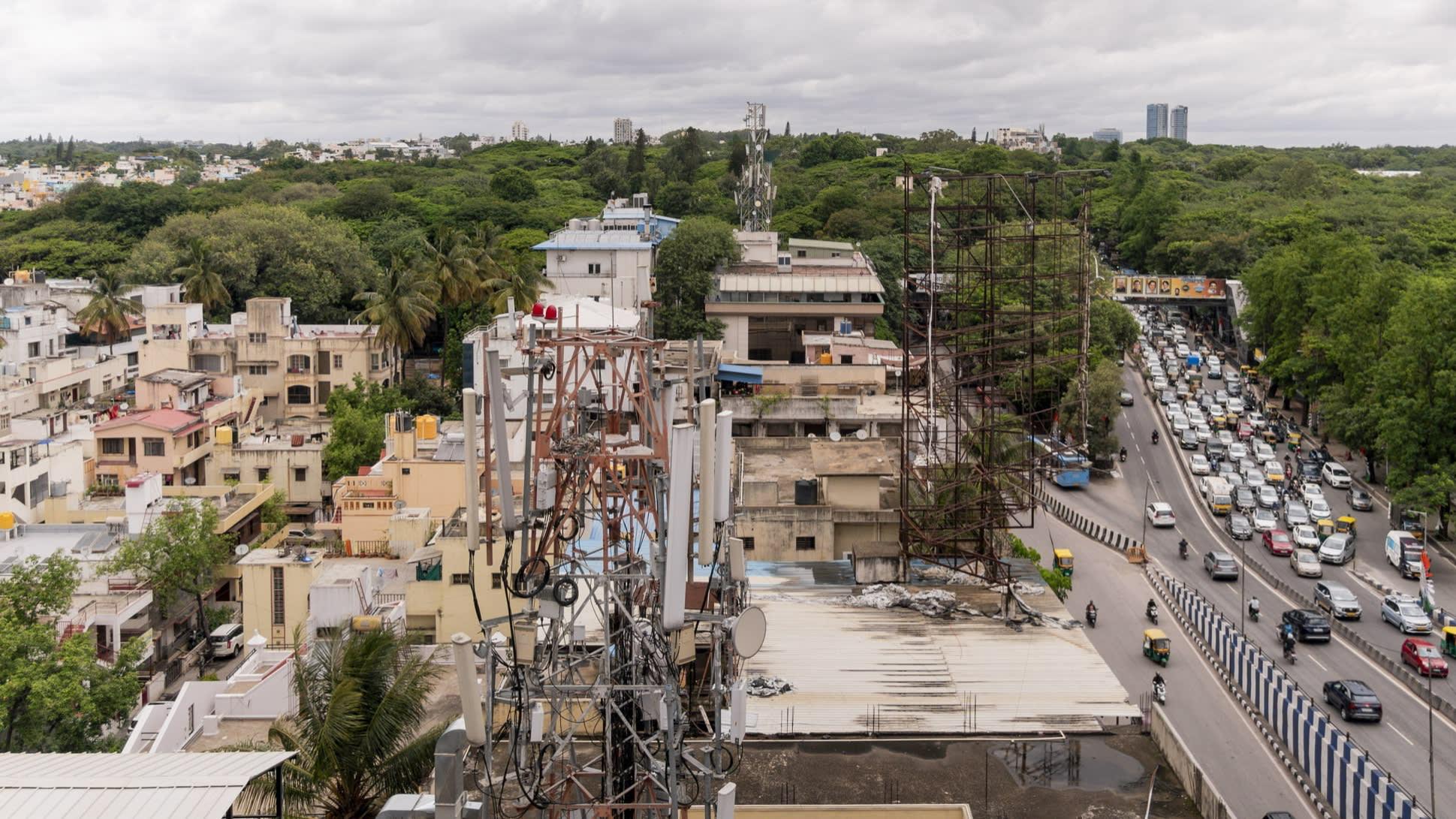
> In parts of Bengaluru, the southern India city and tech hub, you could be mistaken for believing you were in Palo Alto. The campuses for tech behemoths like Google and Microsoft, or Wall Street majors including Goldman Sachs or Morgan Stanley, feature multi-cuisine canteens, crèches and gyms much like their counterparts in New York or San Francisco. But any confusion about geography would dissipate on the typical weekday commute, when it can take almost four hours to drive along the nine-mile stretch of road where some of the world’s largest multinationals have their offices. And unlike in Silicon Valley, these swanky world-class offices lack access to piped water. While most of these campuses have built water conservation units, they have to rely on a network of truck-mounted water tankers every day to fulfil the needs of the area’s million or so employees.
> The overburdened Outer Ring Road business district is part of the wider upending of Bengaluru, formerly and still widely known as Bangalore, from a serene “pensioner’s paradise” with its mild climate to a concreted and congested megacity. After welcoming a wave of tech industry investment, the metropolis has become one of the starkest illustrations of India’s struggles to build the infrastructure that will be needed to keep its economy growing at a brisk rate. “This staggering growth was not foreseen,” says Manas Das, president of the Outer Ring Road Companies Association, which represents about 500 companies such as Adobe, Boeing and Intel, with offices in Bengaluru.
Das’s organisation has not only had to help some of the world’s largest corporations source water, but also lobby the city’s authorities to get to work belatedly to widen the roads and even convince them to extend a long-delayed metro line to the district. “Once you enter into the tech parks you will see a different world,” says Das. “The question is getting in and getting out of here.”
> The issues facing Bengaluru are true of the larger malaise of India’s unplanned cities at a time when the government is betting heavily on continued expansion in its tech sector. With manufacturing still lagging behind, India needs services, especially the almost $300bn tech industry, to bear the heavy load for its growing economy. The country’s abundant cheap tech talent is attracting more multinationals to open what are called Global Capability Centres, making those pressures acute. These centres employ hundreds of thousands of Indians to support various back-office and digital functions, becoming a new and crucial growth engine for the world’s fastest growing major economy as the global race in artificial intelligence heats up. Of the more than 1,800 GCCs in the country, Bengaluru is already home to around one-third of them. Between 2005 and 2023, India’s services exports grew six times from $53bn to $338bn and its share in global exports rose from around 2 per cent to over 4.5 per cent, while the share of merchandise exports remained below 2 per cent, according to Goldman.
> But with tech services accounting for nearly half of service exports, and Bengaluru at its fulcrum, Goldman warned that the “resilient growth” of the sector cannot be taken for granted, with gaps emerging in tech talent and lagging investment in infrastructure posing a risk across various cities. “From an environmental perspective, the growth in these sectors is putting pressure on the natural resources of cities,” it said in a report last year, stressing that “Bengaluru, which has the largest share of IT companies and GCCs in India, is facing a water crisis.” In the first half of this year, 1.7mn sq m of office space, half the size of New York’s Central Park, was bought or leased in Bengaluru, accounting for more than a third of India’s total such transactions, according to real estate consultant Knight Frank. This was more than new leases of office space in Bengaluru for the entire 2024. That build-up has choked Bengaluru. The city has become prone to annual flooding and its once benign climate is becoming noticeably hotter thanks to the reduction of its green cover and impact of climate change, with the city’s development severely lagging behind its population influx.
> Some of the city’s most prominent residents have been openly critical. Pharma billionaire Kiran Mazumdar-Shaw wrote on X last month that “the state plunders [and] kills the golden goose with no responsibility to provide basic infrastructure [and] civic amenities — building rules are flouted to make money”. Another Bengaluru tycoon sitting inside a leafy company campus sighs in exasperation when asked about the strains on the city. Pointing to the logjammed roads outside the office, he says Bengaluru’s administrators need to be placed on a “war footing” to sort it out. A real estate chief executive says Bengaluru’s authorities “can’t plan for a moving target” and suggests an “embargo on leasing” for new offices. TV Ramachandra, professor at Bengaluru’s Indian Institute of Science, questions who the unrestrained development benefits. “If we are unable to supply the water, then why are we allowing the growth?” he says. “What is the point in claiming that we are a mega growth engine and all?” Any city has to be “liveable” and people should have adequate infrastructure and basic amenities, Ramachandra adds, with Bengaluru failing at both these. “The citizens have lost the city.”
> Born in Bangalore in 1958, TV Mohandas Pai grew up in a city of fewer than 1mn people that bears little resemblance to the one that houses an estimated 14mn today. Once part of the royal kingdom of Mysore before British rule, Bangalore’s location atop a ridge in the Deccan Plateau blessed it with pleasant summers and mild winters, a contrast to the harsher extremes endured by most other Indian megacities. It was a “small town, nice town, there’s no traffic, no cars, a few buses”, the 66-year-old chair of angel investor Aarin Capital recalls, as the din of traffic builds outside his central Bengaluru office. “We used to play in the streets, go to the ground and play cricket, go to the library, cycle to college, go for long walks. Very nice life, nothing happened.” That began to change by the early 1990s, when the tech industry flocked to the city, then a sleepy military cantonment, university hub and home to a handful of state-run defence companies. Even before India’s economy shook off the socialist “Licence Raj” restrictions, Infosys, now the country’s second-largest IT services company after Tata Consultancy Services, had shifted its headquarters to the city, lured by ample space and low rents.

1 Comment
> In parts of Bengaluru, the southern India city and tech hub, you could be mistaken for believing you were in Palo Alto. The campuses for tech behemoths like Google and Microsoft, or Wall Street majors including Goldman Sachs or Morgan Stanley, feature multi-cuisine canteens, crèches and gyms much like their counterparts in New York or San Francisco. But any confusion about geography would dissipate on the typical weekday commute, when it can take almost four hours to drive along the nine-mile stretch of road where some of the world’s largest multinationals have their offices. And unlike in Silicon Valley, these swanky world-class offices lack access to piped water. While most of these campuses have built water conservation units, they have to rely on a network of truck-mounted water tankers every day to fulfil the needs of the area’s million or so employees.
> The overburdened Outer Ring Road business district is part of the wider upending of Bengaluru, formerly and still widely known as Bangalore, from a serene “pensioner’s paradise” with its mild climate to a concreted and congested megacity. After welcoming a wave of tech industry investment, the metropolis has become one of the starkest illustrations of India’s struggles to build the infrastructure that will be needed to keep its economy growing at a brisk rate. “This staggering growth was not foreseen,” says Manas Das, president of the Outer Ring Road Companies Association, which represents about 500 companies such as Adobe, Boeing and Intel, with offices in Bengaluru.
Das’s organisation has not only had to help some of the world’s largest corporations source water, but also lobby the city’s authorities to get to work belatedly to widen the roads and even convince them to extend a long-delayed metro line to the district. “Once you enter into the tech parks you will see a different world,” says Das. “The question is getting in and getting out of here.”
> The issues facing Bengaluru are true of the larger malaise of India’s unplanned cities at a time when the government is betting heavily on continued expansion in its tech sector. With manufacturing still lagging behind, India needs services, especially the almost $300bn tech industry, to bear the heavy load for its growing economy. The country’s abundant cheap tech talent is attracting more multinationals to open what are called Global Capability Centres, making those pressures acute. These centres employ hundreds of thousands of Indians to support various back-office and digital functions, becoming a new and crucial growth engine for the world’s fastest growing major economy as the global race in artificial intelligence heats up. Of the more than 1,800 GCCs in the country, Bengaluru is already home to around one-third of them. Between 2005 and 2023, India’s services exports grew six times from $53bn to $338bn and its share in global exports rose from around 2 per cent to over 4.5 per cent, while the share of merchandise exports remained below 2 per cent, according to Goldman.
> But with tech services accounting for nearly half of service exports, and Bengaluru at its fulcrum, Goldman warned that the “resilient growth” of the sector cannot be taken for granted, with gaps emerging in tech talent and lagging investment in infrastructure posing a risk across various cities. “From an environmental perspective, the growth in these sectors is putting pressure on the natural resources of cities,” it said in a report last year, stressing that “Bengaluru, which has the largest share of IT companies and GCCs in India, is facing a water crisis.” In the first half of this year, 1.7mn sq m of office space, half the size of New York’s Central Park, was bought or leased in Bengaluru, accounting for more than a third of India’s total such transactions, according to real estate consultant Knight Frank. This was more than new leases of office space in Bengaluru for the entire 2024. That build-up has choked Bengaluru. The city has become prone to annual flooding and its once benign climate is becoming noticeably hotter thanks to the reduction of its green cover and impact of climate change, with the city’s development severely lagging behind its population influx.
> Some of the city’s most prominent residents have been openly critical. Pharma billionaire Kiran Mazumdar-Shaw wrote on X last month that “the state plunders [and] kills the golden goose with no responsibility to provide basic infrastructure [and] civic amenities — building rules are flouted to make money”. Another Bengaluru tycoon sitting inside a leafy company campus sighs in exasperation when asked about the strains on the city. Pointing to the logjammed roads outside the office, he says Bengaluru’s administrators need to be placed on a “war footing” to sort it out. A real estate chief executive says Bengaluru’s authorities “can’t plan for a moving target” and suggests an “embargo on leasing” for new offices. TV Ramachandra, professor at Bengaluru’s Indian Institute of Science, questions who the unrestrained development benefits. “If we are unable to supply the water, then why are we allowing the growth?” he says. “What is the point in claiming that we are a mega growth engine and all?” Any city has to be “liveable” and people should have adequate infrastructure and basic amenities, Ramachandra adds, with Bengaluru failing at both these. “The citizens have lost the city.”
> Born in Bangalore in 1958, TV Mohandas Pai grew up in a city of fewer than 1mn people that bears little resemblance to the one that houses an estimated 14mn today. Once part of the royal kingdom of Mysore before British rule, Bangalore’s location atop a ridge in the Deccan Plateau blessed it with pleasant summers and mild winters, a contrast to the harsher extremes endured by most other Indian megacities. It was a “small town, nice town, there’s no traffic, no cars, a few buses”, the 66-year-old chair of angel investor Aarin Capital recalls, as the din of traffic builds outside his central Bengaluru office. “We used to play in the streets, go to the ground and play cricket, go to the library, cycle to college, go for long walks. Very nice life, nothing happened.” That began to change by the early 1990s, when the tech industry flocked to the city, then a sleepy military cantonment, university hub and home to a handful of state-run defence companies. Even before India’s economy shook off the socialist “Licence Raj” restrictions, Infosys, now the country’s second-largest IT services company after Tata Consultancy Services, had shifted its headquarters to the city, lured by ample space and low rents.