
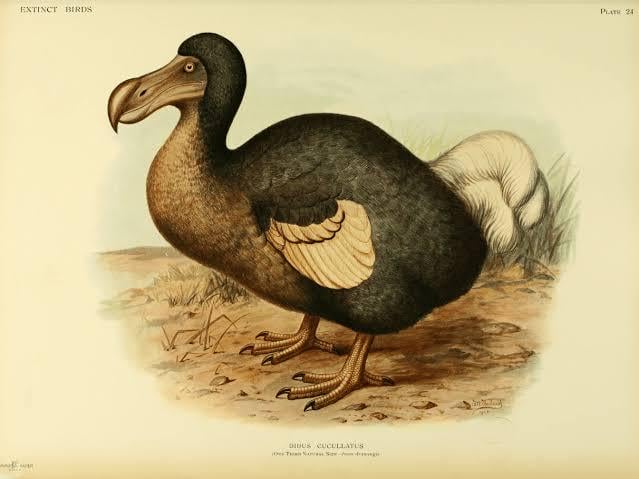
I've been doing a deep dive into ornithological history and some… less publicized documents, and I've come to a conclusion that sounds crazy at first, but I ask you to just hear me out.
We're all taught the same story: the Dodo (Raphus cucullatus) was a flightless bird on Mauritius, discovered by Dutch sailors in the late 16th century, and hunted to extinction by the 1660s. It's the textbook example of human-driven extinction. But what if the timeline is wrong? What if the extinction event was not just exaggerated, but completely fabricated to cover up something else?
My research started with the accounts themselves. The historical records of the Dodo's demise are surprisingly sparse and contradictory. The last widely accepted sighting was in 1662, but the evidence for that is shaky at best. It's less a concrete date and more a point where the scientific community collectively agreed to stop looking. This creates a convenient "event horizon" beyond which any evidence can be dismissed as myth or misidentification.
Now, consider the ecology of Mauritius. It's a large island with dense, near-impenetrable inland forests and complex volcanic cave systems. Even today, new species of insects and plants are being discovered in the high-altitude forests. Is it truly plausible that every single individual of a species was accounted for on an island of that size with 17th-century technology? The Dutch settlement was a small coastal enclave. Their exploration inland would have been extremely limited.
This is where it gets interesting. In the 19th and early 20th centuries, there were numerous, persistent reports from Mauritian locals and British colonists of sightings of a large, flightless, unfamiliar bird in the remote highlands. These were consistently dismissed by authorities as folk tales or cases of mistaken identity (likely of the introduced Red Junglefowl). But when you have multiple, independent accounts from hunters and farmers—people who know wildlife—describing the same unique animal, shouldn't we at least consider it?
So, if a relict population survived, why has it never been confirmed? This is the core of my theory.
The Dodo's survival wouldn't just be a scientific curiosity; it would be a logistical and political nightmare. Mauritius is a sovereign nation, but its economy is deeply tied to international trade and biosecurity. The immediate and total lockdown of the island's interior that would be required by international conservation treaties (like CITES) would be economically devastating. The disruption from teams of scientists, media, and tourists would be immense.
Furthermore, the existence of a "Lazarus taxon" of this magnitude would trigger a catastrophic re-evaluation of global conservation models and funding. The entire narrative of human carelessness leading to irreversible loss is a powerful tool for environmental policy and fundraising. Admitting that the poster child for extinction was, in fact, poorly researched and had been alive all along, would be seen as undermining that entire framework. The reputational damage to major institutions would be irreparable.
Therefore, it is in the mutual interest of both the Mauritian government and international bodies to suppress this information. The "sightings" are quietly discredited, evidence is buried, and the official story is maintained. It's not a malicious conspiracy so much as a systemic one—a case of institutional inertia and choosing a stable, manageable narrative over a chaotic truth.
I know this sounds like the plot of a movie, but I ask you to look at the facts: the flimsy historical evidence, the credible eyewitness accounts over centuries, the logistical and political incentives for a cover-up, and the sheer difficulty of thoroughly surveying every inch of remote wilderness.
Posted by Exotic_Enthusiasm_75
2 Comments
Good read!.. and maybe, stranger things have happened but then wouldn’t it be better to infect them with something that doesn’t spread too easily to other species to finish them off once and for all?
I have two words for you: Dodo Adobo.