Short Version (please do read the full article though): Syria currently faces an increasingly dire food security situation. Thankfully nowhere near the level of Gaza or Sudan, but nonetheless an emerging crisis which is likely to escalate in the near future, and _could_ develop into a humanitarian disaster, especially in the event that large-scale fighting resumes. This crisis is particularly acute in the northeastern provinces under SDF control. The crisis has come about for a number of reasons, most notably the following:
* Economic disruption and infrastructure damage from violence during and after the overthrow of Assad
* The single worst drought to hit Syria in 36 years–in part a result of manmade climate change–reducing wheat yields by **40%**.
* A sudden influx of hundreds of thousands of returning refugees increasing the sheer number of mouths to feed.
* The new government so far all but completely failing to react to the quickly worsening food crisis.
* Foreign governments and NGOs generally being very hesitant to provide aid to Syria, especially with trust in the new government being so low, most of the sanctions placed on Syria during Assad’s rule yet to be lifted, and USAID being dismantled by Trump. Thusfar only Iraq has provided any significant amount of aid.
—-
#Historic drought, wheat shortage to test Syria’s new leadership
DUBAI (Reuters) -Syria faces a potential food crisis after the worst drought in 36 years slashed wheat production by around 40%, squeezing the country’s cash-strapped government, which has been unable to secure large-scale purchases.
Around three million Syrians could face severe hunger, the United Nations’ World Food Programme told Reuters in written answers to questions, without giving a timeframe.
Over half of the population of about 25.6 million is currently food insecure, it added.
In a June report, the U.N.’s Food and Agriculture Organization estimated that Syria faced a wheat shortfall of 2.73 million metric tons this year, or enough to feed around 16 million people for a year.
The situation poses a challenge to President Ahmed al-Sharaa, whose government is seeking to rebuild Syria after a 14-year civil war that saw the toppling of long-time ruler Bashar al-Assad in December.
Wheat is Syria’s most important crop and supports a state-subsidised bread programme – a vital part of everyday life.
Yet Sharaa’s government has been slow to mobilise international support for big grain purchases.
Reuters spoke to a Syrian official, three traders, three aid workers and two industry sources with direct knowledge of wheat procurement efforts, who said more imports and financing were needed to alleviate the impending shortage.
The new government has only purchased 373,500 tons of wheat from local farmers this season, the Syrian government official said, speaking on condition of anonymity. That is around half of last year’s volume.
The government needs to import around 2.55 million tons this year, the source added.
So far, however, Damascus has not announced any major wheat import deals and is relying on small private shipments amounting to around 200,000 tons in total through direct contracts with local importers, the two industry sources said, also declining to be named due to the sensitivity of the matter.
The ministry of information did not respond to a request for comment.
“Half of the population is threatened to suffer from the drought, especially when it comes to the availability of bread, which is the most important food during the crisis,” Toni Ettel, FAO’s representative in Syria, told Reuters.
So far, Syria has received only limited emergency aid, including 220,000 tons of wheat from Iraq and 500 tons of flour from Ukraine.
‘THE WORST YEAR’
While Syria consumes around four million tons of wheat annually, domestic production is expected to fall to around 1.2 million tons this year, down 40% from last year, according to FAO figures.
“This has been the worst year ever since I started farming,” said Nazih Altarsha, whose family has owned six hectares of land in Homs governorate since 1960.
Abbas Othman, a wheat farmer from Qamishli, part of Syria’s breadbasketregion in northeast Hasaka province, didn’t harvest a single grain.
“We planted 100 donums (six hectares) and we harvested nothing,” he told Reuters.
Only 40% of farmland was cultivated this season, much of which has now been ruined, particularly in key food-producing areas like Hassakeh, Aleppo, and Homs, the FAO said.
Local farmers were encouraged to sell what they salvaged from their crop to the government at $450 a ton, around $200 per ton above the market price as an incentive, the official source said.
“In a good year I can sell the government around 25 tons from my six hectares but this year I only managed to sell eight tons,” said Altarsha, the Homs farmer.
“The rest I had to just feed to my livestock as it wasn’t suitable for human consumption,” he said, hoping for better rains in December when the new planting season begins.
Before the civil war, Syria produced up to four million tons of wheat in good years and exported around one million of that.
U.S. POLICY SHIFTIn a major U.S. policy shift in May, President Donald Trump said he would lift sanctions on Syria that risked holding back its economic recovery.
The U.S. Department of Agriculture estimates Syria will need to import a record 2.15 million tons of wheat in 2025/26, up 53% from last year, according to the department’s database.
Still, Syria’s main grain buying agency is yet to announce a new purchasing strategy. The agency did not respond to Reuters questions over the issue.
Wheat imports also face payment delays due to financial difficulties despite the lifting of sanctions, according to two sources with direct knowledge of the matter.
Food was not restricted by Western sanctions on Assad’s Syria, but banking restrictions and asset freezes made it difficult for most trading houses to do business with Damascus.
Russia, the world’s largest wheat exporter and a staunch supporter of Assad, had been a steady supplier but to a large extent has suspended supplies since December over payment delays and uncertainty about the new government, sources told Reuters following Assad’s ouster.
(Reporting by Sarah El Safty and Maha El Dahan. Additional reporting by Orhan Qereman in Qamishli, Syria, Michael Hogan in Hamburg, and Olga Popova and Gleb Stolyarov in Moscow. Editing by Mark Potter)
!ping MIDDLE-EAST&AGRICULTURE
JaceFlores on
Interesting the gov hasn’t announced new purchases of foreign shipments. I know money is a concern but I think the gov could definitely secure grants from nearby Arab states to purchase wheat. So I don’t know what’s up with that
It would also be a good time for countries like Ukraine and the U.S. to send in wheat and wiggle in influence there. Free points for doing a good thing

2 Comments
Short Version (please do read the full article though): Syria currently faces an increasingly dire food security situation. Thankfully nowhere near the level of Gaza or Sudan, but nonetheless an emerging crisis which is likely to escalate in the near future, and _could_ develop into a humanitarian disaster, especially in the event that large-scale fighting resumes. This crisis is particularly acute in the northeastern provinces under SDF control. The crisis has come about for a number of reasons, most notably the following:
* Economic disruption and infrastructure damage from violence during and after the overthrow of Assad
* The single worst drought to hit Syria in 36 years–in part a result of manmade climate change–reducing wheat yields by **40%**.
* A sudden influx of hundreds of thousands of returning refugees increasing the sheer number of mouths to feed.
* The new government so far all but completely failing to react to the quickly worsening food crisis.
* Foreign governments and NGOs generally being very hesitant to provide aid to Syria, especially with trust in the new government being so low, most of the sanctions placed on Syria during Assad’s rule yet to be lifted, and USAID being dismantled by Trump. Thusfar only Iraq has provided any significant amount of aid.
—-
#Historic drought, wheat shortage to test Syria’s new leadership
By Sarah El Safty and Maha El Dahan
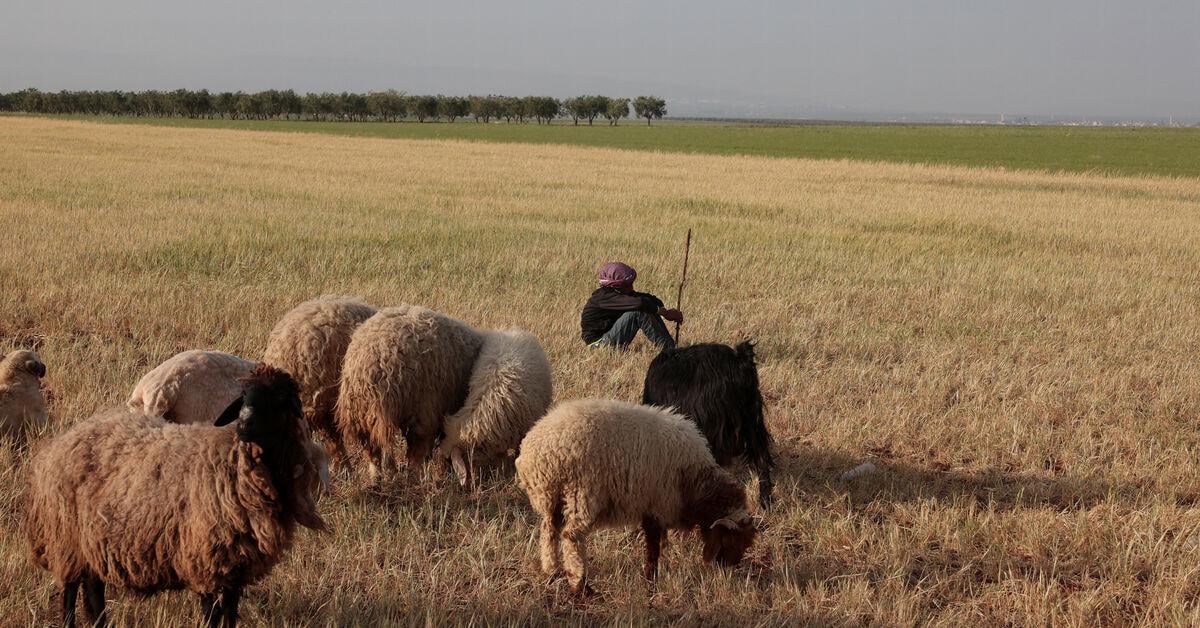
**[IMAGE](https://www.al-monitor.com/sites/default/files/styles/article_hero_large/public/2025-08/2025-08-18T120709Z_2_LYNXMPEL7H0I6_RTROPTP_4_SYRIA-ENVIRONMENT-DROUGHT.JPG?h=d0c2afbe&itok=XVJSC8V_)** (Caption: A shepherd sits near his sheep in a wheat field in Aleppo countryside, Syria, May 8, 2025. REUTERS/Mahmoud Hassano — Mahmoud Hassano)
DUBAI (Reuters) -Syria faces a potential food crisis after the worst drought in 36 years slashed wheat production by around 40%, squeezing the country’s cash-strapped government, which has been unable to secure large-scale purchases.
Around three million Syrians could face severe hunger, the United Nations’ World Food Programme told Reuters in written answers to questions, without giving a timeframe.
Over half of the population of about 25.6 million is currently food insecure, it added.
In a June report, the U.N.’s Food and Agriculture Organization estimated that Syria faced a wheat shortfall of 2.73 million metric tons this year, or enough to feed around 16 million people for a year.
The situation poses a challenge to President Ahmed al-Sharaa, whose government is seeking to rebuild Syria after a 14-year civil war that saw the toppling of long-time ruler Bashar al-Assad in December.
Wheat is Syria’s most important crop and supports a state-subsidised bread programme – a vital part of everyday life.
Yet Sharaa’s government has been slow to mobilise international support for big grain purchases.
Reuters spoke to a Syrian official, three traders, three aid workers and two industry sources with direct knowledge of wheat procurement efforts, who said more imports and financing were needed to alleviate the impending shortage.
The new government has only purchased 373,500 tons of wheat from local farmers this season, the Syrian government official said, speaking on condition of anonymity. That is around half of last year’s volume.
The government needs to import around 2.55 million tons this year, the source added.
So far, however, Damascus has not announced any major wheat import deals and is relying on small private shipments amounting to around 200,000 tons in total through direct contracts with local importers, the two industry sources said, also declining to be named due to the sensitivity of the matter.
The ministry of information did not respond to a request for comment.
“Half of the population is threatened to suffer from the drought, especially when it comes to the availability of bread, which is the most important food during the crisis,” Toni Ettel, FAO’s representative in Syria, told Reuters.
So far, Syria has received only limited emergency aid, including 220,000 tons of wheat from Iraq and 500 tons of flour from Ukraine.
‘THE WORST YEAR’
While Syria consumes around four million tons of wheat annually, domestic production is expected to fall to around 1.2 million tons this year, down 40% from last year, according to FAO figures.
“This has been the worst year ever since I started farming,” said Nazih Altarsha, whose family has owned six hectares of land in Homs governorate since 1960.
Abbas Othman, a wheat farmer from Qamishli, part of Syria’s breadbasketregion in northeast Hasaka province, didn’t harvest a single grain.
“We planted 100 donums (six hectares) and we harvested nothing,” he told Reuters.
Only 40% of farmland was cultivated this season, much of which has now been ruined, particularly in key food-producing areas like Hassakeh, Aleppo, and Homs, the FAO said.
Local farmers were encouraged to sell what they salvaged from their crop to the government at $450 a ton, around $200 per ton above the market price as an incentive, the official source said.
“In a good year I can sell the government around 25 tons from my six hectares but this year I only managed to sell eight tons,” said Altarsha, the Homs farmer.
“The rest I had to just feed to my livestock as it wasn’t suitable for human consumption,” he said, hoping for better rains in December when the new planting season begins.
Before the civil war, Syria produced up to four million tons of wheat in good years and exported around one million of that.
U.S. POLICY SHIFTIn a major U.S. policy shift in May, President Donald Trump said he would lift sanctions on Syria that risked holding back its economic recovery.
The U.S. Department of Agriculture estimates Syria will need to import a record 2.15 million tons of wheat in 2025/26, up 53% from last year, according to the department’s database.
Still, Syria’s main grain buying agency is yet to announce a new purchasing strategy. The agency did not respond to Reuters questions over the issue.
Wheat imports also face payment delays due to financial difficulties despite the lifting of sanctions, according to two sources with direct knowledge of the matter.
Food was not restricted by Western sanctions on Assad’s Syria, but banking restrictions and asset freezes made it difficult for most trading houses to do business with Damascus.
Russia, the world’s largest wheat exporter and a staunch supporter of Assad, had been a steady supplier but to a large extent has suspended supplies since December over payment delays and uncertainty about the new government, sources told Reuters following Assad’s ouster.
(Reporting by Sarah El Safty and Maha El Dahan. Additional reporting by Orhan Qereman in Qamishli, Syria, Michael Hogan in Hamburg, and Olga Popova and Gleb Stolyarov in Moscow. Editing by Mark Potter)
!ping MIDDLE-EAST&AGRICULTURE
Interesting the gov hasn’t announced new purchases of foreign shipments. I know money is a concern but I think the gov could definitely secure grants from nearby Arab states to purchase wheat. So I don’t know what’s up with that
It would also be a good time for countries like Ukraine and the U.S. to send in wheat and wiggle in influence there. Free points for doing a good thing