
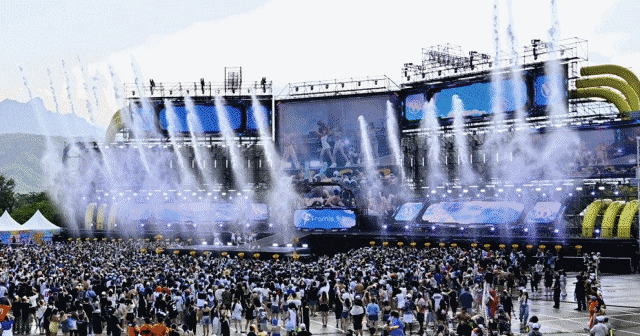
Residents of Gangneung, Gangwon Province are enduring the worst drought in memory, while nearby Sokcho has escaped largely unscathed. On July 23, Sokcho even hosted the “Waterbomb” festival, where participants sprayed and played with water in the city center. Experts say the fate of the two cities diverged because of differences in infrastructure investment, such as underground dams.
Sokcho, long plagued by chronic drought, began investing in water infrastructure after an acute crisis in early 2018. At that time, tap water was cut off nightly for 28 consecutive days. Some 25 apartment complexes received water only every other day, restaurants closed, and residents lined up at water trucks.
Running on a pledge to construct an underground dam, Kim Cheol-su (Democratic Party) was elected mayor that year. The city launched construction in 2019 and completed it in 2021. The dam, built 26 meters beneath Ssangcheon stream, cost 28 billion won and can store 630,000 tons of groundwater—enough to supply Sokcho’s 80,000 residents for about three months.
Sokcho also drilled 15 rock wells, replaced 25 km of aging water pipes, and boosted its water supply efficiency rate from 59% in 2021 to 92% last year, well above the national average of 85%.
Gangneung, by contrast, is still years behind. The city has only recently begun pursuing a similar underground dam project, set to be completed no earlier than 2027—six years after Sokcho. Currently, 87% of Gangneung’s household water relies on a single reservoir, Obong, despite surging demand from tourism, hotels, and golf courses.
Visiting Gangneung on July 30, President Lee Jae-myung rebuked local officials during a drought response meeting. When the mayor suggested waiting for September rains, the president snapped:
“You cannot rely on God. People’s lives cannot be left to chance.”
Officials admit delayed investment has left Gangneung vulnerable. Experts stress that the Foehn wind effect on the Taebaek Mountains already makes the Yeongdong region prone to drought, as rainwater quickly flows into the East Sea. This year, rainfall was less than half the annual average, while heatwaves evaporated what little water fell.
“Like Sokcho, we must secure as many ‘water bowls’ as possible—through underground dams, reservoirs, or other storage systems,” said Prof. Kwon Hyun-han of Sejong University. Unlike traditional dams, underground dams cause little environmental damage, he added.
The government is also considering redirecting water from Doam Dam in Pyeongchang, which holds 30 million tons. Longer-term, experts call for seawater desalination facilities, noting Korea’s world-class technology and Yeongdong’s suitability for deployment.
Experts warn that Gangneung’s plight is not unique. With climate change, sudden droughts, heatwaves, and flash floods are becoming a nationwide threat. “No one knows where the worst drought will strike next year,” said Prof. Kim Seong-jun of Konkuk University. “Every region must prepare by building diverse water storage systems.”
Posted by Freewhale98
1 Comment
>“You cannot rely on God. People’s lives cannot be left to chance.”
The mayor of Gangneung relied on shamanistic rainmaking ceremony to solve drought induced by climate change while Sokcho built climate resilience infrastructure. This resulted in Gangneung having a drought so bad that they now are using water trucks to transport water to Gangneung from neighboring towns.
https://preview.redd.it/f6044ly061nf1.jpeg?width=1170&format=pjpg&auto=webp&s=ab85f18a1e6e2ffdd4f9dd5fac2dfe558c7d038e