
The deeper crime problem that the National Guard can’t solve | Proven solutions have been rejected by the administration in favor of no-tolerance policies and flashy shows of force
Posted by ONETRILLIONAMERICANS
The deeper crime problem that the National Guard can’t solve | Proven solutions have been rejected by the administration in favor of no-tolerance policies and flashy shows of force
Posted by ONETRILLIONAMERICANS
2 Comments
# Trump’s policies
> The program that eventually got Fowlkes to see himself differently—persuading him to leave his street corner and pursue job training after years of cycling in and out of jail—was among several community-violence-intervention initiatives that Donald Trump’s administration abruptly defunded earlier this year. Trump, who has threatened to send federal troops into what he calls the “Crime Drenched City of Baltimore,” is instead relying on a crime-prevention strategy that treats people like Fowlkes, city leaders and criminal-justice experts told me, as irredeemable.
> During a press conference last month announcing that he would be deploying the National Guard to Washington, D.C., Trump briefly held up a picture of some alleged criminals who he said had been taken off the streets by federal officials. “They were rough, rough and tough. But we’re rougher and tougher,” he said. “Look at these people here. They’re not going to be your local school teacher. Look at this guy. He has killed people numerous times. They’re not going to be an asset. They will never be an asset to society. I don’t care. I know we all want to say, ‘Oh, they’re going to be rehabbed.’ It’s not going to be rehabbed.”
> Flanked by the attorney general, the secretary of defense, the FBI director, and other Cabinet officials, Trump went on to describe a crime-fighting philosophy that seemed drawn from the 1980s, when aggressive policing and prosecution policies helped quadruple the nation’s incarcerated population. Studies have repeatedly found that such tactics were ineffective, prohibitively expensive, and even counterproductive, leading Republican and Democratic officials alike to shift toward so-called smart-on-crime approaches that focus more on rehabilitation.
# More effective, less authoritarian alternatives
> Baltimore, just about 40 miles north of the White House, could provide a useful case study.
> While thousands of federal troops and agents were patrolling D.C. last month—at an estimated cost of more than $1 million a day—Baltimore experienced its lowest number of murders for any August on record, according to figures dating back to 1970. Seven people were killed during a summer month that is usually marked by a surge in violence before school starts. Baltimore’s murder rate through the first two-thirds of the year is the lowest it has been since the late 1970s; just more than 90 people have been killed. Though that total is higher than most cities’, it is down considerably from just a few years ago, when the city regularly had upwards of 300 homicides a year.
> Mayor Brandon Scott, who has been following the situation in D.C. closely as Trump has repeatedly threatened to dispatch troops to Baltimore, told me that his city shows that trying to combat crime solely with a “big show of force” is misguided.
> “For those of us who lived through the ’80s, ’90s, and early 2000s, and zero-tolerance policing—all of those failed policies—why would we go back to them?” the 41-year-old Democrat said. “We know that they don’t work.”
> Scott remembers dodging bullets as a child and losing friends to gun violence in his West Baltimore neighborhood. He said he would welcome additional federal support for crime fighting but rejected the idea that sending the National Guard into the city would do anything other than inflame tensions and upset the delicate balance that local leaders have tried to strike between rehabilitation and enforcement.
> In 2004, a year when Baltimore had 270 murders, local police made 91,000 arrests, Scott told me, reciting statistics that he has committed to memory. Last year, the city of just under 600,000 had fewer than 18,000 arrests, and 201 homicides. **“We had fewer homicides with fewer arrests,” he told me, arguing that mass incarceration had done more harm than good in the city where he grew up.**
> Democrats—who have been the main targets of Trump’s threats to deploy federal troops in their cities—have largely abandoned the “Defund the police” rhetoric that emerged after the 2020 killing of George Floyd. Under President Joe Biden, cities accepted millions of dollars in federal grants to bolster their police departments and place more cops on the beat. But Democrats and Republicans have generally paired their investments in policing with support for rehabilitative programs that aim to keep criminals from reoffending.
> Scott told me he sends personal letters to people identified through data analysis and community policing as being the most at risk of committing a crime, giving them an opportunity “to change their life.” If they go on to engage in violence, “we remove them” from the community, he said, arguing that prosecuting the small group of people responsible for most of the city’s crime was more effective than dragnet-style policing that sweeps up undocumented delivery drivers.
# Failures of Trump’s approach
> Wes Moore, Maryland’s Democratic governor, regularly boasts of spending more money on local policing than any of his predecessors. He also says he has put more money toward alternative community programs than his state has ever seen. Like Scott, he has said he is willing to partner with the federal government on anti-crime measures. But he told me that accepting federal troops, and the “stigma” that would come with sending them into a mostly Black city, would be “offensive.”
> “You’re never going to militarize or incarcerate your way out of something that is a much larger social problem,” he said.
> Moore, a combat veteran, said military troops are not trained for domestic policing and asserted that Trump’s use of the National Guard for landscaping duties in the nation’s capital was little more than political “theatrics.”
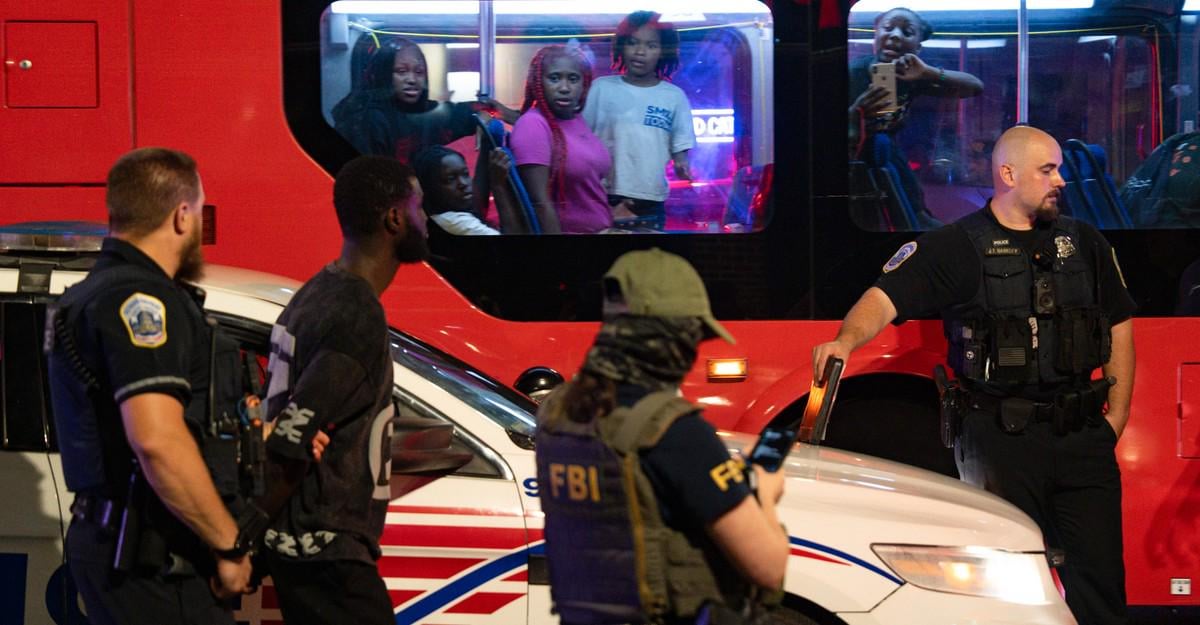
> During one night last week, more than 3,400 people from 22 agencies were involved in the D.C. crackdown, an administration official told me. The surge of federal resources—coming at a cost that few cities could afford to sustain over the long term—resulted in 81 arrests, 37 of which were related to immigration. More than 1,900 total arrests have been made during the past month after officials from the FBI, ATF, and other federal agencies began patrolling the District. The officials have confiscated more than 190 guns.
> Criminal-justice experts I spoke with doubt that Trump’s actions will impact the broader trajectory of crime in D.C.
> “Any kind of crime can be quickly batted down in the very short run, but you’re not going to see any kind of longer-term sustainability,” Amy Solomon, a senior fellow at the Council on Criminal Justice, told me. “It might move to a different area. We know that there are very short-term responses when people are arrested, when some of the root causes aren’t addressed.”
> For years, Solomon worked in the Justice Department’s Office of Justice Programs, which steers federal funds toward various community organizations focused on addressing some of those root causes. Under a 2021 pandemic-recovery bill and a 2022 bipartisan gun-safety law, Congress set aside hundreds of millions of dollars for violence-intervention programs, which aim to prevent crimes before they happen by addressing underlying problems at the neighborhood level. The Trump administration cut more than $800 million for such programs in April, suggesting that they did not align with the president’s vision for advancing public safety.
> Roca Baltimore, the community organization that knocked on Fowlkes’s door days after he was shot in 2021, had a $2 million grant canceled as part of the cuts. The organization targets some of the most at-risk young men in Baltimore, including those who have been arrested multiple times, and offers them a chance to chart a different path, its Baltimore director, Kurtis Palermo, told me. In addition to offering regular check-ins, educational opportunities, and job training, Roca teaches each participant how to pause and think before acting on impulse in highly charged situations.
> Fowlkes, who received his HVAC certification and commercial driver’s license after joining the program, told me he learned how to regulate his emotions and avoid the consequences of rash decision making. “It calmed me down, brought me to a certain level where I could take that eight to 12 seconds and it not cost me my life,” he said. Fowlkes, now a father, told me that as a child in West Baltimore, he witnessed traumatic violence and had few positive role models to look up to.
> The organization is appealing the Trump administration’s decision to cut its funding, pointing to the reduction in crime in recent years and the support it receives from local police. The appeal remains pending.
!ping BROKEN-WINDOWS
The best way to stop heavy crime is to take the very small portion of repeat offenders and jail them til they age out of it.
If someone commits assault multiple times on public transport, it should be 30 years. Unions have begged for more job safety for years.
Sadly soros DAs are hell bent against democrats ever shedding the “crime lover” label so we have to take a massive electoral hit there.