
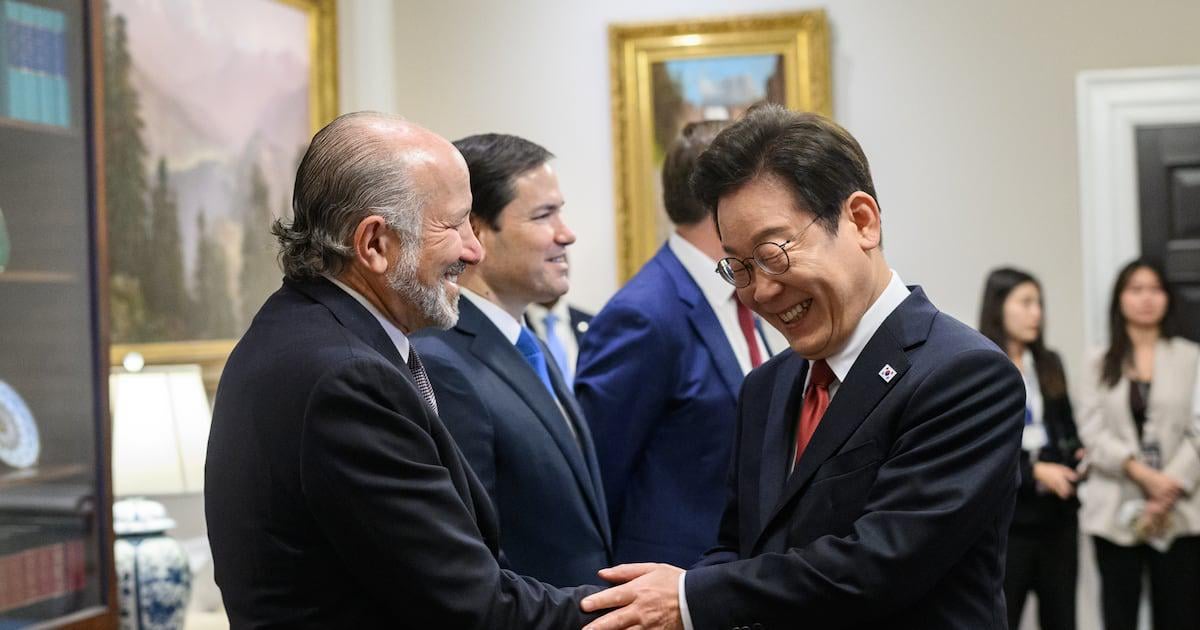
On September 11 (local time), U.S. Secretary of Commerce Howard Lutnick warned Korea: “Either accept the tariff agreement or pay tariffs. There is no flexibility.” His remarks directly countered President Lee Jae-myung’s statement the previous day at his 100-day press conference, where Lee said Korea entered negotiations “to defend against America’s unilateral tariff hikes” and that “we cannot sign an agreement that is not in our national interest.”
In response, the Korean Presidential Office stated on the 12th: “The government will negotiate with national interest as the top priority” and emphasized that “it will not engage in negotiations that deviate from rationality or fairness.”
As tariff negotiations remain deadlocked, the atmosphere between Seoul and Washington has sharply deteriorated. Tensions have been compounded by the detention of 316 Korean workers at the Hyundai–LG Energy Solution joint venture battery plant in Georgia by U.S. immigration authorities, raising concerns that disputes could escalate and prolong talks.
In a September 11 interview with CNBC, Lutnick was asked if the detention of Korean workers was destabilizing the talks. He replied: “The Korean president knows he has not come to the White House to discuss trade with us — and that’s because he hasn’t signed the document. I think Korea is looking at Japan’s agreement. There is no flexibility.” His words were widely seen as a warning that unless Korea signs a deal similar to Japan’s, Washington could raise tariffs back from the currently reduced 15% to the original 25%.
Japan officially implemented its trade deal with the U.S. by executive order on September 4. Korea, however, has yet to sign a finalized agreement. The biggest sticking point is the management of Korea’s $350 billion (approx. ₩486 trillion) U.S. investment fund, which accounts for 84% of Korea’s foreign reserves. Industry Minister Kim Jeong-kwan led a small delegation to New York on September 10, but was reported to have faced major difficulties narrowing differences with Washington.
The two countries remain far apart on several issues, including:
-
Fund management and execution: Korea favors a “financial package” approach that combines direct investment with loans and guarantees, while the U.S. insists Korea’s funds must flow directly into local U.S. projects.
-
Investment fields: Korea wants the fund focused on strategic industries such as batteries and semiconductors, while the U.S. wants projects of its own choosing.
-
Profit distribution: Washington is demanding a “Japan-style” model in which the U.S. retains 90% of the fund’s profits, a proposal Korea strongly rejects.
Professor Heo Yoon of Sogang University’s Graduate School of International Studies warned: “Given President Trump and his aides’ tendencies, if Korea does not accept the U.S.-desired investment fund model, Washington may also step up pressure in security areas, such as reducing U.S. forces in Korea or increasing Korea’s share of defense costs.”
Analysts say the detention of Korean workers has further slowed progress. In an interview with Axios released the same day, Lutnick said: “If you want immigration or want to bring in workers, you must go through the proper process” — placing responsibility for the incident on Korea.
Chief Presidential Secretary Kang Hoon-sik told reporters at Incheon International Airport: “Negotiations with the U.S. have entered a ‘new normal’ era, where standards keep shifting and we must negotiate constantly.” Kim Soo-dong, head of the Global Strategy Research Division at the Korea Institute for Industrial Economics and Trade, added: “With hundreds of Koreans detained, the government seems to have judged that there is no reason to adopt an overly submissive stance.”
Posted by Freewhale98
1 Comment
I’m tired