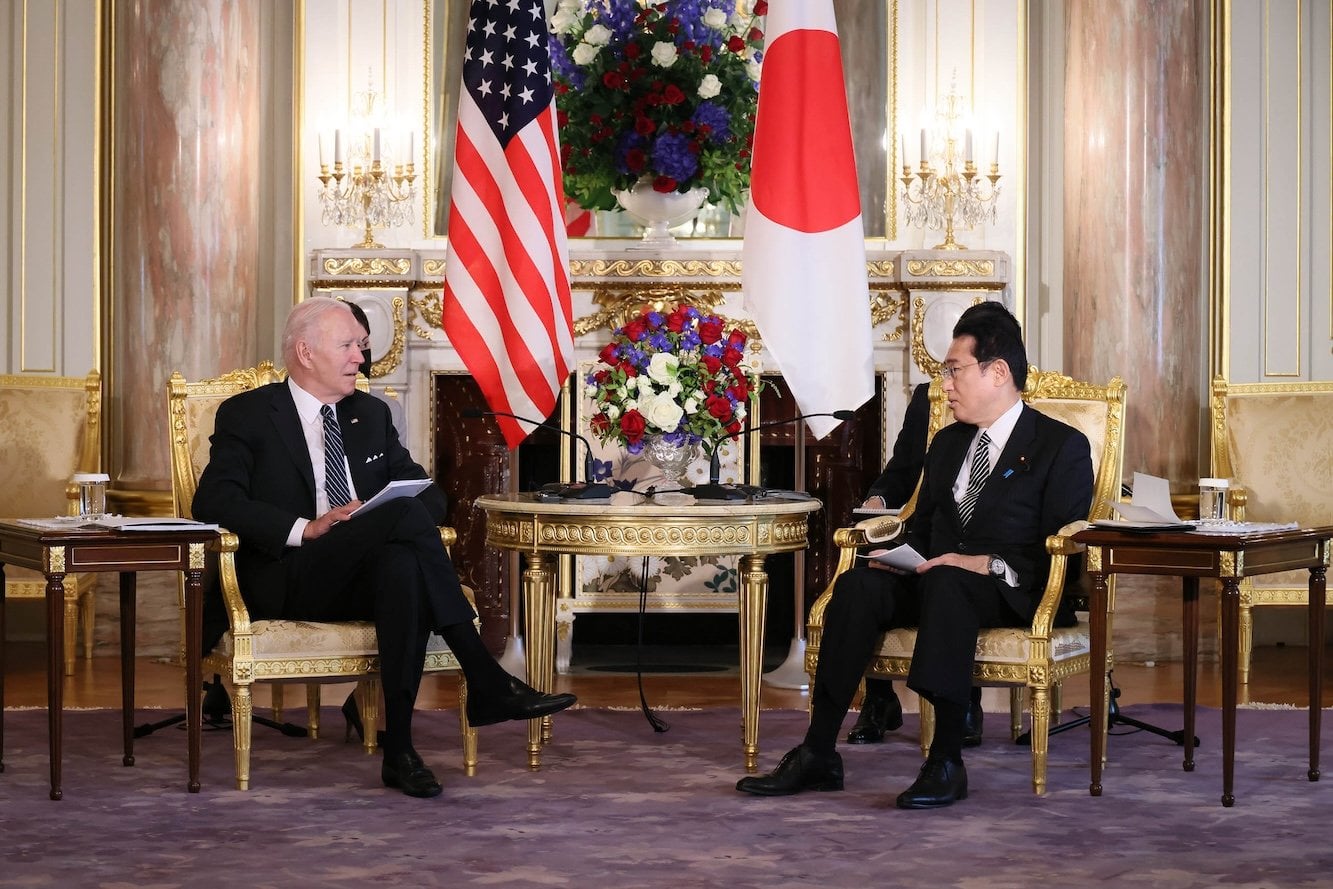
>This week, Tokyo hosted the [U.S.-Japan Security Consultative Committee](https://www.defense.gov/News/Releases/Release/Article/3852169/joint-statement-of-the-security-consultative-committee-22/), which brought together the two countries’ defense and foreign ministers. Although these “2+2 meetings” are fairly mundane and routine occurrences, this one had unusual importance: accelerating the shift from coordination to integration. This was the basic task set forth at the [April summit](https://www.whitehouse.gov/briefing-room/speeches-remarks/2024/04/10/remarks-by-president-biden-and-prime-minister-kishida-fumio-of-japan-in-joint-press-conference/) between U.S. President Joe Biden and Japanese Prime Minister Kishida Fumio. It represents a significant evolution of the U.S.-Japanese alliance.
>
>[…]
>
>The [agreements](https://www.whitehouse.gov/briefing-room/statements-releases/2024/04/10/united-states-japan-joint-leaders-statement/https:/www.whitehouse.gov/briefing-room/statements-releases/2024/04/10/united-states-japan-joint-leaders-statement/) announced at this spring’s Washington summit and [detailed this week in Tokyo](https://www.defense.gov/News/Releases/Release/Article/3852169/joint-statement-of-the-security-consultative-committee-22/) signal a turning point toward a more integrated alliance. This includes command and control, defense industrial production and maintenance, and cooperation with other U.S. allies. Alliance integration, in turn, necessitates deeper bureaucratic entanglement on everything from military operations to defense acquisitions to strategic engagement. This is a brave new world that could eventually lead to a fundamental transformation of the U.S.-Japanese alliance.
>
>These integration efforts represent a significant step forward, and, as stated in Tokyo, they are historic. At the same time, they pose the most significant test for the alliance in decades as it seeks to become more robust. In particular, the United States and Japan are likely to confront several challenges that could limit both the speed and scope of their desired vision. If successful, addressing these challenges could fundamentally change the nature of the alliance.
>
>Aligning new American and Japanese command and control arrangements will require the allies to agree on, among other things, the regional scope of U.S. operational commanders in Japan. Deeper defense industry cooperation will likely require the allies to address political and corporate incentives or risk co-production and co-maintenance. Strengthening regional security networks will require discussions with key partners, including Taiwan, which have heretofore been approached with trepidation by Japan. And truly integrating strategies calls for a bureaucratic change in how the United States conceives of allies’ roles in Washington’s strategy development process. While none of these challenges are insurmountable, openly acknowledging them will be vital if the allies are to overcome them.

1 Comment
Summary:
>This week, Tokyo hosted the [U.S.-Japan Security Consultative Committee](https://www.defense.gov/News/Releases/Release/Article/3852169/joint-statement-of-the-security-consultative-committee-22/), which brought together the two countries’ defense and foreign ministers. Although these “2+2 meetings” are fairly mundane and routine occurrences, this one had unusual importance: accelerating the shift from coordination to integration. This was the basic task set forth at the [April summit](https://www.whitehouse.gov/briefing-room/speeches-remarks/2024/04/10/remarks-by-president-biden-and-prime-minister-kishida-fumio-of-japan-in-joint-press-conference/) between U.S. President Joe Biden and Japanese Prime Minister Kishida Fumio. It represents a significant evolution of the U.S.-Japanese alliance.
>
>[…]
>
>The [agreements](https://www.whitehouse.gov/briefing-room/statements-releases/2024/04/10/united-states-japan-joint-leaders-statement/https:/www.whitehouse.gov/briefing-room/statements-releases/2024/04/10/united-states-japan-joint-leaders-statement/) announced at this spring’s Washington summit and [detailed this week in Tokyo](https://www.defense.gov/News/Releases/Release/Article/3852169/joint-statement-of-the-security-consultative-committee-22/) signal a turning point toward a more integrated alliance. This includes command and control, defense industrial production and maintenance, and cooperation with other U.S. allies. Alliance integration, in turn, necessitates deeper bureaucratic entanglement on everything from military operations to defense acquisitions to strategic engagement. This is a brave new world that could eventually lead to a fundamental transformation of the U.S.-Japanese alliance.
>
>These integration efforts represent a significant step forward, and, as stated in Tokyo, they are historic. At the same time, they pose the most significant test for the alliance in decades as it seeks to become more robust. In particular, the United States and Japan are likely to confront several challenges that could limit both the speed and scope of their desired vision. If successful, addressing these challenges could fundamentally change the nature of the alliance.
>
>Aligning new American and Japanese command and control arrangements will require the allies to agree on, among other things, the regional scope of U.S. operational commanders in Japan. Deeper defense industry cooperation will likely require the allies to address political and corporate incentives or risk co-production and co-maintenance. Strengthening regional security networks will require discussions with key partners, including Taiwan, which have heretofore been approached with trepidation by Japan. And truly integrating strategies calls for a bureaucratic change in how the United States conceives of allies’ roles in Washington’s strategy development process. While none of these challenges are insurmountable, openly acknowledging them will be vital if the allies are to overcome them.
**Upgrading Alliance Command and Control**
>A few years ago, Japan stated its intent to create what was then called a [permanent joint headquarters](https://www.google.com/url?sa=t&rct=j&q=&esrc=s&source=web&cd=&cad=rja&uact=8&ved=2ahUKEwj5t96y9rqHAxXiCTQIHfaQBEMQFnoECCQQAQ&url=https://thediplomat.com/2023/09/japans-defense-ministry-plans-to-launch-permanent-joint-headquarters-in-march-2025/&usg=AOvVaw3c_6rPcqbG5giXzNWGhfie&opi=89978449) to strengthen the effectiveness of joint operations among each of Japan’s Self-Defense Force services. In the subsequent years, that nomenclature changed into what is now called the [Japan Self-Defense Forces Joint Operations Command](https://www.mod.go.jp/j/budget/yosan_gaiyo/2024/yosan_20231222.pdf), and many of its [details](https://asia.nikkei.com/Politics/Defense/Japan-enacts-laws-to-set-up-joint-command-for-Self-Defense-Forces) were fleshed out in [May 2024](https://www3.nhk.or.jp/news/html/20240510/k10014445391000.html). These include establishing it by March 2025 and manning it with roughly 250 people under a four-star flag officer at Japan’s defense ministry in Ichigaya.
>
>Even though that staff size is likely far too small for the Joint Operations Command to be truly effective, its establishment is long overdue. Japan has a chief of staff of its joint staff who oversees the Self-Defense Forces, but he [fulfills](https://spfusa.org/wp-content/uploads/2017/04/Managing-the-U.S.-Japan-Alliance.pdf) the military advisory role akin to the U.S. chairman of the joint chiefs of staff, providing strategic-level guidance and advising the prime minister and the defense minister. In peacetime, he is not responsible for day-to-day command decisions, but in wartime, he takes on the added responsibility of operational command of joint operations.
>
>The Joint Operations Command has no U.S. analogue in Japan. At the moment, [U.S. Forces Japan](https://www.usfj.mil/) is a sub-unified command led by a three-star general without any operational command authority. Instead, it is largely responsible for engaging the Japanese government on all issues that arise under their status of forces agreement.
>
>[…]
>
>The challenge, however, lies in what the United States intends to do. Many [permutations](https://spfusa.org/publications/us-japan-task-force-on-command-relationships-for-new-challenges/) have been [discussed](https://www.csis.org/analysis/vital-next-step-us-japan-alliance-command-and-control-modernization), and many people thought it could take years to conclude the new framework. But in a lightning-short three months, the allies settled on a new command and control structure for the United States. The option [endorsed this week](https://www.defense.gov/News/Releases/Release/Article/3852169/joint-statement-of-the-security-consultative-committee-22/) will increase U.S. Forces Japan’s operational command authority, allowing it to become something akin to U.S. Forces Korea. It remains to be seen whether this upgraded U.S. Forces Japan will be led by a new four-star commander; for the time being, it will be a three-star. Should a [new four-star billet](https://www.stripes.com/theaters/asia_pacific/2024-06-04/austin-us-forces-japan-four-star-14075184.html) ever be created, that move could invite some level of interservice rivalry and would require Congressional approval. Even the new command idea is likely to encounter some of these challenges. These are real complications, but they could be overcome by deft leadership from the secretary of defense and engagement with members of Congress. They are not insurmountable.
>
>Possibly more difficult are those issues with firmer restrictions. Efforts to make U.S. Forces Japan’s more robust will likely require significant increases in personnel and resources — as well as dedicated forces — all of which could encounter significant resistance due to budgetary realities. Importantly, any U.S. commander responsible for defense of both Japan and the broader region could invite [political and legal problems](https://www.csis.org/analysis/vital-next-step-us-japan-alliance-command-and-control-modernization) in Japan. The United States will likely want to give this commander an expanded area of operations and flexibility to respond to threats across the theater, which could clash with Japan’s exclusive self-defense policy.