
I know someone already posted a DW article about the results in Saxony and Thuringia, but I felt like a separate post that goes more in depth about the election's consequences should be made. The DW article posted already states that the AfD now has enough seats to block judges, but the DW article is rather concise and doesn't go into much detail.
Firstly, here are the results of the Thuringia election. There are 88 seats, and the AfD has 32 of them, which is more than one third. Die Linke (The Left) has another 12, and given that the CDU will refuse to enter a coalition with both the AfD and The Left, a majority government is already impossible.
In German states, minority governments can be formed through abstaining (or not being present during the vote) from voting during the election of the Minister-President. This is how the current minority government of Thuringia was formed. The Left, the SPD, and the Greens formed a minority government through the CDU and the FDP abstaining from the vote, and the AfD didn't have enough votes to override the three left-of-center parties.
But with the new election, the AfD now has 32 seats, and the Greens are will not be in the next parliamentary session. So a pure left-of-center minority government is not possible (The Left and SPD combined have 18 seats vs the AfD's 32). But a grand coalition minority government is also not possible (The CDU and SPD combined have 29 seats vs the AfD's 32). This means the only minority government that can be realistically formed at this point would have to include the BSW (The CDU and BSW combined would have 38 seats, enough to prevent the AfD from blocking the formation of a minority government).
For those unfamiliar, BSW is a socially conservative, economically left-wing party. Unfortunately, the BSW's party program is not very precise with their policy proposals and probably won't serve much use to you. But here it is anyway, with the immigration part translated down below.
"Immigration and the coexistence of different cultures can be an enrichment. But this only applies as long as the influx is limited to a level that does not overwhelm our country and its infrastructure, and as long as integration is actively promoted and successful. We know that the price for increased competition for affordable housing, for low-paying jobs and for failed integration is paid primarily by those who are not on the sunny side of life. Anyone who is politically persecuted in their home country is entitled to asylum. But migration is not the solution to the problem of poverty in our world. Instead, we need fair global economic relations and a policy that strives to provide more prospects in the home countries."
Anyway, back to the AfD. Even if a minority government can be formed and maintained (and remember, BSW will be in the minority government no matter what due to the highly limited mathematical possibilities of the parties that can be involved in a minority government), the election results still pose major risks to the stability of Thuringia politics.
Here's a translated excerpt from a German article about the power the AfD now has:
"[In Thuringia and Saxony], no changes to the state constitution will be possible without the approval of the AfD, which requires a two-thirds majority."
"The election of state constitutional judges also requires a two-thirds majority in both states. This can put the highest state courts under pressure. "In Thuringia, the terms of office of all nine members expire by 2029, i.e. before the regular end of the next legislative period."
"Half of all judges in Thuringia will retire within the next ten years – a blockade of the replacement appointments could therefore have serious consequences."
This doesn't mean courts will be completely unable to operate at all, but this does pose a serious threat to the checks and balances systems already in place in Thuringia.
As the Thuringia constitutional court notes (translated):
"After the expiry of their term of office, the members of the Constitutional Court shall continue to hold office until their successor is appointed. The election of the successor shall take place at the earliest three months and at the latest one month before the expiry of the term of office or the reaching of the age limit of the incumbent." (However, only those between the ages of 35 and 68 can members of the Constitutional Court, so the bottom line is that even if there are caveats to get around the AfD judge-blocking powers, it's still very bad)
A German-language blog that focuses on the country's constitutional laws notes that in the state of Thuringia in particular (translated): a majority is required for the election of members of important committees: for the judges' and public prosecutors' election committees and for the parliamentary control commission, which is responsible for parliamentary control of the Office for the Protection of the Constitution.
As further stated in the article, the Thuringia AfD has already been able to utilize its already existent political powers to block judges in some situations.
"The Judges Election Committee is actually a rather inconspicuous body of the Thuringian State Parliament. But in order to appoint probationary judges for life, the Minister of Justice needs the approval of this committee. Each parliamentary group must be represented by at least one person, as required by the Thuringian Constitution. The AfD made the nomination of its candidates dependent on the condition that the other parties elected their candidate as Vice President of the State Parliament. Only when the other parties agreed did the AfD also nominate someone for the Judges Election Committee so that it could begin its work."
Yes, that's right, the other parties were forced to elect an AfD politician as the Vice President of the State Parliament. You can read more about it here. Or as the article stated (once again, translated):
"On Thursday, the Thuringian state parliament elected AfD MP Michael Kaufmann as vice president with a simple majority. The Jena university professor received 45 votes. 35 MPs voted against him, nine abstained.
Ramelow pointed out that the AfD had given up blocking the election committees for judges and public prosecutors after the election of its representative. "I neither like the party nor do I have any sympathy for Professor Kaufmann, but I respect the parliamentary rules," said Ramelow. He therefore wanted to support both – the election of the vice president and the securing of two-thirds majorities for judges and public prosecutors."
The blog states several ways to get out of this dilemma:
- Lowering the majority requirement
- Adding more judicial members
- Making it a requirement to give the opposition some members
- Waiting it out to let the courts decide what to do (Although to have democratic legitimacy, whatever the courts propose should probably also be voted on by the state parliament)
The problem with all of these solutions?
"The only problem is that these proposals would require a constitutional amendment that could prevent an AfD blocking minority."
"In all three federal states [this includes Thuringia], a two-thirds majority is required for constitutional amendments, the election of constitutional judges and the dissolution of the state parliament during an ongoing election period."
The AfD will have 32 of the 88 seats in the upcoming Thuringia state parliament. More than one third. Enough to block constitutional amendments.
Thuringia has become ungovernable.
EDIT: FWIW, I think it's highly unlikely the CDU will break its cordon sanitaire with the AfD. Their own voter base won't be able to stomach it.
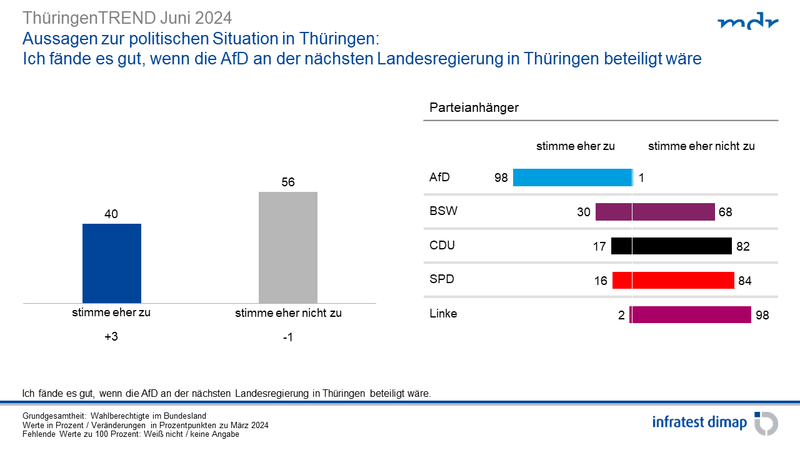
Here are two polls from the last few months showing 1) The % of of each party's voter base that think the AfD entering government is a good idea, and 2) The % of each party's voter base that thinks the Thuringia AfD leader would make a good Minister-President.
Posted by MayorShield