
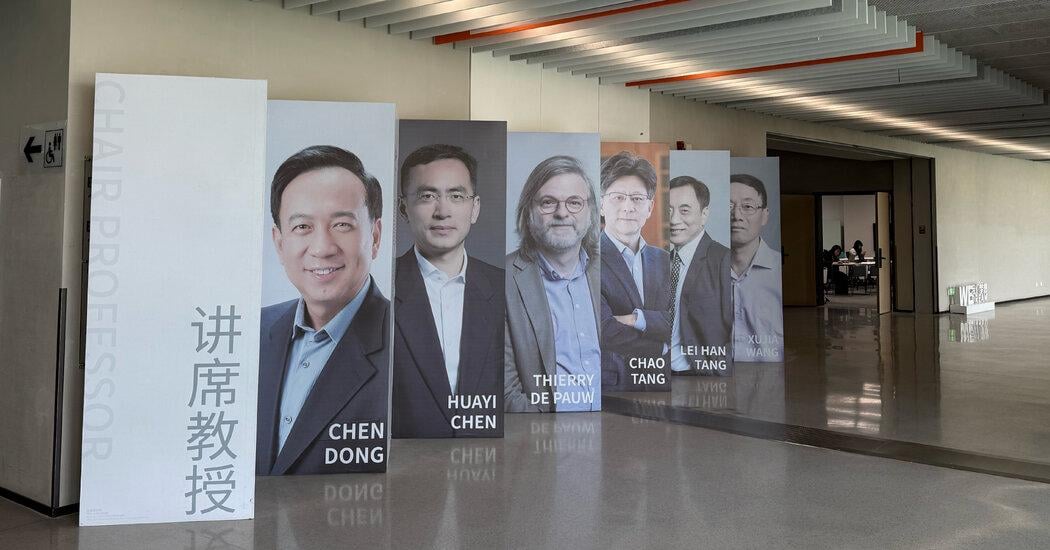
On Oct. 1, China will launch a new type of visa designed to make it easier for graduates of top universities in science, technology, engineering or mathematics to travel to China to study or do business.
The new visa category is part of China’s broader campaign to attract top scientific talent as it vies with the United States for technological and geopolitical dominance. China’s visa was announced a few weeks before Mr. Trump moved to impose a $100,000 fee for H-1B visas for skilled workers.
It is far from clear how much the new K visa, as China’s visa is called, will affect the race for talent. Beijing has yet to release details about the program, including who will be eligible or whether they will be allowed to take up formal employment. And while foreigners with special knowledge have long been eligible for other types of visas to enter China, albeit with more paperwork, it is difficult for foreigners to immigrate to China permanently. But the gesture alone may help position China as becoming more open to the world, while the United States appears to be closing itself off.
“Silicon Valley has become more and more into the ‘America first’ culture,” said George Chen, a partner at The Asia Group, a consulting firm based in Washington, who focuses on technology policy. For tech workers from other countries who worry they are no longer welcome in the United States, he said, “when they see the news about K visas, they might think: I will have another option at least.”
The Chinese government has tried to smooth the process in recent years. For scientists, it has offered generous incentive packages and promised to cut red tape. The new K visa will offer longer stays, multiple entries and will not require an invitation letter from a company.
China still faces many obstacles in drawing large pools of foreign talent. (Those scientists who have relocated to China from overseas have often been people who were born in China, then moved abroad.) There are language barriers and political and cultural differences, not to mention very limited pathways to permanent residency.
The K visa is unlikely to replace the H-1B. The vast majority of H-1B visa holders in the United States are Indian, but relations between China and India are fraught. On Chinese social media, when Global Times, a nationalist tabloid, posted that many Indian news outlets were reporting on the new Chinese visa, many Chinese users responded with racist comments, saying they did not welcome Indians.
Posted by John3262005
1 Comment
This article is just weird. Not the reporting, mind you, but the “at what cost?” garbage that happens at the end.
>On Chinese social media, when Global Times, a nationalist tabloid, posted that many Indian news outlets were reporting on the new Chinese visa, many Chinese users responded with racist comments, saying they did not welcome Indians.
Yes, of course a nationalist tabloid is going to be nationalist. What a surprise. I’m sure PRC citizens are xenophobic, but if you purposefully go fishing for racist comments you will always find them.
>“Don’t be fooled by the K visa,” said Mr. Chen, of the Asia Group. “Yes, the K visa is to get foreign experts. But you want to get the foreign experts to help you advance your own agenda, which is ultimately about self-reliance.”
The same could be said about the H1-B or other types of immigration to the US. Also why are they asking a person at a random Washington-based think tank?