
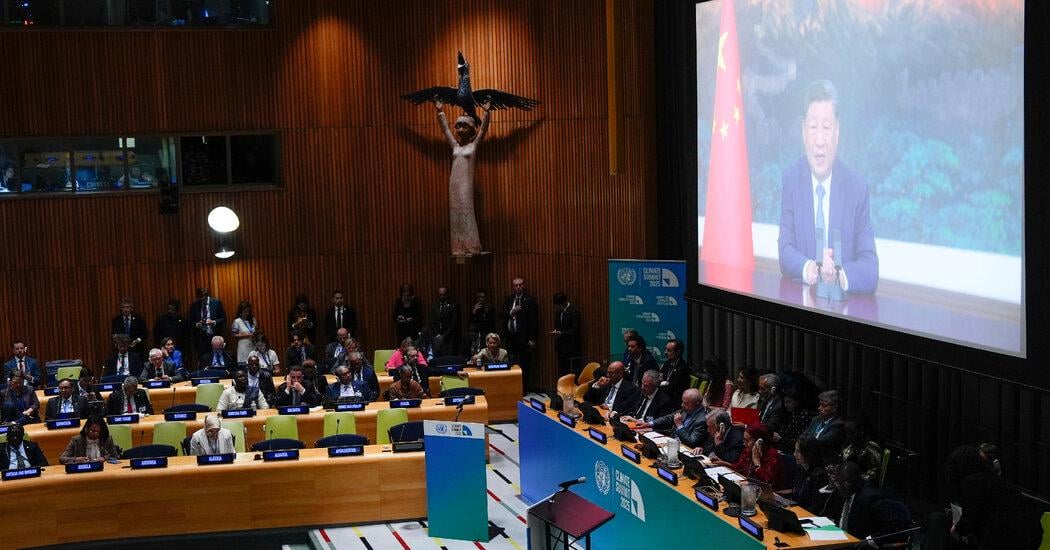
Over a week of appearances at the United Nations, China tried to send the message that Beijing, not Washington, was the responsible power willing to shoulder global duties just as the United States, under President Trump, was signaling retreat.
China’s leaders used the U.N. General Assembly to roll out pledges on trade and fighting climate change that were notable less for their substance than for the image they projected of China as a pillar of stability and global cooperation.
In an apparent reference to the United States, Premier Li Qiang, China’s second-highest ranking official, said in his speech to the assembly on Friday that “the rise in unilateral and protectionist measures such as tariff hikes,” was slowing economic growth. By contrast, Mr. Li said, China had “consistently opened its door wider to the world.”
On Tuesday, he said that Beijing would no longer claim trade benefits reserved for developing nations at the World Trade Organization. Analysts said the announcement was intended to show China backing fairer trade at a time when the Trump administration was doing the opposite by weaponizing tariffs.
On climate, China’s top leader, Xi Jinping, told a U.N. summit by video link on Wednesday that Beijing would commit to a detailed target for reducing greenhouse gas emissions for the first time. Mr. Xi said that going “green and low carbon” was the “trend of our time,” and he criticized countries that were “acting against” that transition, a not-so-veiled swipe at the United States.
The contrast could not be greater. Mr. Xi’s pledge was made a day after Mr. Trump had derided climate change as the “greatest con job” that was “made by stupid people.”
The back-to-back pledges crystallized Beijing’s strategy: to position itself as an antidote to “America First” . Beijing calls its approach “true multilateralism,” which involves rhetorically embracing international organizations and treaties shunned by Mr. Trump like the United Nations, the World Health Organization and the Paris climate accord.
The goal is to persuade other countries that China is a “moral righteous actor” so that they are more likely to take their cues from Beijing and not Washington, said Dylan Loh, an expert on Chinese foreign policy at Nanyang Technological University in Singapore.
“They’re being opportunistic,” Mr. Loh said. “It’s clear that there are pockets of spaces where they see the United States leaving a vacuum in leadership, such as on climate issues, and that is where China is stepping up its game.”
Whether China is doing enough to make a difference, or simply clearing the low bar of expectations set by the Trump administration’s retreat from climate science and global commitments, is an open question.
Posted by John3262005