
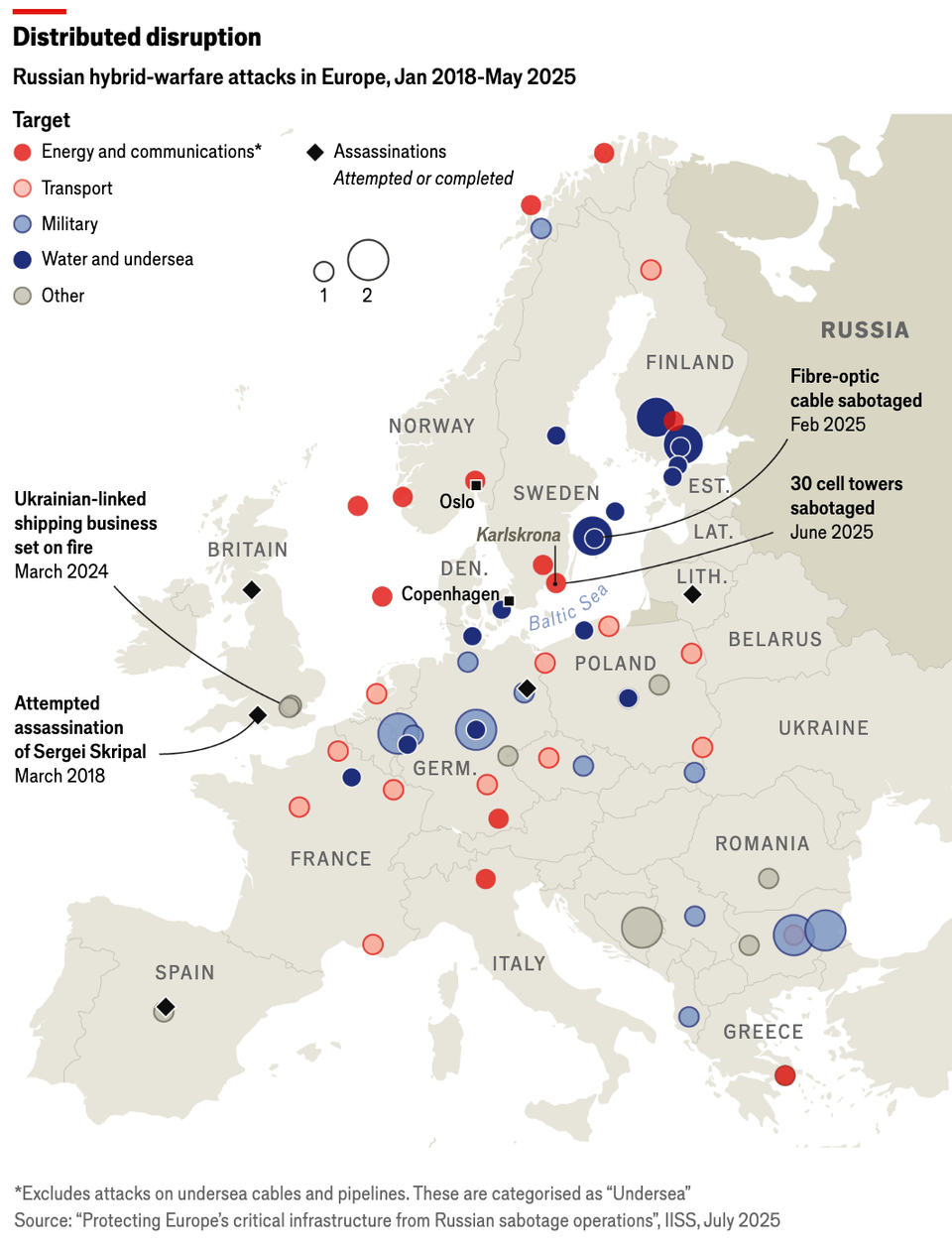
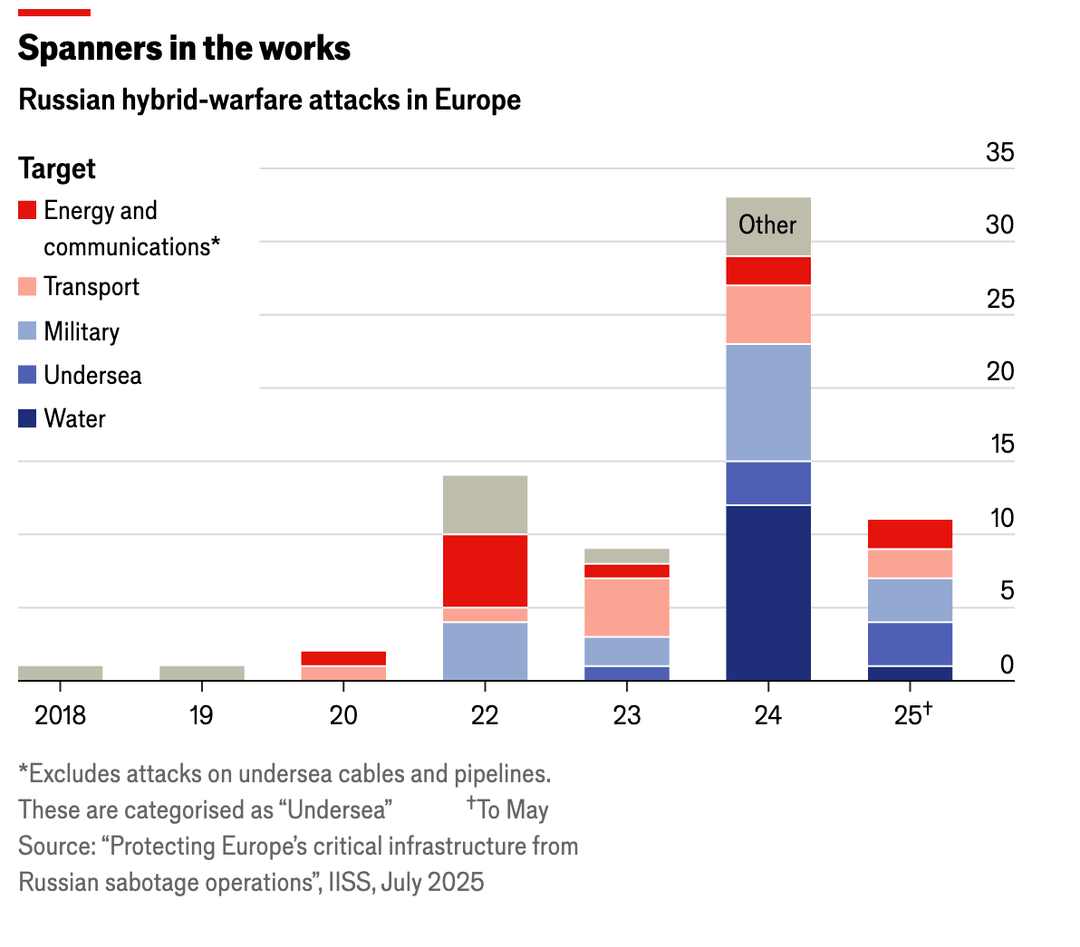
Overview of Russian’s hybrid-warfare attacks in Europe the past seven years (Source:The Economist/IISS)
Posted by Free-Minimum-5844
Overview of Russian’s hybrid-warfare attacks in Europe the past seven years (Source:The Economist/IISS)
Posted by Free-Minimum-5844
5 Comments
I know that MAD has been generally effective in preventing inter-state conflicts since WW2 but the variable of human nature being irrational makes me uneasy with Putin’s experiments here to bait a reaction.
Someone stuxnet them
An unending series of bizzare tragedies and accidents. You don’t have a piece of paper that says “I declare war” so we can’t be at war. I’m not touching you. 🙂
Europe is at war with Russia.
“Hybrid warfare” we have literally invaded countries for less during the GWOT. If Putin were a Muslim he’d have been dead by 2023
Archived version: [https://archive.fo/jO4kI](https://archive.fo/jO4kI).
>But the recent Russian actions are probably aimed at driving wedges between Europe and America, and among European NATO members themselves. Russian incursions create the impression that Europe is unable to protect its airspace, undermining public confidence in governments. They also expose the fact that Mr Trump has little appetite to back his European partners in a moment of crisis. And they accentuate Europe’s internal splits over how to respond.
>Consider the debate unfolding within NATO. Some would like the alliance to punch back hard. “If another missile or aircraft enters our space without permission, deliberately or by mistake, and gets shot down…please don’t come here to whine about it,” warned Radek Sikorski, Poland’s foreign minister, addressing Russia. “You have been warned.” On September 23rd Mr Sikorski’s implied threat was unexpectedly endorsed by Mr Trump himself, though he showed little sign of wanting to get involved directly. Some point to the example of Turkey, which shot down a stray Russian jet in 2015.
>In practice, many allies want to tread carefully. Major-General Jonas Wikman, the head of the Swedish air force, whose jets were among those that responded to the Estonian incursion, says that he has the delegated authority to shoot down Russian planes if needed. “But we will always refer to the threat level,” he adds. “When we talk about Swedish territory, we talk about proportionality.” In the Estonian incident, NATO was able to track the Russian incursion throughout and the intruders, though armed with air-to-air missiles, posed no apparent threat to the ground.
>On paper, each ally has the right to shoot down whatever it likes; it need not wait for permission from NATO. The Baltic states do not have fighter jets of their own—they rely on a rotating cast of allies to patrol their airspace—but their neighbours do. Poland is free to splat the next stray jet. The problem is a political rather than military one. If Russia chose to escalate in response, one concern is that Mr Trump would stand back and that Europeans would squabble among themselves over how far to back the ally that had blown up a Russian aircraft.
>NATO allies all agree that the status quo is becoming untenable. Mike Waltz, America’s ambassador to the United Nations, publicly rebuked Russia at a UN session in New York. Marco Rubio, America’s secretary of state, is thought to have done so in private. In Europe, countries are beefing up their defences. Five days after the Estonian incident, more than 100 Polish paratroopers landed on Gotland, a Swedish island that sits in a commanding position in the Baltic sea, as part of a joint exercise. Sweden has also been moving ground-based air defences to the island and increasing the readiness of its air force. “These are intense days and weeks,” says Major-General Wikman. “We need to be able to stay calm and have the right posture, and we’re quite confident that we are on the right track for that.”
!ping Europe&Foreign-policy
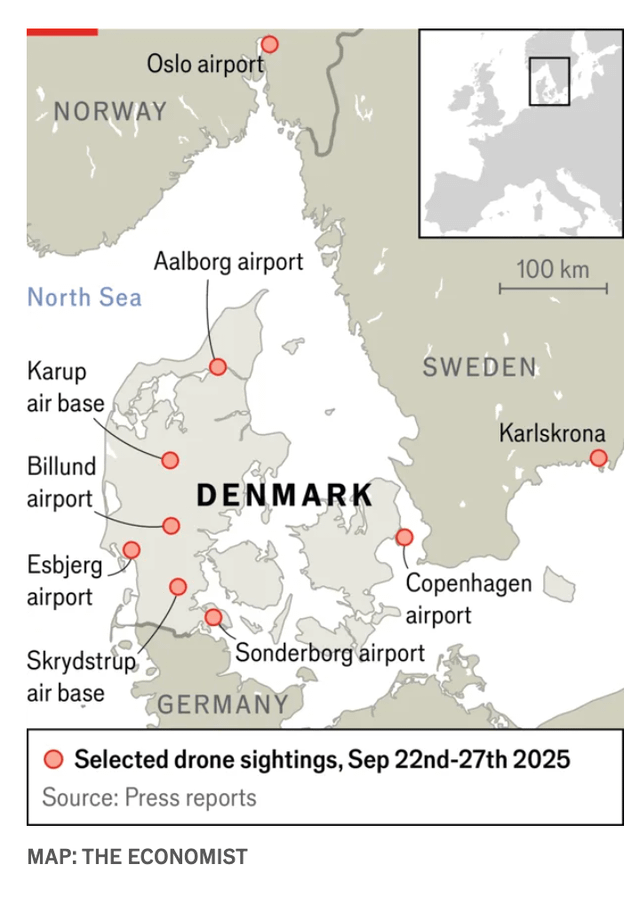
Are the denmark drone sightings linked to russian drones credibly or are these more cases of “okay i’m looking at the sky now because i read the news of drones yesterday and holy shit there’s lights”