
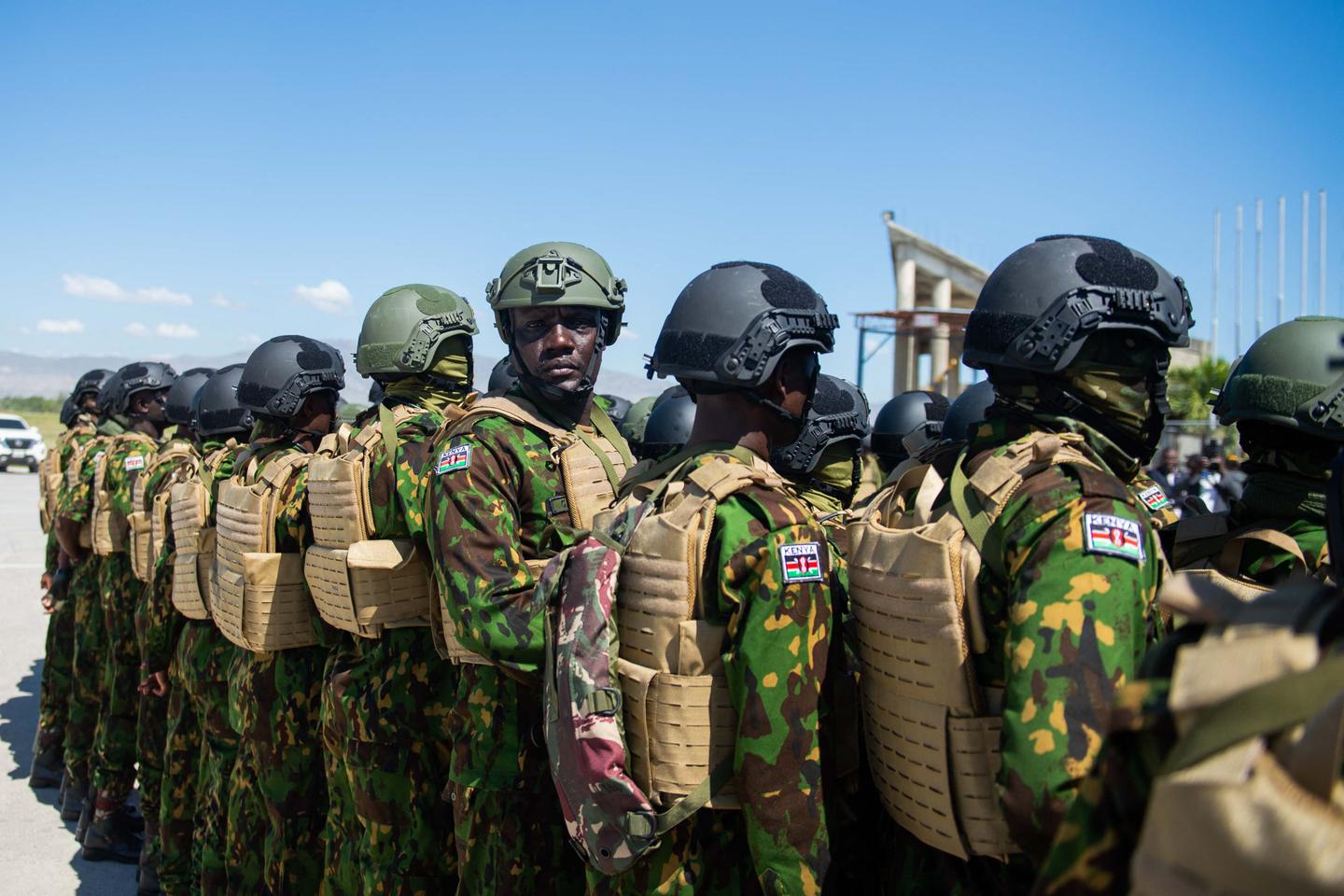
Fifteen months after it first arrived in the Caribbean, the Kenya-led Multinational Security Support Mission in Haiti (MMAS) is set to end on Thursday, October 2, with a mixed record. Speaking in New York during the annual United Nations General Assembly, Kenyan President William Ruto welcomed the fact that his country "stepped forward, offered to lead and deployed our officers" to fight the gangs that control the country and its capital, Port-au-Prince, while also acknowledging the limits of the mission.
Since the premeditated murder of President Jovenel Moïse on July 7, 2021, the collapse of political institutions has only accelerated in the Caribbean nation of some 12 million people. The Kenyan president stressed that the mission led by his country's police had succeeded in securing Port-au-Prince airport, retaking the presidential palace and reopening several key roads.
Yet, beyond these isolated successes, the security force was never able to fully carry out its mission due to a lack of personnel and equipment. Ruto lamented that it "operated below 40% of its authorized personnel strength," and was structurally "underfunded, underequipped." Of the 2,500 police officers originally planned, fewer than 1,000 were actually deployed in Haiti.
The Kenyan leader also expressed disappointment that the mission's vehicles were defective and that pledges of financial support went unfulfilled. Although the mission was endorsed by the United Nations Security Council, it was not funded by the international organization; rather, it depended on voluntary contributions, notably from the United States.
On September 30, the Security Council approved a resolution put forward by the US and Panama aimed at transforming the MMAS into a Gang Repression Force (FRG). With a broader mandate, this new entity is intended to combat violent gangs in Port-au-Prince more effectively.
The number of deployed personnel is expected to rise to 5,550, with a minimum deployment period of 12 months. Under a United Nations mandate – unlike the MMAS – the FRG will have the authority to use military force in the event of threats to peace. Its funding is also expected to be more secure.
Beyond this, the framework for the force remains unclear. It is not yet known whether Kenya will participate or when exactly the force will be deployed.
Kenya surprised the international community in July 2023 by announcing its readiness to send 1,000 police officers to Haiti. The government of the small Caribbean state had been calling in vain for a year for a mission to restore order, as gangs controlled most of the territory. Most countries refused after revelations in 2019 of a scandal involving UN peacekeepers.
According to a study, "peacekeepers" sexually exploited Haitian women and girls during their mission on the island between 2004 and 2017. The blue helmets are also accused of having brought the cholera epidemic that struck the island in 2010, killing nearly 10,000 people. The UN acknowledged its responsibility only reluctantly in 2016.
Posted by John3262005