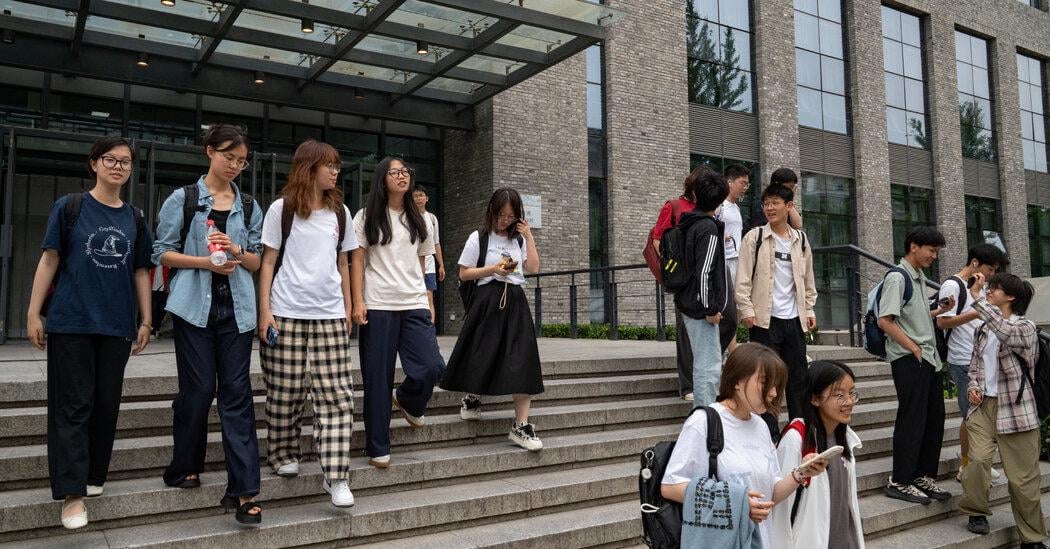
In the days before and since Oct. 1, when the visa was supposed to come into effect, commenters have accused the government of inviting foreigners to steal jobs from Chinese people, at a time when [young people](https://archive.is/o/mSJOl/https://www.nytimes.com/2023/11/01/world/asia/china-unemployment-youth-hostels.html) are finding it harder than ever to land work. They have suggested that foreigners are being blindly worshiped, a longstanding national sore point.
Prominent influencers have also stoked nationalism or xenophobia, claiming that China will be overrun by outsiders. After Henry Huiyao Wang, the president of the Center for China and Globalization, a research group in Beijing, praised the new visa, people on social media called him a race traitor, and their posts were shared thousands of times.
The backlash grew so fierce that the Chinese Communist Party’s official mouthpiece, People’s Daily, [published an editorial](https://archive.is/o/mSJOl/https://baijiahao.baidu.com/s?id=1844672500999822906&wfr=spider&for=pc) calling criticisms of the visa “outlandish” and accusing opponents of misleading the public. Hu Xijin, the former editor in chief of Global Times, a nationalist tabloid, defended the policy, saying in a video that he saw fewer foreigners in China than in Japan or South Korea.
Landing an office job has become incredibly challenging for youths around the world. They and their parents view skilled immigrants as a direct threat. It is imperative for government’s around the world to do what they do for farmers and rural workers, and compel the companies they have great power over (think big banks, telcos, insurance) to make up fake jobs with busy work tbh. If we want to avoid fascism.

1 Comment
When the Chinese government announced a [new visa to attract young science and technology talent](https://archive.is/o/mSJOl/https://www.nytimes.com/2025/09/26/world/asia/china-tech-workers-visas-us-h1b.html), it advertised the move as another step toward becoming the leading scientific power, one to which people from around the globe would flock.
To many in China, it was a gross mistake.
In the days before and since Oct. 1, when the visa was supposed to come into effect, commenters have accused the government of inviting foreigners to steal jobs from Chinese people, at a time when [young people](https://archive.is/o/mSJOl/https://www.nytimes.com/2023/11/01/world/asia/china-unemployment-youth-hostels.html) are finding it harder than ever to land work. They have suggested that foreigners are being blindly worshiped, a longstanding national sore point.
Prominent influencers have also stoked nationalism or xenophobia, claiming that China will be overrun by outsiders. After Henry Huiyao Wang, the president of the Center for China and Globalization, a research group in Beijing, praised the new visa, people on social media called him a race traitor, and their posts were shared thousands of times.
Platforms have been especially flooded by racist comments about Indians, after Indian news outlets reported on the Chinese visa as a possible alternative to the [highly popular](https://archive.is/o/mSJOl/https://www.nytimes.com/2025/09/29/business/india-h1b-visa-trump.html) H1-B visa in the United States, which now comes with a $100,000 fee.
The backlash grew so fierce that the Chinese Communist Party’s official mouthpiece, People’s Daily, [published an editorial](https://archive.is/o/mSJOl/https://baijiahao.baidu.com/s?id=1844672500999822906&wfr=spider&for=pc) calling criticisms of the visa “outlandish” and accusing opponents of misleading the public. Hu Xijin, the former editor in chief of Global Times, a nationalist tabloid, defended the policy, saying in a video that he saw fewer foreigners in China than in Japan or South Korea.
—
Long article. Read the rest here : [https://archive.is/mSJOl#selection-961.0-993.126](https://archive.is/mSJOl#selection-961.0-993.126)
Landing an office job has become incredibly challenging for youths around the world. They and their parents view skilled immigrants as a direct threat. It is imperative for government’s around the world to do what they do for farmers and rural workers, and compel the companies they have great power over (think big banks, telcos, insurance) to make up fake jobs with busy work tbh. If we want to avoid fascism.