
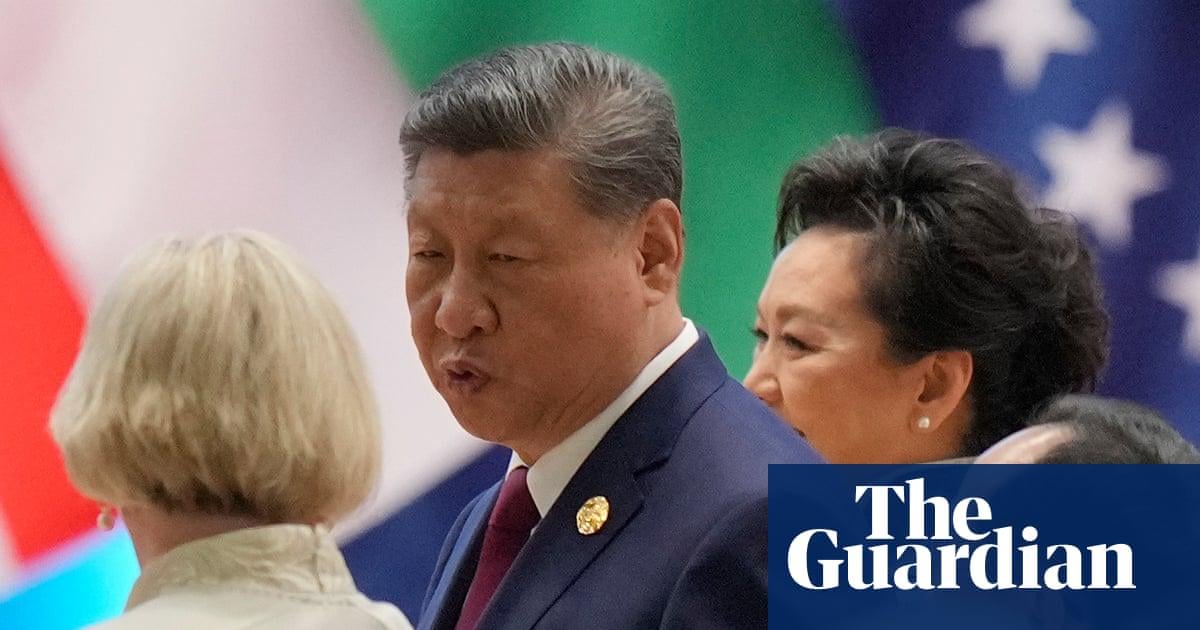
Xi directs quashing of Chinese feminists even as he praises advances at women’s conference
Amy Hawkins Senior China correspondent
Wed 15 Oct 2025 04.00 CEST
Chinese president is behind patriarchal turn in politics with activists silenced for ‘promoting gender antagonism’
Addressing dignitaries gathered in Beijing on Monday, Xi Jinping praised the “historic achievements” of women’s rights in China. In the past 30 years, the Chinese president said, maternal mortality rates had dropped by nearly 80%, and women were now participating in the project of national governance with “unprecedented confidence and vigour”.
Xi was speaking at the global women’s summit, an event on Monday and Tuesday to mark the 30th anniversary of the historic UN’s world conference on women, which took place in Beijing. It was there in 1995 that Hillary Clinton, the then US first lady, delivered her “women’s rights are human rights” speech, lines now often quoted by people in China advocating for women’s rights.
This year, Chinese officials used Xi’s speech to highlight the contributions that China has made to women’s advancements. Xi announced a $10m (£7.5m) donation to UN Women, the organisation’s gender-equality agency, as well as a $100m fund for global south countries.
But while Xi hailed a “glorious chapter of women’s progress”, in recent years, Chinese feminists have found it increasingly difficult to advocate for, or even speak about, women’s rights.
“Today, countless people, primarily young women, identify as feminists and practice feminist choices in their personal lives,” said Lü Pin, an activist based in New Jersey who founded an influential feminist organisation in China that was forced to close in 2018.
“However, feminist activities beyond personal life are severely limited, including public discussion, let alone policy advocacy, accountability and collective action,” said Lü, who has been based in the US since 2015, when several of her associates, known as the “feminist five”, were detained in China after a protest they staged about sexual harassment on public transport.
As leader, Xi has overseen a sweeping crackdown on civil society and led a patriarchal turn in politics. In 2022 he unveiled a new politburo, the executive body of the Chinese Communist party, which for the first time since 1997 included no women.
Although social attitudes towards divorce and workplace equality have become more liberal, the government routinely exhorts women to fulfil what it says are traditional responsibilities of marriage and child-bearing, especially to help the country tackle its falling birthrate. In 2023, Xi said that China should “cultivate a new marriage and child-bearing culture”.
While organised feminist groups have mostly been squashed, there are still independent bloggers and commentators who focus on women’s issues. However, even these are under increasing pressure.
Last month, the official WeChat account of feminist blogger Jiang Chan, whose articles regularly garnered more than 100,000 views, according to China Digital Times, was deleted.
It came a few weeks after more than 1,300 accounts on Weibo, a separate social media platform with nearly 600 million monthly active users, were given temporary or permanent bans for inciting “gender antagonism”. One account was temporarily banned for posting “extreme anti-marriage” rhetoric.
In June, the platform launched a dedicated complaints category for reporting content that “promotes gender antagonism”.
Wang Huiling, a vlogger from rural Anhui province, shot to fame during the Covid-19 pandemic with her forthright videos about marriage, family and women’s independence. Her experience of coming from a village, where social norms are more conservative, stood in contrast to the more middle-class feminist discourse from China’s cities. “When I started posting videos online in 2019, I hadn’t heard of feminism,” she said. She just wanted to share the real-life struggles that she and the women around her faced in Chinese society. “It was only later that I realised I was part of the feminist community and that women fighting for their human rights were feminists.”
At her peak, she had more than 4 million followers on Douyin, TikTok’s sister app in China, and, according to Wang, more than 6 million fans across different platforms.
But Wang’s precise reach in China is now hard to gauge because, in January, all of her social media accounts were deleted without explanation. In April, she was informed that her 2021 memoir, Grassroots Women, had been banned from being reprinted (although it is still available for sale on e-commerce platforms). “I don’t know the specific reason for the ban, but it was probably because they were afraid of my awakening of independence in some women,” Wang said.
Additional research by Lillian Yang
Posted by oatballlove
2 Comments
gfy
https://www.theguardian.com/global-development/2025/mar/05/trump-is-tearing-up-us-womens-rights-the-message-from-your-sisters-in-the-arab-world-dont-give-up-resistance-works
Trump is tearing up US women’s rights. The message from your sisters in the Arab world? Don’t give up: resistance works
Hibaaq Osman
Wed 5 Mar 2025 07.00 CET
The new administration threatens to undo decades of progress in America, but as North Africa and the Middle East have shown, there is power in female solidarity
From outside the US looking in, those of us who have experienced the tumultuous years since the Arab revolutions feel a strange sense of familiarity: the chaos of the Trump-Musk administration, the attacks on minority groups, the elevation of men – a number of whom have been accused of violence against women – to cabinet positions.
Trump seems to have started his second term with the same ferocity, callousness, violence and ignominy in which his first term so notoriously ended. Amid the shock of the past few weeks, a sense of panic can be immobilising. But that is exactly what such a strategy is designed to do.
For women in the US who now feel under attack like never before, who sense their rights, even their bodily autonomy, slipping through their fingers, I bid a weary but warm welcome to the club. You must know that you do not need to look far for solidarity. There are women in the US who have had to fight every step of the way to have their humanity recognised by a bigoted and over-mighty state. African American women, Indigenous American women, Latin American women – their civil rights struggles have been extraordinary and hugely influential across the world.
But if I may, there are many examples to be shared of women in the Arab world who have taken on the laws, institutions and cultures of oppression that mired their daily lives – and won.
It takes a lot to build a platform for respectful conversation, all without ceding your own principles. But it can be done
With some US politicians now looking to bar women from seeking an abortion beyond state lines, you can take inspiration from the women of Libya. Twice now, the Libyan authorities have declared their intention to ban women from independent travel without a male “guardian”. Female activists met these proposals with campaigns that raised global attention and condemnation, exerting political and diplomatic pressure that resulted in the proposals being rescinded.
That this is possible in a country in which decades of dictatorship and conflict have prevented the establishment of a democratic culture shows the power of women organising together in grassroots advocacy. Even when the levers of power are not accessible directly, there is still huge power in working together strategically.
When women in Jordan and Lebanon started work on addressing colonial-era laws that meant convicted rapists could escape punishment by agreeing to marry their victim, there were not many female parliamentarians they could find to champion their cause in the corridors of power. So they found other means. On social media, they developed hugely creative campaigns. Through this activism, women’s groups built coalitions that put the issue on the political agenda, with the laws abolished in both countries within days of each other.
Such laws – which could still be found on the statute book in France as late as the 1990s – are based on an all-too-common belief that it is more shameful to be the victim of rape than it is to be the perpetrator. The work in Jordan and Lebanon then finds a haunting echo in the amazing courage shown last year by Gisèle Pelicot. Her case emphasises that while legal or constitutional changes are vital, the more difficult but fundamental task is to change a culture that allows such violence and discrimination to be conceived and committed at all.