> New Delhi has quietly signed labor mobility agreements with at least 20 countries over the past half-dozen years – in Europe and Asia, including the Persian Gulf – all with developed economies and most without much history of hiring Indian workers.
> The movement to find new labor markets for Indians like Mr. Peka is gathering pace as the United States, long a favored destination for skilled workers, clamps down on all kinds of migration. President Trump has taken aim at the H-1B visa program, which was supposed to be for temporary assignments, making it harder for students and less-skilled workers to gain entry to the American work force.
> The greatest challenge for the movement will be assuring the host countries that the migration really is temporary.
> In most host countries, it is politically risky to suggest that foreigners like Indians could replace native-born workers. The alternative to permanent immigration, called return and reintegration, is untested. Young migrant workers, having invested in a big move and earning well in their new lives, often fall in love, start businesses and want to settle in the places where their careers take off.
>The demographics of developed economies, however, make a blunt case in favor of attracting India’s millions of workers. National populations are shrinking, and retired people are living longer. With deaths exceeding births everywhere from Italy to Russia to South Korea, worries about overpopulation are obsolete. Last month a study prepared by the Boston Consulting Group estimated a global shortfall of 45 million to 50 million workers by 2030, up from five million in 2023.
> Picture 50 million people on a march across borders, filling those holes in the global work force – more than the entire working-age population of Britain. That is the vision of the Global Access to Talent From India Foundation, a think tank established in New Delhi this year.
> Since the Covid-19 pandemic began, about 50 million Indians working in services or manufacturing have had to return to agricultural work, a hard step backward for those who want to enter the skilled, internationalized work force.
> The big English-speaking countries already have well-trodden paths to entry for Indian workers, especially in highly skilled fields. Canada, the United States, Australia and Britain don’t need help from the Indian government to encourage mobility, in the view of the GATI Foundation.
> If it works as intended, migrants work three- or five-year stints without changing citizenship. The host countries stave off economic stagnation. For India, the temporarily expatriated workers will keep sending home remittances – they already send $135 billion a year – and bring back the capital and know-how it takes to spur enterprise in their own country.
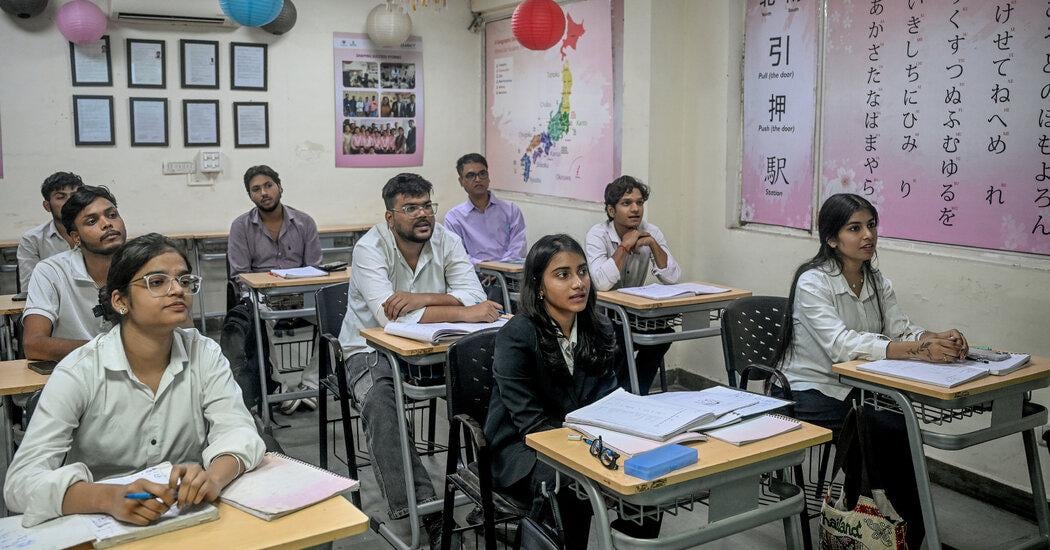
> At an annual India-Japan forum held in New Delhi last December, India’s foreign minister, S. Jaishankar, started the summit by calling for “labor-mobility exchanges.” It topped his list, ahead of defense cooperation, supply chains and chips. In August, the countries started a program that could send 50,000 workers a year from India to Japan.

1 Comment
> New Delhi has quietly signed labor mobility agreements with at least 20 countries over the past half-dozen years – in Europe and Asia, including the Persian Gulf – all with developed economies and most without much history of hiring Indian workers.
> The movement to find new labor markets for Indians like Mr. Peka is gathering pace as the United States, long a favored destination for skilled workers, clamps down on all kinds of migration. President Trump has taken aim at the H-1B visa program, which was supposed to be for temporary assignments, making it harder for students and less-skilled workers to gain entry to the American work force.
> The greatest challenge for the movement will be assuring the host countries that the migration really is temporary.
> In most host countries, it is politically risky to suggest that foreigners like Indians could replace native-born workers. The alternative to permanent immigration, called return and reintegration, is untested. Young migrant workers, having invested in a big move and earning well in their new lives, often fall in love, start businesses and want to settle in the places where their careers take off.
>The demographics of developed economies, however, make a blunt case in favor of attracting India’s millions of workers. National populations are shrinking, and retired people are living longer. With deaths exceeding births everywhere from Italy to Russia to South Korea, worries about overpopulation are obsolete. Last month a study prepared by the Boston Consulting Group estimated a global shortfall of 45 million to 50 million workers by 2030, up from five million in 2023.
> Picture 50 million people on a march across borders, filling those holes in the global work force – more than the entire working-age population of Britain. That is the vision of the Global Access to Talent From India Foundation, a think tank established in New Delhi this year.
> Since the Covid-19 pandemic began, about 50 million Indians working in services or manufacturing have had to return to agricultural work, a hard step backward for those who want to enter the skilled, internationalized work force.
> The big English-speaking countries already have well-trodden paths to entry for Indian workers, especially in highly skilled fields. Canada, the United States, Australia and Britain don’t need help from the Indian government to encourage mobility, in the view of the GATI Foundation.
> If it works as intended, migrants work three- or five-year stints without changing citizenship. The host countries stave off economic stagnation. For India, the temporarily expatriated workers will keep sending home remittances – they already send $135 billion a year – and bring back the capital and know-how it takes to spur enterprise in their own country.
> At an annual India-Japan forum held in New Delhi last December, India’s foreign minister, S. Jaishankar, started the summit by calling for “labor-mobility exchanges.” It topped his list, ahead of defense cooperation, supply chains and chips. In August, the countries started a program that could send 50,000 workers a year from India to Japan.