
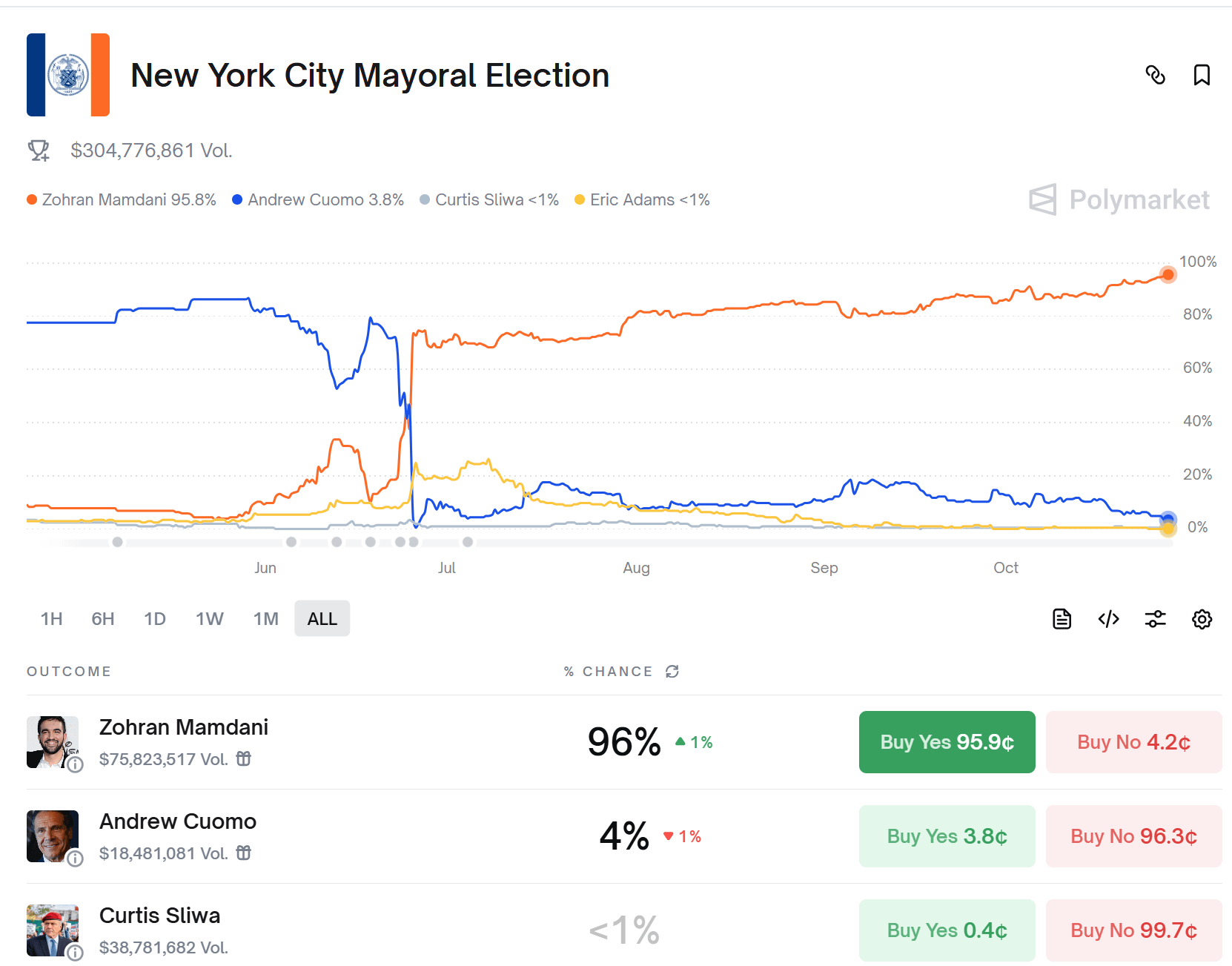
Polymarket has Mamdani at 96% to win the NYC mayoral race, with Cuomo languishing at 4%. That's not "competitive race" numbers – that's "why hasn't this market closed yet" numbers. Looking at that chart, the transformation is stark: Mamdani went from 10-15% in early June to absolutely dominating by mid-July, and he's maintained that position consistently for months.
Now, before anyone dismisses this as just prediction market nonsense, let's remember these markets have been remarkably accurate lately. The 2024 presidential race being exhibit A. When you have this much volume ($300M+) and this level of consensus for this long, that's not just vibes – that's informed money saying this race is cooked.
Why This Matters (And Why We Should Be Paying Attention)
NYC is about to potentially elect its first democratic socialist mayor, and this isn't some small-scale experiment. We're talking 8+ million people, a budget north of $100 billion, and one of the world's premier financial and cultural centers. This is going to be one of the most significant tests of whether progressive policies can actually function at scale in a major American metropolis.
From a neoliberal perspective, there's a lot to be concerned about here, but also some things that are genuinely interesting to watch play out.
The Housing Question
This is probably the biggest one. Mamdani has been pretty vocal about aggressive rent control expansion and skeptical of new market-rate development. From a YIMBY perspective, this is… not great. We know the evidence on rent control is pretty damning – it reduces housing supply, creates inefficiencies, and often ends up helping incumbent renters at the expense of everyone else trying to enter the market. NYC already has some of the worst housing affordability in the country, and if Mamdani goes hard on rent control while being hostile to new development, we could be looking at San Francisco-style dysfunction.
That said, if he actually gets serious about upzoning and streamlining permitting (which some progressive mayors have done), that could be genuinely good. The question is whether he'll prioritize the "build public housing" approach over "let the market build" approach, or find some middle ground.
The Fiscal Reality Check
Here's the thing that's going to be fascinating: NYC faces real budget constraints. The city has pension obligations, debt service, and infrastructure needs that don't care about your political ideology. We've seen progressive mayors in other cities run into the hard wall of fiscal reality pretty quickly. Bloomberg and even de Blasio (who was more progressive) ultimately had to make pragmatic choices because the math doesn't lie.
If Mamdani tries to dramatically expand services without finding sustainable revenue sources, or if his policies lead to business flight, the bond markets are going to have opinions. And unlike Twitter, you can't just ignore bond markets. This could actually be a useful demonstration of how fiscal constraints force moderation even on ideologically committed politicians.
The Business Environment Question
NYC's economy is deeply tied to finance, tech, real estate, and professional services. These industries are mobile in ways they weren't even a decade ago (COVID proved that). If Mamdani pursues aggressive tax increases or creates a hostile regulatory environment, companies can and will leave. We saw this start to happen during the pandemic, and it wouldn't take much to accelerate it.
The counter-argument is that NYC has unique agglomeration benefits that make it sticky – network effects, talent pools, cultural amenities. And maybe that's true! This will be a real-world test of how much you can tax and regulate a city before the benefits of density stop outweighing the costs.
Evidence-Based Policy vs. Ideology
One thing the neoliberal community generally cares about is evidence-based policymaking. Will Mamdani actually look at what works (e.g., congestion pricing, upzoning, streamlined permitting) or will ideology trump evidence? Some democratic socialists have actually been pretty good on housing and transportation policy when they've focused on results over rhetoric. Others have not.
The optimistic take: maybe he'll be pragmatic and focus on things that actually work. The pessimistic take: maybe he'll double down on policies that poll well but have poor track records.
The National Implications
NYC is a trendsetter. What happens there influences progressive politics nationally. If Mamdani succeeds (however you define that), expect more democratic socialists to run for big city mayor positions. If it's a disaster, it could set the movement back significantly.
From a neoliberal perspective, this could go a few ways:
Best case scenario: Mamdani turns out to be a pragmatic progressive who focuses on building housing, improving transit, reducing regulatory barriers, and making government more efficient. He demonstrates that you can be left-wing on values while being evidence-based on policy. This would honestly be great!
Worst case scenario: Aggressive rent control, business-hostile policies, fiscal irresponsibility, and housing supply constraints lead to economic stagnation and declining quality of life. This would be bad for NYC residents and would also hand ammunition to people who want to dismiss any progressive policy out of hand.
Most likely scenario: Somewhere in between. Some good policies, some bad ones, lots of compromises with reality, and ultimately a mixed record that both supporters and critics can cherry-pick from.
The Trump Attack Ad Writes Itself
Here's the uncomfortable truth we need to acknowledge: Trump and the GOP are going to have an absolute field day with this. Imagine the attack ads practically writing themselves: "While hardworking Americans struggle with inflation, New York City – the liberal capital of America – just elected a socialist as mayor. Is this what Democrats want for your city next?"
And here's what makes it worse: it doesn't matter if Mamdani governs pragmatically or if his policies actually work. The optics alone are political gold for Republicans in swing states and districts. Every time Mamdani does anything even slightly controversial, you're going to see it in campaign ads from Michigan to Arizona with ominous music and the "S-word" plastered everywhere. The GOP has been trying to paint mainstream Dems as secret socialists for years – now they have a major city actually electing one, and they don't even have to lie about it.
This is especially dangerous because most Americans don't distinguish between "democratic socialist who wants universal healthcare" and "socialist who wants to abolish private property." To a lot of voters, especially older moderates and independents, socialist = bad, full stop. Doesn't matter that the policy specifics might be popular when polled individually – the label is poison.
The smart move for national Dems is going to be distancing themselves from this hard while hoping Mamdani doesn't give Republicans too much ammunition. But that's also politically tricky because alienating the progressive base has its own costs. Basically, this creates a messaging nightmare for the party heading into 2026 and 2028, and there's not really a clean way out of it.
The Meta Question
There's also something interesting about how decisive this race appears to be. Traditional Democratic establishment candidates got absolutely rolled. Either the NYC Democratic Party is much weaker than people thought, or there's been a genuine ideological shift in the electorate, or Mamdani just ran an exceptionally good campaign while everyone else fumbled.
This matters because if the establishment really is this weak, we might see more insurgent progressive candidates succeed in other major cities. If it's specific to NYC or to Mamdani as a candidate, then maybe it's not replicable.
Bottom Line
I'm not going to sit here and pretend I'm thrilled about every policy position Mamdani has staked out. The rent control stuff makes me nervous, and I'm skeptical of some of the more ambitious spending proposals without clear revenue sources.
But I am genuinely interested to watch this play out. This is either going to be a proof of concept that democratic socialism can work at scale in a major American city, or it's going to be a cautionary tale. Either way, it's going to generate a ton of real-world evidence about what works and what doesn't.
And honestly? That's valuable. We should be experimenting with different approaches at the local level. That's how we figure out what actually improves people's lives versus what just sounds good in theory. Cities are laboratories of democracy and all that.
The fact that the prediction markets are this confident this far out is remarkable and suggests this race really is over barring something extraordinary. So we might as well start thinking seriously about what a Mamdani mayoralty actually means for NYC and for urban governance more broadly.
Gonna be watching this one closely. Time to see if the "democratic socialism can work in practice" crowd or the "fiscal reality always wins" crowd ends up being right.
Either way, it's going to be one hell of a case study.
Posted by Acceptable_Fact423
11 Comments
The reference to the “July Surge” is bizarre. It seems to be plotted for late June ie. when Mamdani won the primary and became the Democratic nominee for mayor
Chat GPT?
Also the reason Mamdani’s betting odds surged is because he won the fucking Democratic primary.
This election literally doesn’t matter.
The NYC mayor has always been extreme. I would wish that democrats stop nationalizing races all the damn time.
Thanks ChatGPT, very cool
All my homies hate Andrew Cuomo
Yeah, the candidate for the democratic party will probably win the mayoral election in NYC.
News at 11.
I don’t care what degen gamblers think
In a perfect/optimistic world, I’d agree with this take. And I actually do hope it ages well (the idea that this will be an objective real-world test for a lot of left-wing policies, or that it could even unite Democrats on evidence-based policy or whatever).
But we still live in our reality of a toxic, polarized political environment, so I’m going to temper my expectations. I’d guess that regardless of what happens in NYC under Mamdani, we will still be arguing for years about whether it was really his policies that resulted in whatever good/bad outcomes we see play out. If things go well, centrists will probably say that things would’ve gone well anyway, and vice versa. If things go poorly, leftists will probably just blame the national environment.
And if recent history is any indicator, we probably won’t even be able to agree on what counts as “things going well” vs “things going poorly”.
Nice essay amigo
AI slop post
Bot post