
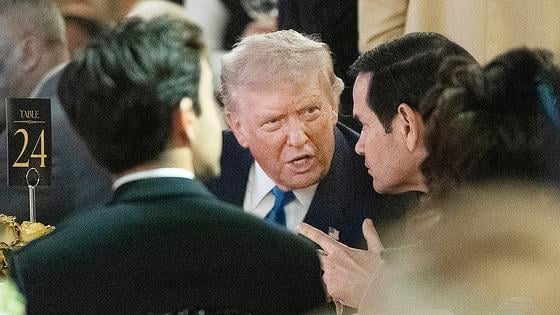
Fred Fleitz, vice president of the America First Policy Institute (AFPI) and a close aide to former U.S. President Donald Trump, said on November 3 (local time) that “President Trump’s position is that if South Korea wants nuclear weapons, he would support it.”
Fleitz previously served as chief of staff of the National Security Council (NSC) during Trump’s first term.
Speaking at an online seminar hosted by the Institute for Corean-American Studies (ICAS), Fleitz was asked by The JoongAng Ilbo about the implications of Trump’s recent remarks supporting South Korea’s request to build nuclear-powered submarines. He replied, “It would be a tremendous leap and a very provocative situation for North Korea,” reaffirming that Trump would back Seoul’s move if it chose to develop nuclear weapons.
Fleitz explained that the situation surrounding South Korea’s nuclear ambitions had changed significantly compared to the Biden administration. He said, “Former President Yoon Suk-yeol’s proposal to either develop an independent nuclear program or redeploy U.S. tactical nuclear weapons on the peninsula drove the Biden administration crazy.”
He continued, “Eventually, through Yoon’s state visit to the U.S. and the Camp David trilateral summit with the U.S. and Japan, he agreed to withdraw that idea.”
However, Fleitz said that unlike the Biden administration, “The Trump administration would not show the same strong opposition.” He added, “Trump would first reassure South Korea and Japan that America’s nuclear umbrella is guaranteed,” but he reiterated that Trump would likely support Seoul’s decision if it truly wanted nuclear weapons.
When asked whether Trump’s ultimate goal in dialogue with North Korea remained “denuclearization,” Fleitz did not give a direct answer. Instead, he repeatedly emphasized that “President Trump’s goal is not regime change.”
On the question of Japan’s potential nuclear armament, Fleitz also did not rule out the possibility that Trump might support it, though he noted, “Given the strong domestic opposition in Japan, the likelihood of Japan acquiring nuclear weapons is extremely low.”
He concluded, “There’s still a long way to go, but if South Korea wants it, Trump will support it.”
Regarding Trump’s recent visit to South Korea and the unfulfilled “surprise meeting” with North Korean leader Kim Jong-un, Fleitz said, “It seems Trump does not yet want to meet with Kim Jong-un.”
He added, “There’s currently no U.S. ambassador to South Korea, and Trump hasn’t named a special envoy for North Korea yet. These positions should be filled quickly before any serious dialogue begins.”
He stressed the urgency of appointing a new ambassador to Seoul, noting that the post has been vacant since Acting Ambassador Joseph Yun returned to Washington last month, with Kevin Kim temporarily filling in to assist during Trump’s visit.
“Several candidates were considered, but some declined or withdrew,” Fleitz said. “There’s still debate between the White House and State Department over whether to nominate a political appointee or a career diplomat. Since Trump views the ambassador to South Korea as a critical position, he will likely choose someone he knows personally and trusts.”
He pointed out that “George Glass, the U.S. ambassador to Japan, lives in Florida and is a Mar-a-Lago member who can call Trump anytime,” suggesting that “a similar type of person will be chosen for South Korea.”
As for key figures managing Korean Peninsula policy, Fleitz named Marco Rubio as the most influential, describing him as “Secretary of State and National Security Advisor.”
He explained, “Unlike during Trump’s first term, when he heard from many senior officials, this time Trump is relying on a small inner circle: Rubio, Defense Secretary Pete Hegseth, CIA Director John Ratcliffe, and Chief of Staff Susie Wiles.”
According to Fleitz, “Rubio has been expanding his influence by keeping Trump’s foreign policy from drifting too far toward isolationism.”
He also said that “Ratcliffe’s influence has grown remarkably in recent months” and described him as “a trusted figure who avoids media attention.”
Lastly, Fleitz evaluated the two recent summits between President Lee Jae-myung and Trump, saying, “President Lee hit a home run.”
He added, “Many in the U.S. thought of Lee as anti-American, pro-China, and pro-North Korea, but his decision to visit Japan first and to have South Korea build nuclear-powered submarines in Philadelphia was a remarkable step forward.”
In July, Fleitz also expressed concern on X (formerly Twitter), saying,
“Reports that former President Yoon Suk-yeol is being mistreated while in detention, and media reports that he could face the death penalty or life imprisonment, are deeply troubling.”
Posted by Freewhale98
1 Comment
I think this is a spicy take on this sub, but I think Japan and Korea can’t rely on the US and should have their own nuclear weapons.