
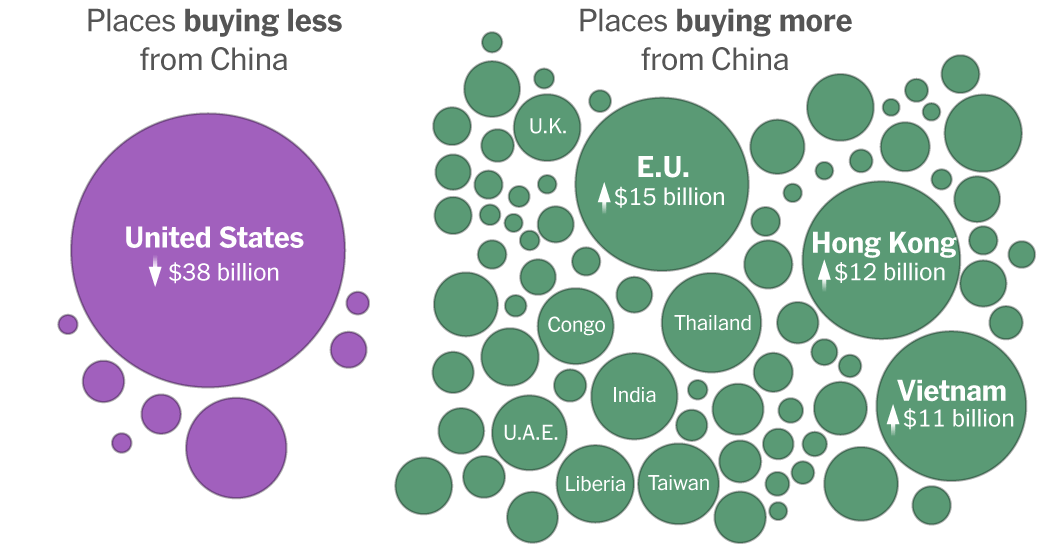
As President Trump has imposed steep tariffs on China, American importers are buying much less. But the rest of the world is making up the difference, buying more from China than ever.
China has offset the decline from America with breathtaking speed. Shipments to other parts of the world have surged this year, demonstrating that China’s manufacturing dominance will not be easily slowed. Chinese exports are on track to reach another record this year. That’s because China was prepared. It has been seeking out new customers for years, and its massive manufacturing investment allows it to sell goods at low prices.
Last week, Mr. Trump reduced the tariffs he imposed on China, though they remain at heights not seen in decades. He insists that his tariffs will force a revival of American factories and create jobs — a pledge that is contested by many economists and manufacturing experts. It is also unclear how effective his policies will be in stemming the flow of goods that originate in China and route through other countries before arriving in the United States.
The rest of the world is caught between the two superpowers. Some countries, including Vietnam and members of the European Union, are deeply concerned about the risk posed by China’s exports to their own industries, and China faces a backlash in the form of tariffs in regions like Europe. Other nations, like Argentina and Nigeria, are buying low-cost Chinese technology to modernize their economies but running up wider trade imbalances with China.
It remains to be seen how effective Mr. Trump will be in pressuring countries, especially those in Asia, to reject rerouted Chinese exports as part of trade negotiations. These workarounds limited the impact of his trade measures with China during his first term.
One thing is certain: American consumers are buying more goods from other parts of Asia. In September, Thailand’s exports to the United States rose by 33 percent. Taiwan’s exports also grew by 51 percent, and Singapore’s by 13 percent.
The shifts in China’s exports are part of what is expected to be a continuing and unpredictable transformation. Mr. Trump’s tariff reduction last week, which he said lowered overall tariffs on China to about 45 percent from about 55 percent, could stabilize China’s exports to the United States, said Gerard DiPippo, associate director of the RAND China Research Center.
But despite agreeing to a one-year trade truce with China, Mr. Trump is considering whether to impose additional tariffs on industries dominated by China, such as pharmaceuticals and drones. He is vowing to wean America off its reliance on China for some critical minerals. With more than three years left in office, Mr. Trump’s campaign to reshape trade is unlikely to end here.
Posted by John3262005