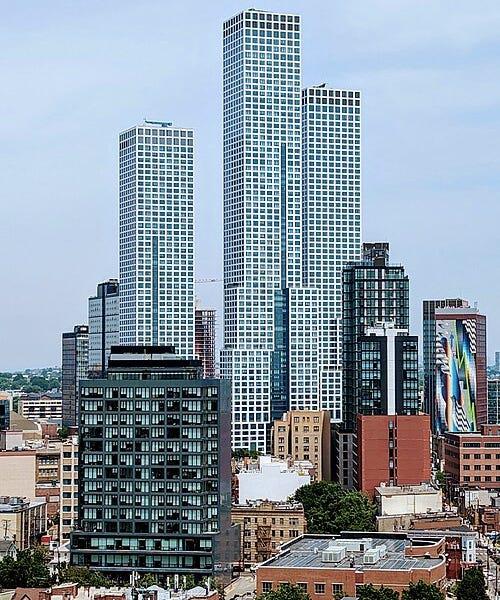
> Jersey City is a unicorn. It’s one of the only coastal cities growing like a sunbelt city. Over the past 15 or so years, its population has increased by 20 percent and its housing stock by 24 percent. But instead of growing out, as they do down south, Jersey City grew up.
> Last month, I wrote about the political and economic forces that made Jersey City’s building boom possible for Vital City’s housing issue (which readers of this newsletter should absolutely check out). It’s not an unalloyed success story: There have been real growing pains and missed opportunities. But through its building boom, Jersey City has managed to retain its diversity, protect low-income tenants, add to its affordable housing stock, and create a more vibrant street scene. All the while, it’s done more than its fair share to address the housing shortage in the New York area.
> In this post, I’m going to focus on the development pattern that Jersey City exemplifies. The majority of its new construction took place in two areas right next to PATH train stations: At Exchange Place and Newport on the Hudson River waterfront and at Grove Street and Journal Square some ways inland. These relatively small neighborhoods were able to add thousands of homes by permitting a couple dozen towers with hundreds of units apiece. (In fact, these Jersey City neighborhoods actually have higher-density base zoning than anywhere in Manhattan, where the tallest buildings are only possible because of “air rights” purchased from nearby properties.)
> Niskanen Center housing policy analyst Alex Armlovich calls this pattern “missing massive” development, in contrast to the “missing middle” housing idealized by many urban planners. It’s a pattern that’s commensurate with the housing need in a region with an extreme shortage, and complimentary to a transit system like PATH. Missing massive development deserves more attention from advocates, researchers and policymakers. It ought to be evaluated on its own terms, distinct from traditional downtown high-rise development, suburban edge cities, or missing middle housing.
> Big ass trains, arriving every 15 minutes or better, are symbiotic with super high-density urbanism. (Case in point: Vancouver.) These should be mixed-use neighborhoods, combining housing, commercial, and institutional structures. Missing massive doesn’t necessarily have to mean high rises, either. Washington, DC, for instance, does missing massive density within its strict height limits. Thanks to the development in NoMa and the Navy Yard, DC is one of very few coastal cities that comes close to Jersey City’s growth rate in recent years.
> But DC and JC are exceptions. Outside of big city downtowns, only a handful of neighborhoods around the country reflect this transit-oriented, missing massive pattern. I explored many of them over the course of my book research
!ping YIMBY
unfaircrab2026 on
When I think of Vancouver I think of housing affordability success. The real problem with Vancouver is the massive sfa suburbia built
near downtown. If it was more in line with the density we see in the Plateau/Mile End in Montreal we’d be better off
Selling suburban Americans on streetcar suburbs which can achieve great density is far easier than selling them on massive towers and the chance to buy a cube in that tower.
dubiouscoffee on
JC is doing our part for democracy (building housing for blue voters to live in)
CincyAnarchy on
Unironically I do think “missing middle” discourse smuggled in a lot of NIMBYism with it. Particularly NIMBYism against larger and taller housing projects that are necessary in what are “already urban” neighborhoods.
Like, you know what? Sure. Streetcar suburbs rule. When I think about nearly all the neighborhoods I’ve visited and thought “Yeah I could live here?” They’re all streetcar suburbs. I live in one right now, though it was more of a “Streetcar Exurb” when it was built in the 1920s.
There is no “final form” neighborhoods reach and then it’s fair for that neighborhood to be frozen in amber. As a city grows, so does it’s core, and so should it’s neighborhoods.

4 Comments
> Jersey City is a unicorn. It’s one of the only coastal cities growing like a sunbelt city. Over the past 15 or so years, its population has increased by 20 percent and its housing stock by 24 percent. But instead of growing out, as they do down south, Jersey City grew up.
> Last month, I wrote about the political and economic forces that made Jersey City’s building boom possible for Vital City’s housing issue (which readers of this newsletter should absolutely check out). It’s not an unalloyed success story: There have been real growing pains and missed opportunities. But through its building boom, Jersey City has managed to retain its diversity, protect low-income tenants, add to its affordable housing stock, and create a more vibrant street scene. All the while, it’s done more than its fair share to address the housing shortage in the New York area.
> In this post, I’m going to focus on the development pattern that Jersey City exemplifies. The majority of its new construction took place in two areas right next to PATH train stations: At Exchange Place and Newport on the Hudson River waterfront and at Grove Street and Journal Square some ways inland. These relatively small neighborhoods were able to add thousands of homes by permitting a couple dozen towers with hundreds of units apiece. (In fact, these Jersey City neighborhoods actually have higher-density base zoning than anywhere in Manhattan, where the tallest buildings are only possible because of “air rights” purchased from nearby properties.)
> Niskanen Center housing policy analyst Alex Armlovich calls this pattern “missing massive” development, in contrast to the “missing middle” housing idealized by many urban planners. It’s a pattern that’s commensurate with the housing need in a region with an extreme shortage, and complimentary to a transit system like PATH. Missing massive development deserves more attention from advocates, researchers and policymakers. It ought to be evaluated on its own terms, distinct from traditional downtown high-rise development, suburban edge cities, or missing middle housing.
> Big ass trains, arriving every 15 minutes or better, are symbiotic with super high-density urbanism. (Case in point: Vancouver.) These should be mixed-use neighborhoods, combining housing, commercial, and institutional structures. Missing massive doesn’t necessarily have to mean high rises, either. Washington, DC, for instance, does missing massive density within its strict height limits. Thanks to the development in NoMa and the Navy Yard, DC is one of very few coastal cities that comes close to Jersey City’s growth rate in recent years.
> But DC and JC are exceptions. Outside of big city downtowns, only a handful of neighborhoods around the country reflect this transit-oriented, missing massive pattern. I explored many of them over the course of my book research
!ping YIMBY
When I think of Vancouver I think of housing affordability success. The real problem with Vancouver is the massive sfa suburbia built
near downtown. If it was more in line with the density we see in the Plateau/Mile End in Montreal we’d be better off
Selling suburban Americans on streetcar suburbs which can achieve great density is far easier than selling them on massive towers and the chance to buy a cube in that tower.
JC is doing our part for democracy (building housing for blue voters to live in)
Unironically I do think “missing middle” discourse smuggled in a lot of NIMBYism with it. Particularly NIMBYism against larger and taller housing projects that are necessary in what are “already urban” neighborhoods.
Like, you know what? Sure. Streetcar suburbs rule. When I think about nearly all the neighborhoods I’ve visited and thought “Yeah I could live here?” They’re all streetcar suburbs. I live in one right now, though it was more of a “Streetcar Exurb” when it was built in the 1920s.
There is no “final form” neighborhoods reach and then it’s fair for that neighborhood to be frozen in amber. As a city grows, so does it’s core, and so should it’s neighborhoods.