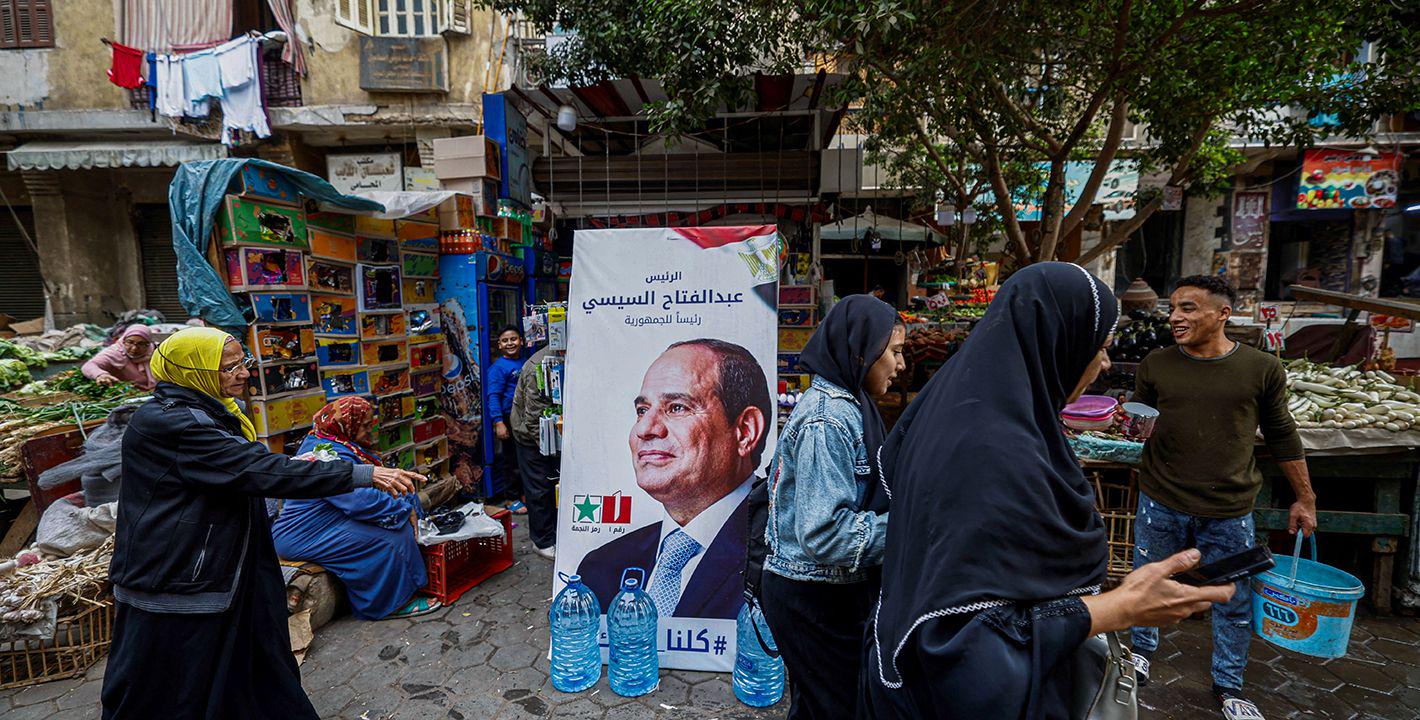
President Abdel-Fattah el-Sisi seeks to modernize Egypt. The “new republic” he is building is marked by a radical redefinition of the social contract established after 1952, a new form of state capitalism, and a reinforcement of presidential powers within an emerging military guardianship. The regime is strong and cohesive at the top, however, its inability to achieve social and political hegemony and its overreliance on coercion leave the Second Republic at permanent risk of unravelling.
**Key Themes:**
* Sisi has replaced the extensive social welfare and redistributive polices of the post-1952 republic with an ethos of “nothing for free,” while marginalizing the public sector, which previously formed the primary sociopolitical constituency of the regime;
* The president has awarded himself “hyperpresidential” powers exceeding those of all his predecessors;
* The political primacy of the armed forces is both set in stone and fundamental to the evolution of the Second Republic;
* Sisi’s revival of state capitalism, based on parastatal agencies under his control, is generating a hybrid economy comprising public-public partnerships and the subordination of private capital to the state’s needs;
* Tension is inherent in the goals Sisi seeks in the political, economic, and social domains, threatening the longevity of the new republic he is forging.
**Findings:**
* The Egyptian regime is strong and cohesive at the top, but rests on weak political and ideological foundations, compelling it to extend patronage to a wider circle of beneficiaries despite the state’s dwindling financial resources;
* The regime is investing in repression, ideological domination by crowding the information space, and palliative measures such as cash programs for the poor. However, these do not generate social and political consensus given the severe cuts to social service spending and an unwillingness to undertake structural reforms that would genuinely emancipate market forces;
* Only repeated massive injections of capital by external partners have kept the regime from failing dramatically, but this has enabled it to maintain public policies and investment strategies that have exacerbated economic problems and left it ill-equipped to confront future challenges;
* The Second Republic might not outlive Sisi’s presidency, but the break with the post-1952 republic is irreversible, so the new republic’s legacies will endure—for good or bad.
* The accumulation of private wealth by the regime’s core members is turning them into a propertied class and paving the way for a novel fusion with the upper middle-class elite. This may be the most enduring consequence of the Second Republic.

1 Comment
**Summary:**
President Abdel-Fattah el-Sisi seeks to modernize Egypt. The “new republic” he is building is marked by a radical redefinition of the social contract established after 1952, a new form of state capitalism, and a reinforcement of presidential powers within an emerging military guardianship. The regime is strong and cohesive at the top, however, its inability to achieve social and political hegemony and its overreliance on coercion leave the Second Republic at permanent risk of unravelling.
**Key Themes:**
* Sisi has replaced the extensive social welfare and redistributive polices of the post-1952 republic with an ethos of “nothing for free,” while marginalizing the public sector, which previously formed the primary sociopolitical constituency of the regime;
* The president has awarded himself “hyperpresidential” powers exceeding those of all his predecessors;
* The political primacy of the armed forces is both set in stone and fundamental to the evolution of the Second Republic;
* Sisi’s revival of state capitalism, based on parastatal agencies under his control, is generating a hybrid economy comprising public-public partnerships and the subordination of private capital to the state’s needs;
* Tension is inherent in the goals Sisi seeks in the political, economic, and social domains, threatening the longevity of the new republic he is forging.
**Findings:**
* The Egyptian regime is strong and cohesive at the top, but rests on weak political and ideological foundations, compelling it to extend patronage to a wider circle of beneficiaries despite the state’s dwindling financial resources;
* The regime is investing in repression, ideological domination by crowding the information space, and palliative measures such as cash programs for the poor. However, these do not generate social and political consensus given the severe cuts to social service spending and an unwillingness to undertake structural reforms that would genuinely emancipate market forces;
* Only repeated massive injections of capital by external partners have kept the regime from failing dramatically, but this has enabled it to maintain public policies and investment strategies that have exacerbated economic problems and left it ill-equipped to confront future challenges;
* The Second Republic might not outlive Sisi’s presidency, but the break with the post-1952 republic is irreversible, so the new republic’s legacies will endure—for good or bad.
* The accumulation of private wealth by the regime’s core members is turning them into a propertied class and paving the way for a novel fusion with the upper middle-class elite. This may be the most enduring consequence of the Second Republic.