
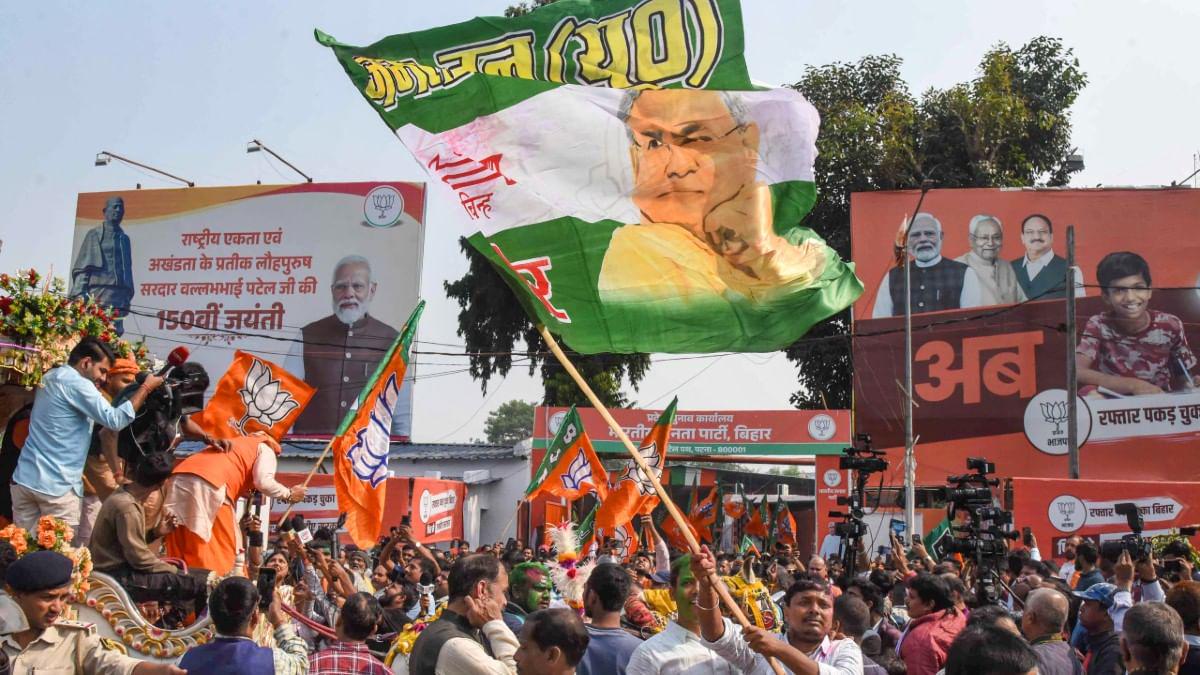
I have to study but I cant miss a chance to talk about the bihar election since i Have been following it on and off since the summer of this year
Anyhow this is a intersting piece by my favorite journalist Shekar Gupta who got me through my finals and who I read during my graudation party.
Hope others enjoy it!
Posted by ewatta200
2 Comments
● The first is that however incredible this landslide might look, the ossified vote banks remain. As fights become more direct, either between two parties or alliances, the gap between a rout and a landslide can be just a few percentage points. The JDU got 15.39 percent vote in 2020 and it has now gone up by about 4 percentage points to 19.26 (provisional figures at the time of writing). The BJP has risen, but only by a percentage point to 20.11 (provisional figures). Both have contested in a few seats fewer but let’s read that as marginal because these have gone to their allies. The most important ally, the Paswan dynasty’s Lok Janshakti Party (LJP), for example, contested just 29 seats this time, compared to 135 in 2020. Its vote percentage has remained frozen at just over 5 percent. It’s evident that in the other constituencies, its tiny vote parcels must’ve gone to the BJP or JDU.
[](https://vdo.ai/contact?utm_medium=video&utm_term=theprint.in&utm_source=vdoai_logo)
Now, flip the coin. The Yadav dynasty RJD’s vote share has remained almost constant around 23 percent, as has the Congress party’s around 9 percent. It is clear, therefore, that the two alliance partners have not lost any vote share. It is just that the NDA has built a better alliance with Paswan’s LJP and Jitan Ram Manjhi’s Hindustani Awam Morcha (HAM) to build that additional 5-8 percent kicker over frozen BJP/JDU votes. That kicker is the difference between a rout and a landslide. This is the central message of this election. The rival cannot take away your committed voters. You have to stitch alliances to bring in the “others”.
● Second, transactional appeals work if enough voters find them credible. The Rs 10,000 given to 1.4 crore women on the eve and during the campaign, and the promise of another two lakh was a lot in a state with a per capita income of Rs 69,000 per year. Plus, the voters had evidence that this was for real. In a transactional competition, one who has the power and the chequebook will always have an advantage.
● The third, following this, is that oldest truism in marketing. That nothing fails more disastrously than an obvious lie or impossibility. This was Tejashwi Yadav’s promise of a state government job to one member from each of the state’s 2.76 crore families. This only drew derision and even some contempt in a state with barely 20 lakh government employees: is this guy even serious? Or does he think we are stupid?
The opposition has consolidated yadav and Muslim vote but they didn’t realize how much opposition there is for yadavs in Bihar.
All the other castes voted together for modi and nitish. It also seems like yadav vote flipped to NDA as well coz this level of majority is not possible without some flipping.
For nitish I think this might be the end of an excellent career for him. He saved Bihar and made it safe for its citizens. Hope next era leaders take him as impression and improve the state while protecting everyone