
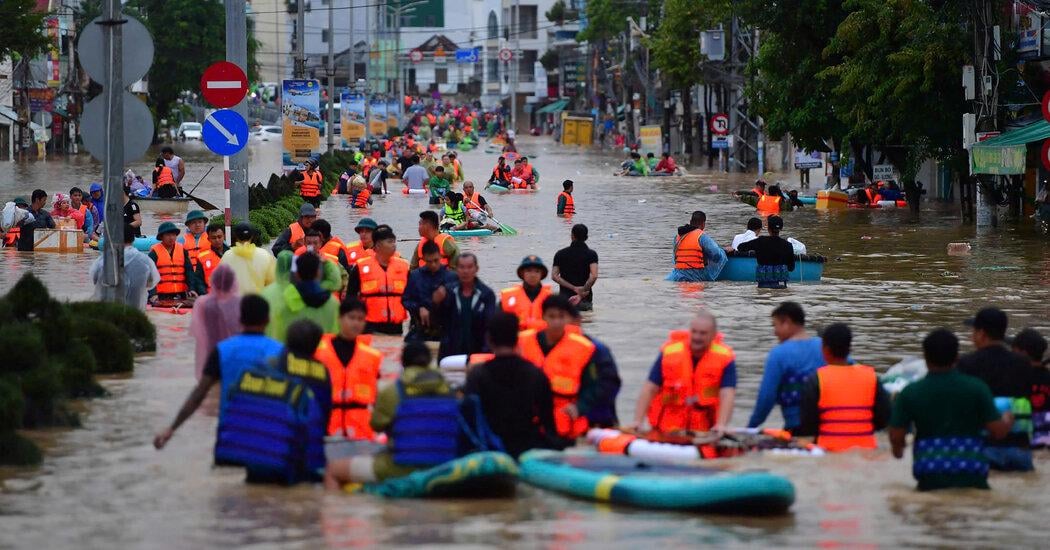
Vietnam’s year of floods, mud and death | Scientists suggested that climate change could make central Vietnam a global hot spot for destructive storms. This year has seemed to prove the point
Posted by ONETRILLIONAMERICANS
Vietnam’s year of floods, mud and death | Scientists suggested that climate change could make central Vietnam a global hot spot for destructive storms. This year has seemed to prove the point
Posted by ONETRILLIONAMERICANS
1 Comment
# The latest storm
> Central Vietnam has become the latest epicenter of a deadly rainy season in Asia that has been supercharged by climate change, and seems to drag on without end.
> More than 90 people in the nation have been killed in the past week from flooding and landslides, and around a dozen more are missing, government officials reported Sunday.
> In one province, more than six feet of rain has fallen over the past few days. Peak coffee harvesting has been delayed. One government report noted that at least 200,000 homes have been flooded from the weekend’s heavy rains.
> “It’s never happened like this before,” said Dao Dang Cong Trung, 44, the leader of a small rescue team from Hoi An who took his speedboat to the most damaged areas. “Local residents told me the floodwater rose too fast and they didn’t have time to do anything, so the damage is severe to their houses and many people died.”
# This year’s destruction in Vietnam
> Vietnam has been hit by 14 typhoons this year. Five was the average a few decades ago. The rain from the past few days did not even come from a cyclone — but to add inundation on top of injury, a 15th major storm has just formed off the country’s south central coast.
> Images of this year’s relentless battering — of thick, soupy brown water sloshing over homes, shops, coffee plantations, tourist hotels and family tombs — have become both ubiquitous and disorienting. They can be hard to place in time, for many, because even as the rainy season is supposed to fade (as of this month), the floods have spread.
> Central Vietnam has been the hardest hit, from around Da Nang last month to more than 300 miles south, near Nha Trang, where the suffering is concentrated now.
> But Ho Chi Minh City flooded in August and again in early November. Hanoi was underwater last month, in a two-week period when three typhoons hit Vietnam. The rivers around Hue, a onetime royal capital, rose by 17 feet during a wet stretch of October, carrying muck into carefully restored historic buildings.
# Climate change connections
> Climate scientists stress that Vietnam — along with many other nations — needs to move faster to get ahead of rapid change caused by global warming.
> The old standards, for rain, storms or how high rivers will rise, no longer fit an era when research shows that once-in-a-century extremes can happen far more often than that.
> Geographically, Vietnam is especially vulnerable. A [2024 study](https://www.researchgate.net/publication/381911920_Changes_to_tropical_cyclone_trajectories_in_Southeast_Asia_under_a_warming_climate) identified it as a climate change “hot spot,” showing that warming temperatures adding moisture to the atmosphere and heating up the South China Sea would combine with typhoon patterns to create a vortex of risk.
> “We wrote that in 2024, thinking it would be something that would play out over the next few decades, not the next 12 months,” said Benjamin P. Horton, chair of the earth science department at the University of Hong Kong, and a co-author of the report.
> “You’d expect rain anyhow, but it’s becoming more extreme,” he added. “When you have natural variation, when it should be wetter, climate change takes it to the next level.”
> Mr. Trung, the rescuer with the boat, said he was still trying to process the disasters that no longer seem natural.
!ping ECO&SEA