
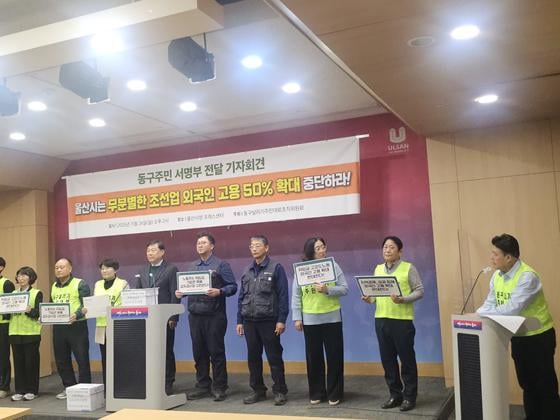
Major shipyards such as HD Hyundai Heavy Industries and HD Hyundai Mipo Dockyard are concentrated in Ulsan’s Dong-gu district, and local residents are now organizing full-scale opposition to the expansion of the “Ulsan Metropolitan Visa.” Residents fear that a rapid influx of foreign workers could destabilize job security and wages for domestic workers.
The Ulsan Metropolitan Visa is a program in which skilled workers are trained overseas in advance and then brought to Ulsan’s shipbuilding sites to work for about two years. Ulsan City, together with South Gyeongsang Province, was selected in May as a pilot region for the metropolitan visa program and launched a study in August to consider expanding it.
In connection with this, the Dong-gu residents’ group “5th Committee for Reviving Dong-gu” held a press conference at Ulsan City Hall on the 24th to announce their opposition. The group stated, “Because Dong-gu allows foreign workers for up to 30% of the regular workforce in shipbuilding, there are already over 7,000 migrant workers employed at Hyundai Heavy Industries and related facilities. Expanding that percentage further would increase the number to as many as 12,500 foreign workers.” The group added, “A large-scale influx of foreign workers without appropriate countermeasures will negatively affect residents’ quality of life and the local economy. Fixing the dual labor structure between primary contractors and subcontractors, and preventing the outflow of skilled domestic workers, are the real keys to solving the labor shortage—not expanding foreign worker visas.” The organization called for the immediate cancellation of the metropolitan visa initiative, saying, “The city’s plan, which targets 50% foreign-worker employment among HD Hyundai Heavy Industries’ partner firms, must be scrapped.”
On the other hand, Ulsan City is moving toward expanding overseas skilled labor–training programs to address the acute workforce shortage in shipbuilding. The city stated that 49 Vietnamese workers will arrive on the 26th under the first batch of metropolitan visas. A city official said, “Between the end of this year and January next year, additional workers from Uzbekistan (19 people) and Thailand (28 people) who received metropolitan visas will enter Korea. We plan to bring in about 440 metropolitan visa workers to Ulsan by next year.”
Separate from the metropolitan visa program, Ulsan is also seeing results from its “Global Skilled Talent Training Program” conducted in cooperation with Uzbekistan. In July, 97 young trainees from Uzbekistan completed the first round of training in key shipyard jobs such as electrical work and painting. They then underwent three months of basic education—including Korean language, workplace etiquette, and basic legal knowledge—and were recently assigned to shipbuilding companies in the Ulsan area. This project is a three-party cooperation model in which Ulsan City provides educational infrastructure and visa issuance, HD Hyundai Heavy Industries provides technical training, and the Uzbek government handles recruitment and training facilities. The city plans to train an additional 411 skilled workers in Uzbekistan by the end of the year, and to secure 230 more trainees from Vietnam and Thailand as well.
Ulsan is sourcing shipbuilding labor overseas because domestic manpower has not kept pace with the rising number of ship orders. According to the Shipbuilding & Offshore Plant Human Resources Development Committee (ISC), the job vacancy rate in the shipbuilding industry last year was 14.7%, nearly double the national industrial average of 8.3%. The Korea Offshore & Shipbuilding Association estimates that Korea’s shipbuilding sector faces a shortage of around 12,000 workers every year, and by 2027, as many as 130,000 additional workers could be needed.
Posted by Freewhale98
5 Comments
South Korean population decline made its shipbuilding sector unable to keep up with rising ship orders only with native population. So, foreign workers are brought to Ulsan causing tensions in local population. The locals accuse foreigners ruining their neighborhoods and destroying local businesses. According to locals, these foreigners don’t shop at local shops, don’t buy local products and don’t eat at local restaurants. So, they don’t want these foreigners in the neighborhood.
I wonder how the government and President will react considering they said they support a diverse Korea and are against prejudice and discrimination against immigrants
Could this encourage moving shipbuilding to the US? The labor is more expensive, but the market is also much bigger.
South Korea will be such an interesting place to watch when I turn 50 in 18 years, I don’t even know if it’ll be recognizable since the demographic collapse is backed in and its clear the right would rather just die than let in immigrants.
If you don’t want migrants make them citizens