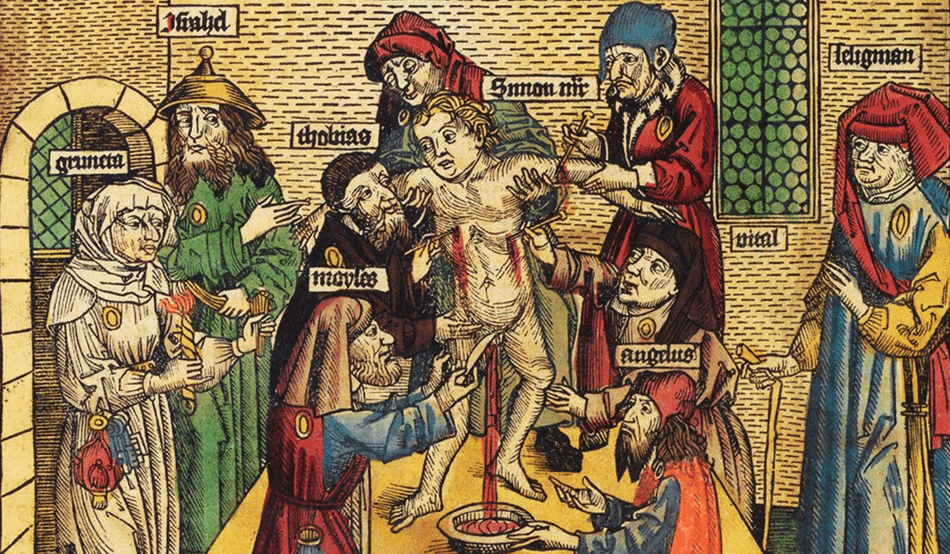
> “Gentiles have been imagining Jews seated together at a ritual table sipping gentile blood for millennia.”
I would’ve said “anti-semites” instead of “gentiles.” Dividing the world between Jewish people and non-Jewish people is overly simplistic and plays into toxic narratives about “us” and “them.” It’s indisputable that gentile persons, associations, and even governments have engaged in horrific anti-Semitic actions and rhetoric; I don’t want to downplay that. But, they did that because they were anti-Semitic, not just because they were gentiles. There is value in distinguishing between “this is the ideology and the people who propagate it” versus “this is what *they* think of *us*.” The latter plays into the same rhetoric that has harmed Jewish people and communities; though, of course the results are not comparable in harm caused. I just think it’s poor rhetoric.
Overall, the article feels like it’s the beginning of a longer paper or essay. I wish it was longer and presented empirical evidence, rather than solely anecdotes. The protest described is clearly bad-faith and bad-taste in its portrayal of the violence in Gaza. But, it’s the one of only two modern examples the author mentions, with Tucker Carlson’s clear canard against the Jewish people for “having Jesus killed”; the others are actions from the Classical Era through the Middle Ages. There’s clearly a connection in rhetoric and imagery between the modern examples and the historical ones, but I’m unsure as to the larger point the author is trying to make. Is she trying to say that anti-Semitism is growing as a problem? Because I’d agree, and there’s data that shows that. Beyond that, there are instances of actual violence against Jewish people in the US within this year. So why not use the data and the anecdotes? The closing sentence of the article would be a great thesis statement to explore in depth, so I feel a little lacking after not receiving that exploration.
> “The United States is both incomprehensibly powerful and also insulated from the violence and vulnerability which attends many of the countries over which its power has immense impact. Thus, the people across the globe who are materially affected by American action, among them both Israelis and Palestinians, are reduced to little more than symbolic flourishes in US political discourse.”
I find that many of the people I’ve spoken to about the War in Gaza actually do care about Palestinians more than just as symbolic flourish. I know people who saw videos and photos that moved them to call for a cease-fire in protests. I think the author is taking an overly-simplistic view of a complex issue. Sure, there are many protestors and posters who clearly only cared about the issues of Palestine for clout, or because it became trendy. But that doesn’t change the fact that many of them have genuine concern for children. The ad with Patrick Stewart talking about donating to feed hungry children reached me. It’s hard to see human tragedy and not have a reaction. The quoted line seems to show me that an offensive protest stand in a train station, that I didn’t even hear about until now despite living in Greater DC, is more important to the author than analyzing whether people can see genuine human tragedy and respond in honesty.

1 Comment
> “Gentiles have been imagining Jews seated together at a ritual table sipping gentile blood for millennia.”
I would’ve said “anti-semites” instead of “gentiles.” Dividing the world between Jewish people and non-Jewish people is overly simplistic and plays into toxic narratives about “us” and “them.” It’s indisputable that gentile persons, associations, and even governments have engaged in horrific anti-Semitic actions and rhetoric; I don’t want to downplay that. But, they did that because they were anti-Semitic, not just because they were gentiles. There is value in distinguishing between “this is the ideology and the people who propagate it” versus “this is what *they* think of *us*.” The latter plays into the same rhetoric that has harmed Jewish people and communities; though, of course the results are not comparable in harm caused. I just think it’s poor rhetoric.
Overall, the article feels like it’s the beginning of a longer paper or essay. I wish it was longer and presented empirical evidence, rather than solely anecdotes. The protest described is clearly bad-faith and bad-taste in its portrayal of the violence in Gaza. But, it’s the one of only two modern examples the author mentions, with Tucker Carlson’s clear canard against the Jewish people for “having Jesus killed”; the others are actions from the Classical Era through the Middle Ages. There’s clearly a connection in rhetoric and imagery between the modern examples and the historical ones, but I’m unsure as to the larger point the author is trying to make. Is she trying to say that anti-Semitism is growing as a problem? Because I’d agree, and there’s data that shows that. Beyond that, there are instances of actual violence against Jewish people in the US within this year. So why not use the data and the anecdotes? The closing sentence of the article would be a great thesis statement to explore in depth, so I feel a little lacking after not receiving that exploration.
> “The United States is both incomprehensibly powerful and also insulated from the violence and vulnerability which attends many of the countries over which its power has immense impact. Thus, the people across the globe who are materially affected by American action, among them both Israelis and Palestinians, are reduced to little more than symbolic flourishes in US political discourse.”
I find that many of the people I’ve spoken to about the War in Gaza actually do care about Palestinians more than just as symbolic flourish. I know people who saw videos and photos that moved them to call for a cease-fire in protests. I think the author is taking an overly-simplistic view of a complex issue. Sure, there are many protestors and posters who clearly only cared about the issues of Palestine for clout, or because it became trendy. But that doesn’t change the fact that many of them have genuine concern for children. The ad with Patrick Stewart talking about donating to feed hungry children reached me. It’s hard to see human tragedy and not have a reaction. The quoted line seems to show me that an offensive protest stand in a train station, that I didn’t even hear about until now despite living in Greater DC, is more important to the author than analyzing whether people can see genuine human tragedy and respond in honesty.