
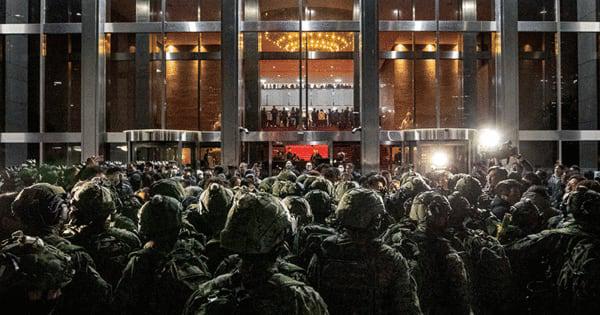
On the night of December 3, 2024, former President Yoon Suk-yeol declared emergency martial law in a televised broadcast, saying he would “protect the Free Republic of Korea from plunging into a ruinous abyss.”
The choice he made that night, which ended after just six hours, has continued to unfold as a disaster nearly a year later.
Yoon ultimately became the first sitting president in Korean constitutional history to be arrested and detained, and he and First Lady Kim Keon-hee both were arrested and indicted. He was removed from office, the administration collapsed, and those who acted on his martial law declaration, from the prime minister to cabinet ministers, as well as the top leadership of the military, police, and prosecution, were all charged and put on trial.
The aftershocks of the coup attempt have grown so severe that even Yoon’s former party, the People Power Party, is now being labeled as a collaborator in the martial law conspiracy, with some calling for the party’s dissolution.
1. Martial law deemed unconstitutional: beginning a treason investigation
Because the emergency martial law did not meet constitutional requirements, it quickly came to be treated as an act of insurrection.
The treason investigation against Yoon began at the prosecution just two days after martial law was lifted, on December 6. Prosecutors formed a joint special investigation team with the military prosecutor’s office and immediately booked Yoon as a suspect on charges of being the “ringleader of an insurrection.”
On December 10, the task force arrested former Defense Minister Kim Yong-hyun.
From that point onward, the prosecution, police, and the Corruption Investigation Office (CIO) began competing to investigate the treason case, clashing as each agency asserted authority over the investigation into the sitting president.
Eventually, the CIO — which had been given jurisdiction — obtained an arrest warrant for the sitting president, went to the presidential residence to take him into custody, and even clashed physically with the Presidential Security Service when Yoon refused to comply.
After two attempts, Yoon was finally arrested on January 15.
On January 19, the CIO detained him on charges including being the leader of an insurrection. The prosecution then took over the case and indicted him on January 26. On April 4, the Constitutional Court removed him from office.
Following the presidential election and the change of government, three independent special counsel investigations began in June, extending the probe beyond Yoon, revealing more crimes.
2. Twenty-five people have been indicted so far
A total of 25 individuals, including former President Yoon, have been indicted across investigations led by prosecutors, military prosecutors, and the special counsel launched in June.
The special counsel began by targeting former cabinet members who attended the Cabinet meeting preceding the martial law declaration.
Former Prime Minister Han Duck-soo, former Interior Minister Lee Sang-min, former National Intelligence Service Director Cho Tae-yong, and former Defense Minister Kim Yong-hyun were indicted on insurrection-related charges.
Former Justice Minister Park Sung-jae had his arrest warrant rejected twice but is expected to be indicted without detention after additional investigation.
Former Prime Minister Han was charged with aiding the ringleader of an insurrection by failing to stop the president despite knowing martial law was illegal, as well as recommending the convening of the Cabinet meeting. His first-trial verdict is scheduled for January 21, and the special counsel has requested a 15-year prison sentence.
The special counsel also indicted former President Yoon and former Defense Minister Kim on charges of foreign enemy crimes (general aiding of the enemy), alleging that they sent a South Korean military drone toward Pyongyang to fabricate a national security crisis as justification for martial law.
3. Military leadership devastated
The military hierarchy was also shaken.
Former Army Chief of Staff Park An-su, who served as martial law commander, and former Defense Security Command chief Yeo In-hyung were arrested and indicted for participating in the insurrection.
Former Special Warfare Commander Gwak Jong-geun and former Capital Defense Commander Lee Jin-woo are currently being tried in military courts.
In total, 16 military personnel are facing trial in either military or civilian courts.
4. Final investigations underway: Calls to dissolve the People Power Party grow
With the treason special counsel set to end on December 14, investigators are continuing final inquiries into Rep. Choo Kyung-ho, former Justice Minister Park Sung-jae, and former Prime Minister Hwang Kyo-ahn.
Rep. Choo, who was the ruling party’s floor leader at the time, is accused of obstructing the parliamentary vote to lift martial law.
The ruling party has used this to accuse the entire People Power Party as collaborators in the coup attempt, even raising the possibility of dissolving the party entirely.
Recently, the ruling Democratic Party of Korea has argued that after the special counsel concludes, a “second comprehensive special counsel investigation” must take place.
DPK leader Jeong Cheong-rae said, “It is time to bring together everything that was insufficient in the three special counsels and finally uncover the full truth.”
Posted by Freewhale98
2 Comments
This is an overview of judicial progress made on prosecuting insurrectionists in Korea. Unlike popular perception, the judicial process and investigation have been slow.
Korean government still failed to conclude the origin and the motive of insurrection even after a year has passed. There are many theories with the dominant theory being his wife, but it is still a theory as Yoon is refusing to confess the origin and motive.
The number of indictment is significantly lower compared to the US, with only 25 indictments made ( US indicted 725 people on Jan 6 insurrection by the end of 2021).
The first verdict is also late, expected to be made on January – February, 2026.
That is why DPK is considering second wave of special counsel to finalize the investigation.
>number of indictment is significantly lower compared to the US, with only 25 indictments made ( US indicted 725 people on Jan 6 insurrection by the end of 2021)
Isn’t that down to just the differences between the events? The Korean coup attempt involved as few people as possible and as many as necessary, to avoid the plans leaking preemptively. The US capitol insurrection was a whole crowd of people, naturally there would be hundreds of indictments.