
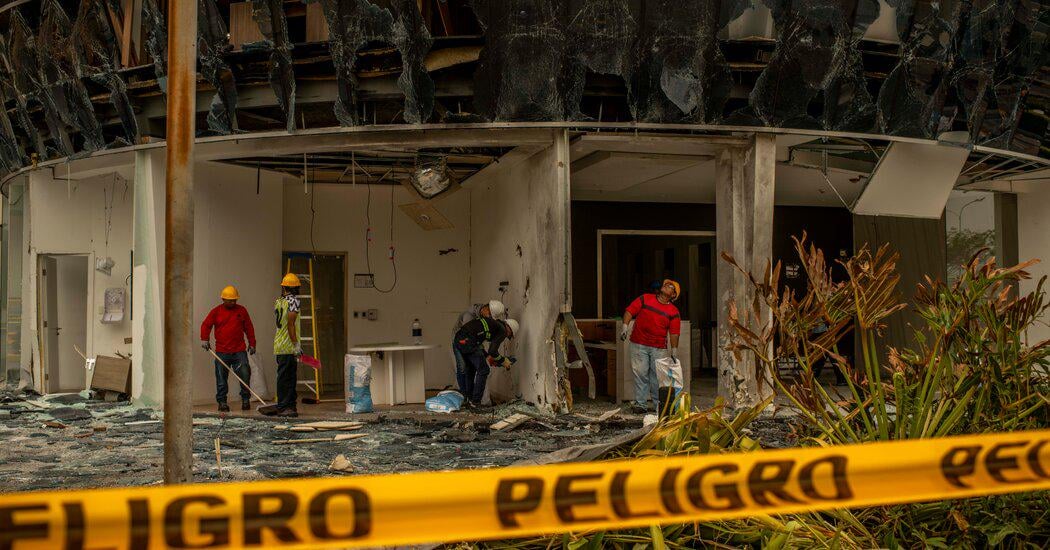
Fighting an international alliance of gangs, guerrilla groups, drug cartels and mafias, the Ecuadorean military found itself alone.
By 2022, the government had lost control of major prisons, with gangs running them as recruitment centers. Killings were rising fast, and it was clear that far more cocaine was moving through the country than the authorities could ever hope to seize.
But when the U.S. ambassador at the time, Mike Fitzpatrick, phoned Washington to convey Ecuador’s plea for help, his calls fell on deaf ears, he said.
“‘Where is the fentanyl? That’s our focus right now,’” he recalled being told by senior State Department officials. “Ecuador didn’t have a fentanyl hook to sell to Washington, it’s all cocaine.”
Since President Trump first took office in 2017 and continuing through President Joseph R. Biden’s term, the United States largely shifted its focus to combating fentanyl, the drug driving a national overdose crisis.
Given the soaring fentanyl deaths in the United States, making it a priority made sense, officials say. But the severity of the switch gave room for cocaine traffickers, once a prime target of American law enforcement, to thrive — so much that Ecuador nearly collapsed into the grip of criminal groups, according to five current and former U.S. and Ecuadorean officials. In the decades-long war against drugs, cocaine, it seemed, was no longer a priority.
Even now, after the United States eventually mustered a response and increased financial aid to help Ecuador’s military fight drug groups, its government is struggling to keep control.
The Trump administration has launched an aggressive military campaign in the region, attacking boats it says are smuggling drugs, but it is unclear whether those strikes will make a dent in the resurgent cocaine trade. Nor is it clear whether that is its ultimate goal.
While American officials have called the campaign a counterdrug operation, they have offered little evidence that the boats carried drugs. The operation has also focused on Venezuela, whose role in the drug trade is fairly limited. Privately, American officials have made clear that the Trump administration aims to drive Venezuela’s authoritarian leader from power.
Many Ecuadoreans now feel torn between wanting U.S. help and fearing the Trump administration’s assertion of dominance over the region. When Ecuador held a referendum in November on whether to let foreign military bases in the country — which analysts called a thinly veiled invitation for U.S. forces — voters rejected it. Yet when several fishermen on the Pacific were stopped by Ecuador’s Navy on a recent day, they were glad to see any military presence at all. Criminals ran the waves, they said, extorting fishermen who dared go farther to sea.
By the time Mr. Trump first became president, Mexican cartels, lying low in Ecuador, were consolidating their power.
The cartels worked with Colombian groups to push cocaine into Ecuador, where gangs then exported the drug using speedboats, submarines and hijacked cargo containers bound for Europe and the United States. As the trade grew, those partnerships expanded to include European mafias, officials say.
Posted by John3262005
1 Comment
It’s both deeply frustrating and understandable at the same time.
Fentanyl is much deadlier and its proportion of functional:non-functional users is much lower