
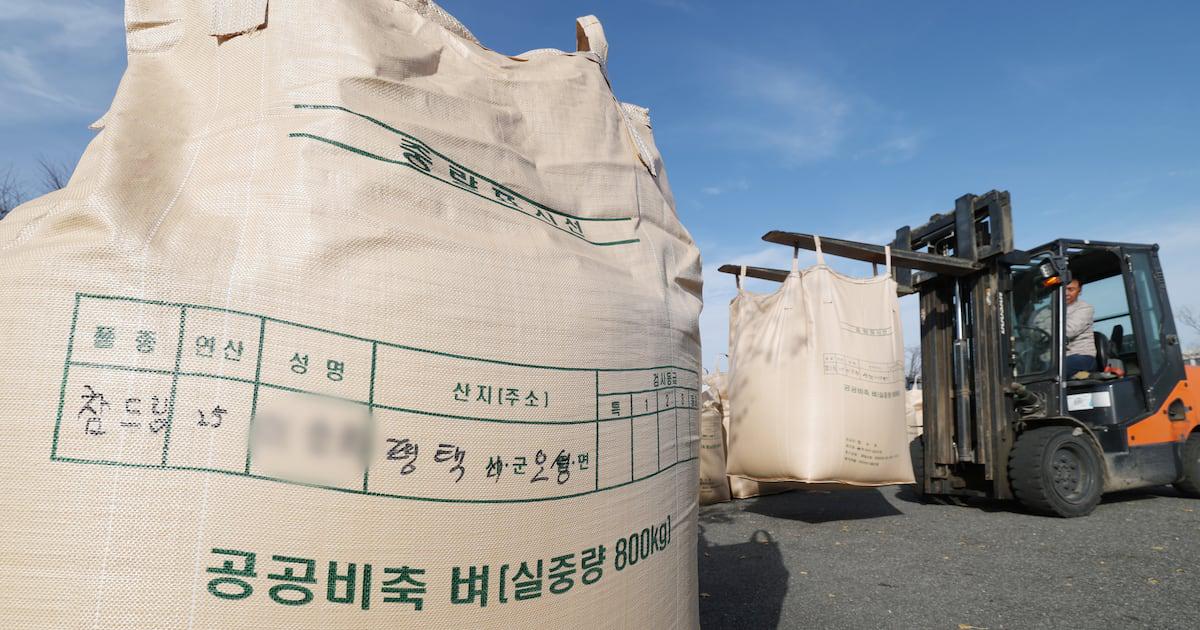
Last month’s producer-level rice prices were found to be 24% higher than a year earlier. Normally, prices fall starting in October when newly harvested rice enters the market, but this year the opposite is happening. Analysts say that because the government decided to isolate (purchase and store) 100,000 tons of the expected surplus crop, the market developed an expectation that government buying might further expand. Industry experts worry that once the revised Grain Management Act, which requires the government to purchase surplus rice, goes into effect next year, rice prices could rise even more.
According to the National Data Service on the 1st, as of November 25, the producer-level wholesale price of rice was 57,046 won per 20 kg. This is 24% higher than a year ago (46,021 won).
Typically, rice prices rise steadily from the beginning of the year but fall in October when large volumes of new rice flood the market. This year, however, a strange phenomenon has occurred: prices are rising during the harvest season.
An official from the Ministry of Agriculture, Food and Rural Affairs explained, “Large-scale farms are delaying shipments by using their storage facilities.” Earlier, the government decided to purchase most of the annual surplus production (about 130,000 tons) — a total of 100,000 tons. Because of this, competition among private Rice Processing Centers (RPCs) to buy rice has intensified, reducing the usual seasonal decline in prices.
Industry officials expect that when the revised Grain Management Act takes effect next August, the upward trend in rice prices may grow even stronger. The revision mandates that the government must intervene and isolate rice from the market if production volume and prices meet certain criteria. Until now, the government has made discretionary decisions on whether and how much to buy, but starting next year, the law will require “automatic purchases” when the criteria are met. As a result, there is a higher likelihood that the government’s rice procurement volume will increase.
Rising rice prices can contribute to higher consumer inflation. Moreover, it undermines the government’s effort to reduce rice-growing acreage. Kim Han-ho, a professor of Agricultural and Resource Economics at Seoul National University, said, “If rice prices remain high, reducing the cultivation area will be delayed, and shifting to alternative crops will not be easy. Unless the government aggressively increases the budget for crop-conversion subsidies, the structural imbalance will continue to repeat.”
Posted by Freewhale98
2 Comments
[ context ]
This is quite a delicate matter for Korean government. The farmers have been suffering for a while because of overproduction of rice, which led to collapse of prices and income for farmers. Farmers gets angry and demands the government to buy their excess rice to stabilize the market. Then, the government isolates the crop, the grain price goes up like this year, leading to inflation. How to balance rural income and grain price for urban workers have been quite difficult balance, especially when Democratic Party of Korea (DPK) is in power as their main electorate consists of rice farmers and urban working class.
Why is there a rice price crisis in both Japan and South Korea?