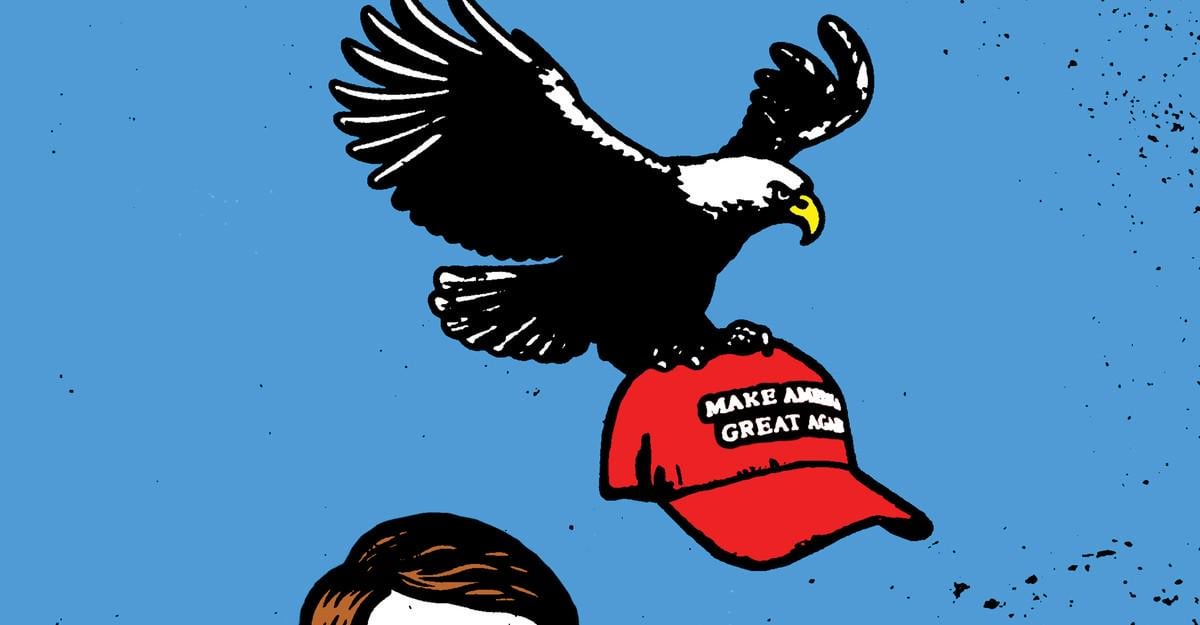
What comes after Donald Trump? What compelling social vision can replace MAGA’s offerings and reverse the tide of global populism? In considering these questions, I find myself returning to an unlikely group of 20th-century thinkers: the neoconservatives.
Here’s why the original neocon thinkers—people such as Irving Kristol, James Q. Wilson, Jeane Kirkpatrick, and Daniel Patrick Moynihan—can be so helpful right now: They focused their attention on the bloody crossroads where morality and politics intersect. They saw politics through the lens of not only polling and social-science data, but also literature, philosophy, psychology, and theology. They asked the big questions—not just How can we win the next election? but How can we create a civilization to be proud of ? The moral and spiritual tenor of their political writings could be a tonic for a society in moral and spiritual crisis.
These days, when people hear the word neocons, they tend to think of Republicans who supported the Iraq War. But the notoriety the neocons attained for supporting that war has obscured their origins as a dissident faction within the American left, one that was staunchly anti-communist but mostly preoccupied with domestic policy.
Neoconservatism coalesced into a movement in the 1970s, but it has its roots in the cafeteria of the City College of New York in the late 1930s. The poor immigrant kids who would go on to found the movement were the Trotskyists who sat in one alcove of that dining hall. They spent their days arguing with one another and with the Stalinists who sat in the neighboring alcove. In those days, Kristol, Irving Howe, Seymour Martin Lipset, Nathan Glazer, and others were convinced that communism was the future, and so it mattered what kind prevailed.
The neoconservatives all broke with Marxism during the Stalin era, and most of them became Franklin D. Roosevelt–style Democrats. Kristol fought the Nazis in Europe and realized that if communism ever came to America, it would turn into a massively corrupt criminal enterprise, which is what eventually happened in the Soviet Union. After the war, many of the neocons went on to become social scientists at places such as Harvard, Princeton, and UC Berkeley. Others became journalists or editors of magazines such as Commentary and Encounter.
Their second big shift occurred during the 1960s and ’70s. Glazer went to work in the Kennedy administration, at the Housing and Home Finance Agency (the predecessor to the Department of Housing and Urban Development). In 1965, Kristol and Daniel Bell founded a magazine called The Public Interest. Swept up in the intoxicating social-science confidence of the era, they believed that we now had the knowledge to settle old ideological feuds and solve social problems scientifically. “Men are learning how to make an industrial economy work,” Moynihan wrote in the magazine’s first issue.
That confidence underlaid the explosion of social-policy making that helped define the ’60s. Lyndon B. Johnson’s Great Society brought a raft of new programs that aimed to eliminate poverty and inequality. The Nixon administration followed with more in the same vein—the creation of the Environmental Protection Agency and the Occupational Safety and Health Administration, along with a 20 percent increase in Social Security benefits and proposals for both a national health-insurance system and a universal basic income for households with children.
From 1960 to 1980, federal spending increased from about $91 billion to about $584 billion. In 1960, defense spending made up about half of the federal budget. By 1980, it was down to less than a quarter. At the start of 1960, approximately 250,000 people were on welfare in New York City. At the beginning of 1969, about 900,000 were.
The new programs did not produce the intended results. By the 1970s, the economy was in terrible shape, pushed into a recession by the Vietnam War, an oil embargo, and the high cost of Johnson’s Great Society. In May 1975, the unemployment rate hit 9 percent. A few years later, the inflation rate neared 15 percent. The productivity rate started to decline in 1973—and the poverty rate ticked upward.
Social measures, too, painted a grim picture. From 1960 to 1980, divorce rates more than doubled. The share of children born out of wedlock more than tripled. Violent-crime rates also more than tripled. Drug use exploded. The public-housing projects that had been built with such promise turned into hellscapes. As someone who grew up in New York City in the ’70s, I’m astounded by the level of social disorder we all learned to live with. Pretty much everyone I knew got mugged. In 1972 and 1973, there was a serial castrator and killer in Manhattan nicknamed Charlie Chop-Off. He was never caught, and such was the general chaos that it wasn’t even that big of a story.
The neocons were mostly immigrant kids who’d grown up in places like Brooklyn, when the borough was still a haven for working-class New Yorkers. They had seen their families rise out of poverty by embracing the common bourgeois virtues: hard work, thrift, self-reliance, self-discipline, respect for tradition, and an intense focus on education. When the counterculture arose in the ’60s, the neocons were dismayed to see affluent kids at Berkeley, Harvard, and Columbia dropping out, doing acid, denouncing the industrious and traditional culture of their parents, and embracing the social anarchy resulting from that culture’s erosion.
boardatwork1111 on
When I’m in a “insist that I’m right no matter how catastrophically wrong I’ve been” competition and my opponent is Neoconservatism:
The neocons were right… About some conflicts. Their implementation was godawful and the geopolitical framework they operated on (“America strong!”) was by-and-large counterproductive.
dhessi on
Meanwhile, the NYT editorial board is hyping up a drone and AI arms race:

8 Comments
>david brooks
nice try
Article text:
What comes after Donald Trump? What compelling social vision can replace MAGA’s offerings and reverse the tide of global populism? In considering these questions, I find myself returning to an unlikely group of 20th-century thinkers: the neoconservatives.
Here’s why the original neocon thinkers—people such as Irving Kristol, James Q. Wilson, Jeane Kirkpatrick, and Daniel Patrick Moynihan—can be so helpful right now: They focused their attention on the bloody crossroads where morality and politics intersect. They saw politics through the lens of not only polling and social-science data, but also literature, philosophy, psychology, and theology. They asked the big questions—not just How can we win the next election? but How can we create a civilization to be proud of ? The moral and spiritual tenor of their political writings could be a tonic for a society in moral and spiritual crisis.
These days, when people hear the word neocons, they tend to think of Republicans who supported the Iraq War. But the notoriety the neocons attained for supporting that war has obscured their origins as a dissident faction within the American left, one that was staunchly anti-communist but mostly preoccupied with domestic policy.
Neoconservatism coalesced into a movement in the 1970s, but it has its roots in the cafeteria of the City College of New York in the late 1930s. The poor immigrant kids who would go on to found the movement were the Trotskyists who sat in one alcove of that dining hall. They spent their days arguing with one another and with the Stalinists who sat in the neighboring alcove. In those days, Kristol, Irving Howe, Seymour Martin Lipset, Nathan Glazer, and others were convinced that communism was the future, and so it mattered what kind prevailed.
The neoconservatives all broke with Marxism during the Stalin era, and most of them became Franklin D. Roosevelt–style Democrats. Kristol fought the Nazis in Europe and realized that if communism ever came to America, it would turn into a massively corrupt criminal enterprise, which is what eventually happened in the Soviet Union. After the war, many of the neocons went on to become social scientists at places such as Harvard, Princeton, and UC Berkeley. Others became journalists or editors of magazines such as Commentary and Encounter.
Their second big shift occurred during the 1960s and ’70s. Glazer went to work in the Kennedy administration, at the Housing and Home Finance Agency (the predecessor to the Department of Housing and Urban Development). In 1965, Kristol and Daniel Bell founded a magazine called The Public Interest. Swept up in the intoxicating social-science confidence of the era, they believed that we now had the knowledge to settle old ideological feuds and solve social problems scientifically. “Men are learning how to make an industrial economy work,” Moynihan wrote in the magazine’s first issue.
That confidence underlaid the explosion of social-policy making that helped define the ’60s. Lyndon B. Johnson’s Great Society brought a raft of new programs that aimed to eliminate poverty and inequality. The Nixon administration followed with more in the same vein—the creation of the Environmental Protection Agency and the Occupational Safety and Health Administration, along with a 20 percent increase in Social Security benefits and proposals for both a national health-insurance system and a universal basic income for households with children.
From 1960 to 1980, federal spending increased from about $91 billion to about $584 billion. In 1960, defense spending made up about half of the federal budget. By 1980, it was down to less than a quarter. At the start of 1960, approximately 250,000 people were on welfare in New York City. At the beginning of 1969, about 900,000 were.
The new programs did not produce the intended results. By the 1970s, the economy was in terrible shape, pushed into a recession by the Vietnam War, an oil embargo, and the high cost of Johnson’s Great Society. In May 1975, the unemployment rate hit 9 percent. A few years later, the inflation rate neared 15 percent. The productivity rate started to decline in 1973—and the poverty rate ticked upward.
Social measures, too, painted a grim picture. From 1960 to 1980, divorce rates more than doubled. The share of children born out of wedlock more than tripled. Violent-crime rates also more than tripled. Drug use exploded. The public-housing projects that had been built with such promise turned into hellscapes. As someone who grew up in New York City in the ’70s, I’m astounded by the level of social disorder we all learned to live with. Pretty much everyone I knew got mugged. In 1972 and 1973, there was a serial castrator and killer in Manhattan nicknamed Charlie Chop-Off. He was never caught, and such was the general chaos that it wasn’t even that big of a story.
The neocons were mostly immigrant kids who’d grown up in places like Brooklyn, when the borough was still a haven for working-class New Yorkers. They had seen their families rise out of poverty by embracing the common bourgeois virtues: hard work, thrift, self-reliance, self-discipline, respect for tradition, and an intense focus on education. When the counterculture arose in the ’60s, the neocons were dismayed to see affluent kids at Berkeley, Harvard, and Columbia dropping out, doing acid, denouncing the industrious and traditional culture of their parents, and embracing the social anarchy resulting from that culture’s erosion.
When I’m in a “insist that I’m right no matter how catastrophically wrong I’ve been” competition and my opponent is Neoconservatism:
https://i.redd.it/gh36ctvsde6g1.gif
>David Brooks
Lol. Lmao even.
Reminds me of [this song](https://youtu.be/qTOBvGzurxA) which has aged wonderfully.
The neocons were right… About some conflicts. Their implementation was godawful and the geopolitical framework they operated on (“America strong!”) was by-and-large counterproductive.
Meanwhile, the NYT editorial board is hyping up a drone and AI arms race:
https://www.nytimes.com/interactive/2025/12/09/opinion/editorials/us-china-military-ai-tech.html
This is what manufacturing consent looks like
https://preview.redd.it/onpodl6hhe6g1.jpeg?width=596&format=pjpg&auto=webp&s=7100c01e54a3e68c35239e3d9023d420a4c5afd5