
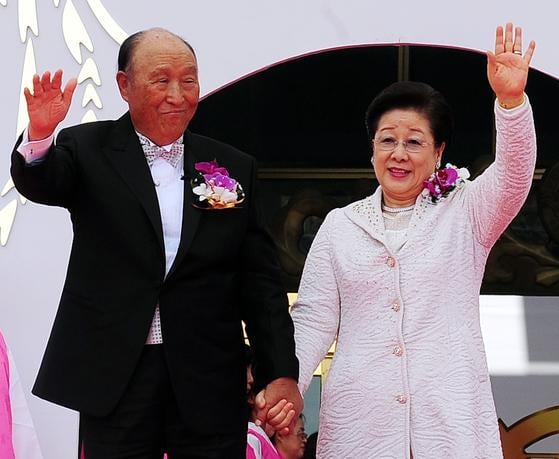
The central issue lobbied by Yoon Young-ho, former global headquarters director and de facto second-in-command of the Unification Church, was the Korea–Japan undersea tunnel. For nearly 45 years, the Unification Church has pursued this project with extraordinary persistence. The project would require a budget well exceeding 100 trillion won (tens of billions of dollars) and is impossible without the consent of both the Korean and Japanese governments.
Why has the Unification Church been so relentlessly committed to the Korea–Japan undersea tunnel?
The Nation of Adam and the Nation of Eve
In 1981, Unification Church founder Sun Myung Moon unveiled his vision of an “International Peace Highway.” The concept envisioned a global highway network connecting Tokyo–Seoul–Pyongyang–Beijing–Moscow–London–New York. The starting point of this plan was the Korea–Japan undersea tunnel, which would physically link Korea and Japan beneath the sea.
Moon referred to Korea as the “Father Nation” and Japan as the “Mother Nation.” In Unification Church theology, Korea is the “Adam Nation”—the central country where God’s providence begins and the birthplace of the Messiah. Japan, by contrast, is designated the “Eve Nation,” whose role is to support Adam and nurture future generations.
Just as husband and wife must unite physically to create new life, Moon argued, a new civilization could only be born if the divided nations of Korea and Japan were physically united through an undersea tunnel.
Japan’s “Atonement and Restoration”
In Unification Church doctrine, the act of cleansing sin is called “indemnity,” and returning to God’s domain afterward is called “restoration.” Because Japan persecuted Korea during the imperial era, the church teaches that mere verbal apologies are insufficient. Instead, Japan must provide material blessings to Korea as a form of atonement.
This belief explains why donations from Japanese Unification Church members were used to purchase land and fund surveys related to the Korea–Japan undersea tunnel project.
Enormous Cost and Extreme Engineering Challenges
The proposed tunnel would run from Karatsu in Saga Prefecture, Japan, to Busan or Geoje Island in Korea. The Unification Church has in fact purchased land in Karatsu and excavated partial tunnel segments for exploratory purposes. When Japanese church members visit these sites, they are often led to believe that the tunnel project is already a concrete, ongoing enterprise.
Experts, however, widely agree that the project’s feasibility is extremely low. The estimated cost exceeds 100 trillion won, and the economic returns are far from guaranteed.
The engineering difficulty is immense. The Channel Tunnel between the United Kingdom and France spans 50 km, with only 38 km undersea. By contrast, the Korea–Japan undersea tunnel would be at least 200 km long, with approximately 140 km underwater—more than four times longer than the Channel Tunnel.
Moreover, the Korea Strait reaches depths of up to 220 meters, creating enormous water pressure. The region also lies along a seismic fault zone, raising serious concerns about earthquakes and volcanic activity.
Allegations of Lobbying in Busan Politics
Since Sun Myung Moon first announced the plan, the Korea–Japan undersea tunnel has become the Unification Church’s central mission and long-standing obsession. Given its cost and regulatory hurdles, the project cannot be pursued by the church alone; it requires explicit approval from both governments.
Any tunnel originating in Japan would ultimately terminate in Busan, making the city strategically vital to the church. Recently, allegations of political lobbying involving the Unification Church led to the resignation of Oceans and Fisheries Minister Jeon Jae-soo. In 2017, then–Busan Mayor Seo Byung-soo commissioned a publicly funded feasibility study on the tunnel. At the time, Jeon Jae-soo was a National Assembly member representing Busan.
During the 2021 Busan mayoral by-election, then–People Power Party interim leader Kim Jong-in visited Busan and made a surprise statement, declaring that he would actively support the construction of Gadeokdo New Airport and would also seriously review building the Korea–Japan undersea tunnel linking Busan’s Gadeokdo to Kyushu, Japan.
The People Power Party’s Busan mayoral candidate Park Hyung-joon initially embraced the party’s stance but later retreated after facing criticism from the Democratic Party, which labeled the proposal a “pro-Japanese pledge.” Park subsequently stated that economic feasibility studies must come first, signaling a more cautious approach.
Posted by Freewhale98
1 Comment
This article explains why Moonies infiltrated Korean and Japanese politics. They are trying to build a tunnel between Japan and Korea. In the process, they have exploited Japanese followers, gaslighting them about the war crimes of WW2. They colluded with politicians from both countries to gather funds and get permission.
This shows how church-state collusion could lead to economic inefficiency. If Moonies plan was successful, Japan and Korea would have wasted hundreds of billions dollars on an useless tunnel.