
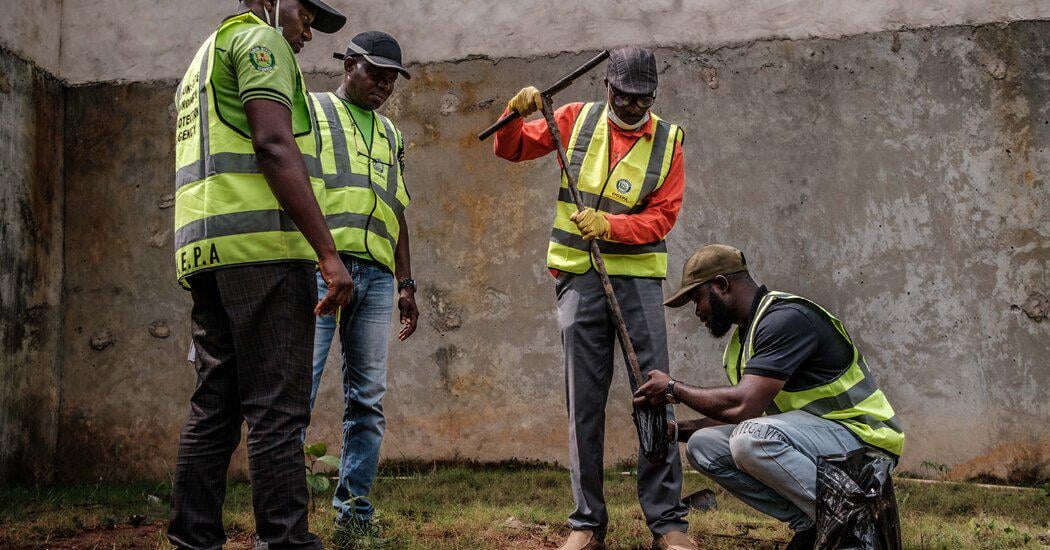
The Nigerian government has begun cataloging the health and environmental damage caused by factories that shipped recycled lead to the United States for use in car batteries.
A team of scientists arrived Tuesday in the industrial town of Ogijo, Nigeria, outside Lagos, to test the soil and air for lead. Officials have shut down recycling factories in the area and are making plans to conduct blood tests on about 500 people who live nearby. Public health experts in Nigeria described the response as one of the most aggressive campaigns to alleviate lead poisoning in the country’s history.
That led them to towns like Ogijo, which has become the heartland of lead recycling in Africa. Blood tests commissioned by The Times and The Examination found that about 70 percent of volunteers had lead poisoning. Half the children had lead in their bodies at levels associated with permanent brain damage.
While the extent of the pollution and the ecological damage remain unknown, local officials are already talking in broad terms about compensating people who live nearby. Some families say that they’ve been encouraged to move but cannot afford to do so.
The auto industry has known for decades that international lead recycling factories were spewing toxic smoke into the air. A major battery manufacturer blocked an effort to address the problem, while car companies repeatedly declined to sign onto inspection and certification programs.
The shutdown of Ogijo’s recycling plants could prove so costly for those companies that they finally invest in cleaner technology and better working conditions, said Andreas Manhart, a senior researcher at the Oeko-Institut, a research institution in Germany that promotes safe recycling practices.
In announcing the shutdown of the plants, the Nigerian authorities cited a widely shared New York Times video that profiled an 11-year-old boy named Freeman Ominyi, who had more than five times as much lead in his blood as the World Health Organization’s threshold for lead poisoning. His father said Freeman suffers from headaches, stomach aches and body pains, which are common symptoms of lead poisoning.
The video and articles sparked debate across local radio and television and on social media. The Nigerian Senate voted to request that the country’s emergency management agency help pay for people near the factories to move away. Lawmakers proposed creating a task force to trace lead exports and coordinate the cleanup and medical responses.
In response to the Times and The Examination’s findings, East Penn Manufacturing, one of the world’s largest battery makers, said it stopped buying lead from Nigeria. But experts say that without industry standards or regulations, metal buyers will continue to pivot from one unsafe recycler to the next.
One solution is for the auto industry to support an independent certification program for lead suppliers, said Mikey Jarrell, a researcher at the University of California, San Diego who studies the recycling industry.
The auto industry has resisted programs like that for decades. Most carmakers declined to comment on the findings, the cleanup in Nigeria or their views on a certification program. Most carmakers said they rely on their suppliers to abide by the law and sustainable sourcing policies, though lead isn’t generally among the metals and minerals that get special attention.
The Nigerian government has made — and broken — promises before to clean up the battery recycling industry. Still, some residents of Ogijo said the government’s response left them optimistic. Residents watched on Tuesday as scientists in reflective jackets used augers to extract soil samples.
Posted by John3262005
2 Comments
Hopefully, Nigeria is able to keep on the promise of cleaning up the battery recycling industry. Though they have broken similar promises before.
Still, this one seems different according to some residents of Ogijo, as they watch scientists in reflective jackets used augers to extract soil samples.
Definitely an article to read.
However the NYTIMES investigation that made Nigeria do this is extremely informative.
If you want to read the NYTIMES investigation,
The Auto Industry Was Warned: Battery Recycling Was Poisoning People
https://archive.ph/ldCYA
How We Linked the Auto Industry to Lead Poisoning
https://archive.ph/DZ4Ie
Well, Trump has already fucked Nigeria and South Africa off, hopefully they can invest in their economies
Plus, if they’re willing to shut these factories down, maybe that will encourage more Nigerians to look at other cases of corruption